
Anyone has” is generally correct when you are making a statement because “anyone” is treated as a singular subject in English grammar. Singular subjects usually take singular verbs, which is why “has” is used instead of “have” in most standard sentences. This structure is widely accepted in both formal and informal English.
“Anyone have” is usually incorrect in standard statements, but it becomes correct in questions or when used with auxiliary verbs like “does.” In those cases, the base form “have” is used after the helping verb, which follows standard grammar rules for question formation.
Many English learners feel confused when choosing between “anyone has” and “anyone have” because the word “anyone” sounds like it could refer to multiple people. This confusion often leads to incorrect verb usage, especially when forming questions or writing sentences in different tenses.
Understanding this difference is important because subject-verb agreement is a basic rule in English grammar. Using the correct form will make your sentences sound natural, clear, and grammatically correct, which is essential for both speaking and writing confidently.
Which Is Correct: “Anyone Has” or “Anyone Have”?
“Anyone has” is correct when you are making a normal statement because “anyone” is treated as a singular subject. This means it should be followed by a singular verb form like “has.”
Example
Anyone has the right to speak.
If anyone has a question, please ask.
“Anyone have” is not correct in standard statements, but it can appear in questions or informal speech with auxiliary verbs.
Example
Does anyone have a pen?
Does anyone have any questions?
What Does “Anyone” Mean in English?
“Anyone” is an indefinite pronoun used to refer to any person without specifying who exactly. Even though it may seem like it refers to many people, it is grammatically treated as singular.
Example
Anyone can join the class.
Anyone can learn English.
Understanding that “anyone” is singular helps you choose the correct verb form.
Example
Anyone is welcome.
Anyone has a chance to succeed.
Why “Anyone Has” Is Correct in Statements
“Anyone has” is correct because “anyone” is singular, and singular subjects require singular verbs. This follows the basic rule of subject-verb agreement in English.
Example
If anyone has information, please share it.
Anyone has the ability to improve.
Using the correct form makes your sentences clear and grammatically accurate.
Example
Anyone has the option to participate.
Why “Anyone Have” Is Used in Questions
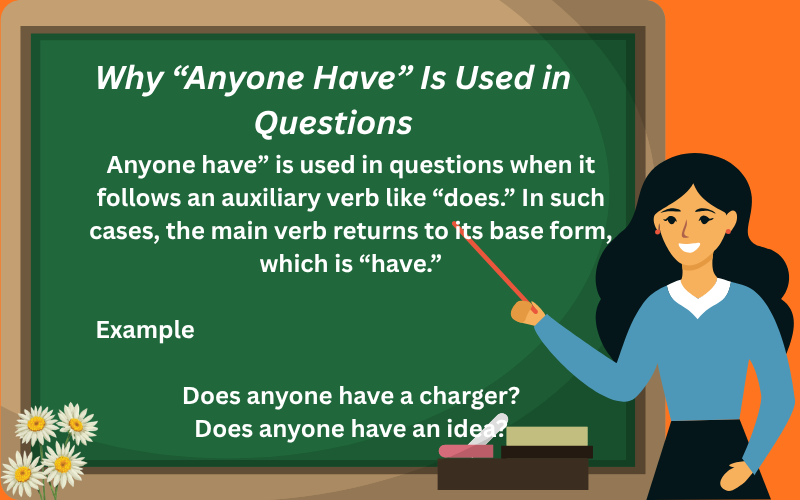
“Anyone have” is used in questions when it follows an auxiliary verb like “does.” In such cases, the main verb returns to its base form, which is “have.”
Example
Does anyone have a charger?
Does anyone have an idea?
This structure is a standard rule in English grammar for forming questions.
Example
Does anyone have any suggestions?
Grammar Rule: Subject-Verb Agreement with “Anyone”
In English, indefinite pronouns like “anyone,” “someone,” and “everyone” are treated as singular. This means they take singular verbs like “has,” “is,” or “does.”
Example
Everyone has a role.
Someone has your book.
Following this rule helps you avoid common mistakes.
Example
Anyone has the right answer.
Can “Anyone Have” Ever Be Correct?
Yes, “anyone have” can be correct when used with auxiliary verbs or in informal contexts. It is commonly seen in questions formed with “does.”
Example
Does anyone have a pen?
It may also appear in casual speech, but standard grammar rules should still be followed in formal writing.
Example
Does anyone have any ideas?
Common Mistakes to Avoid
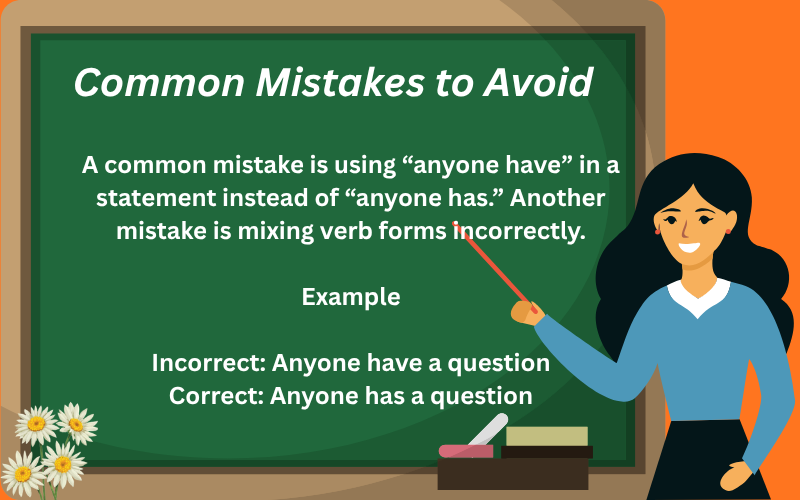
A common mistake is using “anyone have” in a statement instead of “anyone has.” Another mistake is mixing verb forms incorrectly.
Example
Incorrect: Anyone have a question
Correct: Anyone has a question
Avoiding these mistakes improves clarity and grammar.
Example
Incorrect: If anyone have doubts
Correct: If anyone has doubts
See Also: Whichever vs Whatever: Difference, Rules & Examples Guide
Real-Life Examples of “Anyone Has”
“Anyone has” is commonly used in formal and written English when making general statements.
Example
If anyone has concerns, please inform us.
Anyone has the right to ask questions.
It helps create clear and correct sentences.
Example
Anyone has access to the system.
Real-Life Examples of “Anyone Have”
“Anyone have” is mostly used in questions with auxiliary verbs or in casual speech.
Example
Does anyone have a phone charger?
Does anyone have experience with this?
It is widely used in spoken English.
Example
Does anyone have any updates?
“Anyone Has” vs “Anyone Have” in Daily Conversations
In daily conversations, people often use the correct form naturally without thinking about grammar rules. “Anyone has” is used in statements, while “anyone have” appears in questions.
Example
If anyone has questions, let me know.
Does anyone have questions?
Using the correct form improves communication.
Example
Anyone has the right answer?
“Anyone Has” vs “Anyone Have” in Writing
In writing, correct grammar is very important. “Anyone has” should be used in statements, while “anyone have” should only be used with auxiliary verbs.
Example
If anyone has feedback, please share it.
Using incorrect forms can reduce the quality of your writing.
Example
Incorrect: Anyone have feedback
Correct: Does anyone have feedback
“Anyone Has” vs “Anyone Have” for Students and Exams
For students, using correct grammar is essential. “Anyone has” is the correct form in statements and should be used in exams.
Example
If anyone has an answer, raise your hand.
Using incorrect forms can lead to mistakes.
Example
Incorrect: Anyone have an answer
Correct: Anyone has an answer
Quick Comparison: “Anyone Has” vs “Anyone Have”
“Anyone has” is correct in statements because “anyone” is singular.
Example
Anyone has a chance.
“Anyone have” is used in questions with auxiliary verbs.
Example
Does anyone have a question?
Tips to Remember the Correct Usage
To remember the correct form, always think of “anyone” as a singular word. Use “has” in statements and “have” only after auxiliary verbs.
Example
Anyone has a book
Does anyone have a book?
Practice will help you use the correct form naturally.
Example
If anyone has questions
Does anyone have questions?
Why Using Correct Forms Improves Your English
Using correct subject-verb agreement makes your English sound more natural and fluent. It also shows a strong understanding of grammar rules.
Example
If anyone has suggestions, share them.
It improves both speaking and writing skills.
Example
Does anyone have an idea?
If you enjoyed reading this article, you might also like the ones below.”
- Flew vs Flown: Meaning, Difference, and Correct Usage
- Persue vs Pursue: Meaning, Difference, and Correct Usage
- Scrap vs Scrape: Meaning, Difference, Correct Usage, and Examples
- Swap vs Swop Meaning, Difference, Correct Usage, and Examples
- Copy That vs Roger That: Meaning, Difference, and Usage
FAQs
Which is correct: anyone has or anyone have?
“Anyone has” is correct in statements, while “anyone have” is used in questions with auxiliary verbs.
Is “anyone have” grammatically wrong?
It is incorrect in statements but correct in questions like “Does anyone have.”
Why do we use “has” with anyone?
Because “anyone” is treated as a singular subject.
Can I use “anyone have” in speaking?
Yes, but usually in questions with “does.”
Do native speakers use both forms?
Yes, but they use them in different grammatical structures.
What is the rule for “anyone”?
It is a singular pronoun and takes singular verbs.
Which is better for exams?
“Anyone has” in statements is correct.
Is “anyone has” formal or informal?
It can be used in both contexts.
How can I remember the difference?
Think of “anyone” as singular.
Can I say “does anyone has”?
No, it should be “does anyone have.”
See Also: Serpent vs Snake What’s the Difference?
Conclusion
In conclusion, “anyone has” is the correct form for statements because “anyone” is a singular pronoun that requires a singular verb. It is widely used in both formal and informal English and should be your default choice when writing or speaking.
“Anyone have” is only correct when used with auxiliary verbs like “does” in questions. Understanding this difference will help you avoid common grammar mistakes and improve your overall English fluency.