The difference between scrap or scrape can be easy to miss because the words look and sound similar. However, they describe different actions and situations. Scrap usually relates to discarded material or getting rid of something, while scrape often means rubbing or removing something from a surface.
You might collect old metal as scrap, or you might scrape food from a plate. The words can also work as verbs, so their meanings change slightly depending on how you use them in a sentence.
“Scrap” can also mean to cancel or abandon a plan. For example, a company might scrap an old project. “Scrape,” on the other hand, can describe making contact with a rough surface or removing a thin layer from something.
Learning the difference helps you avoid using the wrong word when writing or speaking. Once you connect each word with its main meaning, the choice becomes much easier.
Quick Answer
Scrap and scrape have different meanings.
| Word | Main Meaning | Example |
|---|---|---|
| Scrap | Discarded material, or to abandon something | They decided to scrap the old plan. |
| Scrape | To rub, scratch, or remove something from a surface | I scraped the paint off the wall. |
Simple rule: Use scrap for discarded material or something you abandon. Use scrape when you rub, scratch, or remove something from a surface.
Related Guide: Serpent vs Snake
Quick Overview of Scrap vs Scrape
| Word | Part of Speech | Meaning | Usage | Example |
| Scrap | Noun & Verb | A small piece or to discard something | Informal and formal contexts | He scrapped the old plan. |
| Scrape | Noun & Verb | To rub or remove material from a surface | Physical actions and injuries | She scraped her knee. |
What Does “Scrap” Mean?
The word “scrap” generally refers to a small leftover piece of material or the act of discarding something that is no longer useful. It is commonly used in industries, everyday conversations, and business contexts.
Examples of “Scrap”
- He decided to scrap the outdated proposal.
- She collected fabric scraps for quilting.
- The company scrapped its expansion plans.
- They sold the old car for scrap.
- I wrote my ideas on a scrap of paper.
What Does “Scrape” Mean?
The term “scrape” means to rub, scratch, or remove material from a surface using friction or a sharp edge. It is frequently used to describe physical actions, injuries, and cleaning processes.
Examples of “Scrape”
- She scraped her knee while playing.
- He scraped the paint off the wall.
- Please scrape the mud from your shoes.
- The chef scraped the batter from the bowl.
- The car scraped against the wall.
Key Differences Between Scrap and Scrape
| Feature | Scrap | Scrape |
| Meaning | A small piece or to discard | To rub or remove by friction |
| Usage | Materials, plans, or leftovers | Physical actions and surfaces |
| Part of Speech | Noun and Verb | Noun and Verb |
| Context | Business, recycling, and writing | Cleaning, injuries, and friction |
| Example | They scrapped the project. | He scraped his elbow. |
Historical Origin of Scrap and Scrape
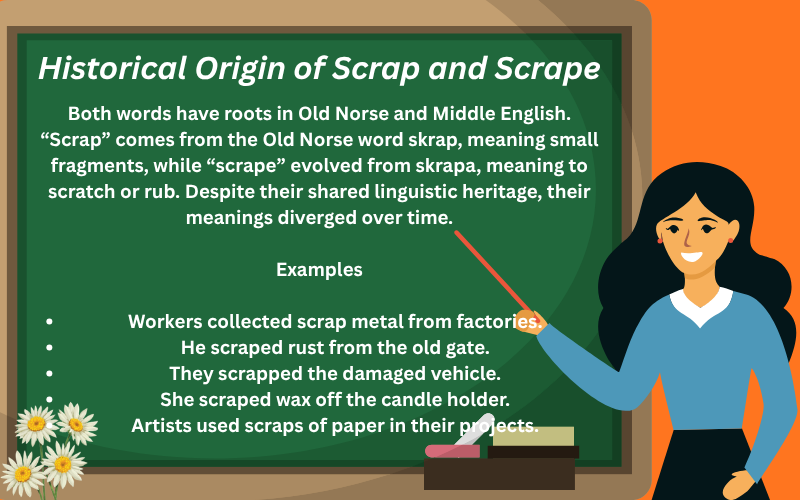
Both words have roots in Old Norse and Middle English. “Scrap” comes from the Old Norse word skrap, meaning small fragments, while “scrape” evolved from skrapa, meaning to scratch or rub. Despite their shared linguistic heritage, their meanings diverged over time.
Examples
- Workers collected scrap metal from factories.
- He scraped rust from the old gate.
- They scrapped the damaged vehicle.
- She scraped wax off the candle holder.
- Artists used scraps of paper in their projects.
Visit Also: Wish vs Hope
The Etymology and Linguistic Roots of “Scrap” and “Scrape”
The words “scrap” and “scrape” share common linguistic origins rooted in Old Norse. Over centuries, these terms evolved in spelling and meaning. While “scrap” came to represent fragments and discarded materials, “scrape” developed into a verb describing friction or removal from a surface.
Examples:
- Ancient traders collected scrap materials for reuse.
- Craftsmen scraped wood to smooth surfaces.
- Builders used scrap metal in construction.
- Workers scraped paint from old structures.
- Artists created collages using paper scraps.
Scrap vs Scrape in Everyday Communication
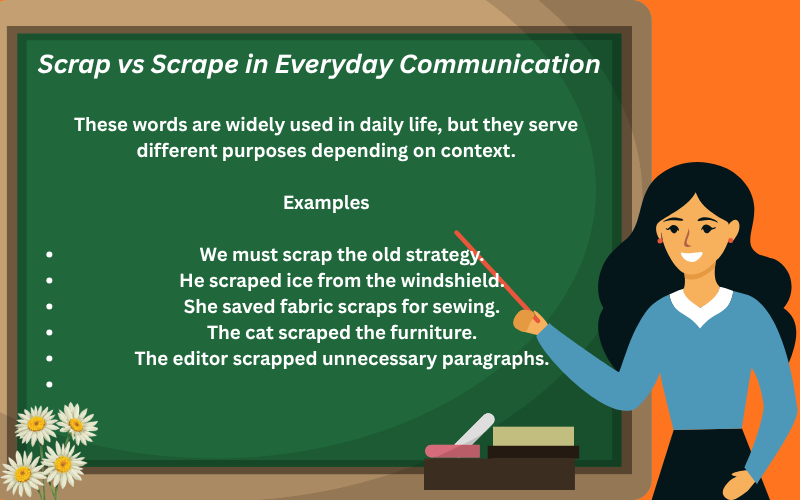
These words are widely used in daily life, but they serve different purposes depending on context.
Examples
- We must scrap the old strategy.
- He scraped ice from the windshield.
- She saved fabric scraps for sewing.
- The cat scraped the furniture.
- The editor scrapped unnecessary paragraphs.
Usage of “Scrap” and “Scrape” in Business and Industry
Both terms are essential in professional and industrial contexts. “Scrap” commonly refers to discarded materials and canceled projects, while “scrape” relates to mechanical processes and surface cleaning.
Examples:
- The factory sells scrap metal for recycling.
- The company scrapped its outdated policy.
- Workers scraped rust from machinery.
- Engineers reused scrap materials in production.
- Technicians scraped residue from equipment.
Scrap vs Scrape in Technology and the Digital World
In the digital age, these words have taken on specialized meanings. “Scrap” is used in project management and software development to indicate cancellation, whereas “scrape” refers to extracting data from websites—a process known as web scraping.
Examples:
- Developers scrapped an outdated software feature.
- Analysts scrape data from websites for research.
- The company scrapped the beta version.
- Programmers scrape online data using automation tools.
- The team scrapped an inefficient algorithm.
For More: Dreamt or Dreamed
When to Use “Scrap”
Use “scrap” when referring to leftover materials, small pieces, or the act of discarding something unnecessary or outdated.
Examples
- The company scrapped the outdated policy.
- Keep the scraps for future projects.
- They scrapped the broken machine.
- He wrote the number on a scrap of paper.
- She used scrap wood to build a shelf.
When to Use “Scrape”
Use “scrape” when describing the act of rubbing, scratching, or removing something from a surface.
Examples
- He scraped mud off his boots.
- She scraped her elbow during the fall.
- Please scrape the leftovers into the bin.
- The painter scraped off the old wallpaper.
- The shovel scraped against the concrete.
The Role of “Scrap” and “Scrape” in Recycling and Environmental Sustainability
These terms play an important role in environmental discussions. “Scrap” is associated with recycling and waste management, while “scrape” relates to cleaning and restoration processes.
Examples:
- Recycling centers process scrap metal efficiently.
- Builders reuse scrap wood to reduce waste.
- Workers scrape old paint before restoration.
- Mechanics sell scrap parts for recycling.
- Conservators scrape dirt from historical artifacts.
Common Synonyms and Alternatives to “Scrap” and “Scrape”
Synonyms of “Scrap”
- Discard
- Abandon
- Reject
- Fragment
- Remnant
Synonyms of “Scrape”
- Scratch
- Rub
- Shave
- Remove
- Abrade
Examples
- They discarded the old equipment.
- He scratched the surface gently.
- She abandoned the idea midway.
- The chef removed the residue with a spatula.
- The artist used fragments of paper in her collage.
Common Mistakes with Scrap and Scrape
| Incorrect Usage | Correct Usage |
| He scraped the old plan. | He scrapped the old plan. |
| She found a scrape of paper. | She found a scrap of paper. |
| They scrapped mud from their boots. | They scraped mud from their boots. |
| The car was sold for scrape. | The car was sold for scrap. |
| He scraped the broken machine. | He scrapped the broken machine. |
Tips to Remember the Difference Between Scrap and Scrape
Helpful Tips
- Scrap refers to pieces or discarding something.
- Scrape involves rubbing or scratching a surface.
- Scrap is related to waste or fragments.
- Scrape is associated with friction or removal.
- Both words can function as nouns and verbs.
Memory Trick
Scrap = Small Pieces or Something Discarded
Scrape = Scratch or Remove from a Surface
Real-Life Conversation Examples
Example 1
Manager: The project is no longer viable.
Employee: Let’s scrap it.
Example 2
Parent: What happened to your knee?
Child: I scraped it while playing.
Example 3
Chef: Don’t waste the mixture.
Assistant: I’ll scrape it from the bowl.
Example 4
Mechanic: This car is beyond repair.
Owner: Then scrap it for parts.
Why People Confuse Scrap and Scrape
People often mix up these words because:
- They have similar spellings and pronunciations.
- Both originate from Old Norse roots.
- They can function as nouns and verbs.
- Their meanings sometimes overlap in informal speech.
- Typographical errors are common.
Why People Search “Scrap vs Scrape”
Users search for this topic to:
- Improve grammar and vocabulary.
- Avoid common writing mistakes.
- Understand subtle differences in English.
- Enhance professional and academic communication.
- Learn correct usage with examples.
Should You Use Scrap or Scrape?
- Use scrap when referring to fragments or discarding something.
- Use scrape when describing rubbing or removing material.
- Choose the correct term based on context.
- Prefer accuracy to avoid confusion.
- Review examples to ensure proper usage.
See Also: Everyday or Every Day
FAQs
What is the difference between scrap and scrape?
“Scrap” can mean discarded material or getting rid of something. “Scrape” means to rub against a surface, scratch it, or remove something from it.
Is it scrap or scrape metal?
Usually, scrap metal is correct when you mean unwanted or recyclable metal.
Example:
The workers collected scrap metal.
What does scrape mean?
“Scrape” means to rub something against a surface or remove something from a surface.
Example:
She scraped the mud off her shoes.
What does scrap mean?
“Scrap” can refer to leftover or discarded material. As a verb, it can also mean to abandon or cancel something.
Example:
The company scrapped the old plan.
Is scrap a verb or a noun?
“Scrap” can be both a noun and a verb.
As a noun:
He sold the scrap for recycling.
As a verb:
They scrapped the project.
Is scrape a verb or a noun?
“Scrape” can also work as both a verb and a noun.
As a verb:
I scraped the ice from the window.
As a noun:
He got a scrape on his knee.
Can scrap mean cancel?
Yes. As a verb, scrap can mean to cancel, abandon, or get rid of a plan, project, or idea.
Can scrape mean scratch?
Yes. “Scrape” can describe rubbing against something and causing a mark or removing part of its surface.
Which is correct: scrap metal or scrape metal?
Scrap metal is correct when you mean unwanted metal collected for reuse or recycling.
Conclusion
Choosing between scrap or scrape depends on what you want to describe. “Scrap” commonly refers to discarded material or the act of abandoning something.
“Scrape” focuses on rubbing, scratching, or removing something from a surface. You can scrape paint from a wall or scrape food from a plate.
The two words may look similar, but their meanings are quite different. Using the context of your sentence can quickly tell you which one belongs there.
When you mean discarded material or canceling something, choose scrap. When you mean rubbing, scratching, or removing something from a surface, choose scrape.