When someone says copy that vs roger that, both phrases may sound like they mean exactly the same thing. They do share a similar purpose, but they have slightly different uses and backgrounds. Both phrases can show that you received and understood a message.
“Copy that” usually means “I received your message” or “I understand what you said.” People often use it in radio communication, military-style conversations, aviation, and casual speech.
“Roger that” also confirms that you received and understood a message. However, “roger” comes from older radio communication practices, where “Roger” represented the letter R and meant that the message had been received.
In everyday conversations, people sometimes use these phrases interchangeably. Still, understanding the difference can help you choose the one that fits the situation and tone.
Quick Answer
Both “copy that” and “roger that” confirm that you received and understood a message.
| Phrase | Meaning | Common Use |
|---|---|---|
| Copy that | I received and understand your message. | Radio, work, casual communication |
| Roger that | I received and understand your message. | Radio, military-style communication, informal speech |
The main difference is usage and origin, rather than basic meaning.
Copy that focuses on receiving and understanding the information, while roger that has a longer history in radio communication.
Related Guide: Whichever vs Whatever
Quick Overview of Copy That vs Roger That
| Phrase | Origin | Meaning | Usage | Example |
|---|---|---|---|---|
| Copy That | Military & Aviation | Message received and understood | Informal and professional | Copy that, I’ll handle it. |
| Roger That | Radio Communication | Message received | Formal radio and aviation contexts | Roger that, proceeding as instructed. |
What Does “Copy That” Mean?
The phrase “copy that” means that a message has been received, understood, and acknowledged. It is commonly used in military, aviation, emergency services, and modern workplace communication.
Examples of “Copy That”
- Copy that, I’ll send the report shortly.
- Copy that, your instructions are clear.
- Copy that, I’ll meet you at 5 PM.
- Copy that, the task is in progress.
- Copy that, I’ll update you soon.
What Does “Roger That” Mean?
The phrase “roger that” originated from early radio communication. “Roger” was used to represent the letter “R” in the phonetic alphabet, which stood for “Received.” Today, it means a message has been received but does not necessarily confirm understanding or compliance.
Examples of “Roger That”
- Roger that, message received.
- Roger that, we are moving forward.
- Roger that, awaiting further instructions.
- Roger that, the coordinates are noted.
- Roger that, we’ll report back soon.
Key Differences Between Copy That and Roger That
| Feature | Copy That | Roger That |
|---|---|---|
| Meaning | Received and understood | Received |
| Origin | Military and aviation jargon | Early radio communication |
| Level of Clarity | Confirms understanding | Confirms receipt only |
| Modern Usage | Common in casual and professional settings | More formal and traditional |
| Response Type | Indicates comprehension and action | Indicates acknowledgment |
Historical Origin of Copy That and Roger That
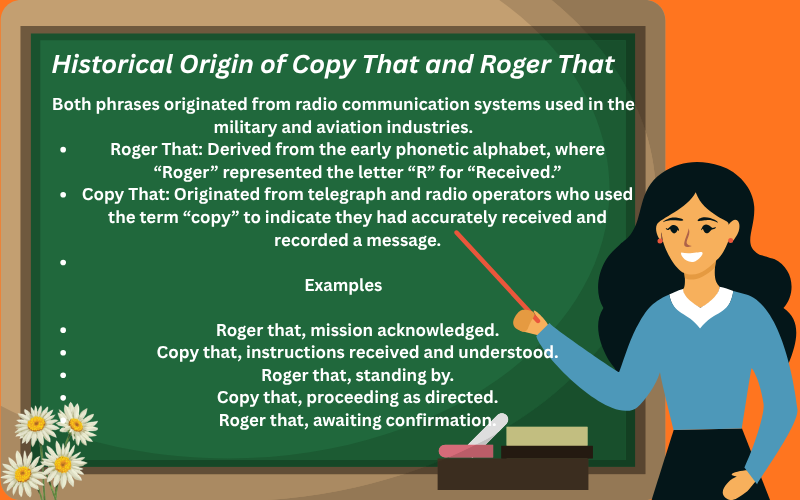
Both phrases originated from radio communication systems used in the military and aviation industries.
- Roger That: Derived from the early phonetic alphabet, where “Roger” represented the letter “R” for “Received.”
- Copy That: Originated from telegraph and radio operators who used the term “copy” to indicate they had accurately received and recorded a message.
Examples
- Roger that, mission acknowledged.
- Copy that, instructions received and understood.
- Roger that, standing by.
- Copy that, proceeding as directed.
- Roger that, awaiting confirmation.
Visit Also: Should Of or Should Have
The Origin and Historical Background of “Copy That” and “Roger That”
The phrases “copy that” and “roger that” originated from early military and aviation communication systems. They were developed to ensure clarity and accuracy in radio transmissions, especially during high-stakes operations. “Roger” was part of the phonetic alphabet used before NATO standardized it, representing the letter “R,” which stood for “Received.” Meanwhile, “copy” indicated that a message had been successfully received and recorded.
Examples:
- Roger that, message received loud and clear.
- Copy that, instructions noted and understood.
- Roger that, awaiting further orders.
- Copy that, proceeding as directed.
- Roger that, standing by for confirmation.
Usage of “Copy That” and “Roger That” in Military and Aviation Communication
Both phrases play a crucial role in military and aviation environments, where precise and concise communication is essential. “Roger that” confirms receipt of a message, while “copy that” confirms both receipt and understanding. These acknowledgments help prevent miscommunication during operations.
Examples:
- Pilot: Adjust altitude to 12,000 feet.
Co-pilot: Roger that. - Commander: Secure the perimeter immediately.
Soldier: Copy that. - Air Traffic Control: Maintain current heading.
Pilot: Roger that. - Dispatch: Proceed to the designated location.
Officer: Copy that. - Control Tower: Hold position.
Pilot: Roger that.
When to Use “Copy That”
Use “copy that” when you want to confirm that you have received and understood a message, especially when action is required.
Examples
- Copy that, I’ll complete the task today.
- Copy that, I understand the instructions.
- Copy that, I’ll join the meeting shortly.
- Copy that, the deadline is noted.
- Copy that, I’m on it.
When to Use “Roger That”
Use “roger that” when you want to acknowledge that a message has been received, particularly in formal or radio-style communication.
Examples
- Roger that, instructions received.
- Roger that, proceeding to the location.
- Roger that, we’ll stand by for updates.
- Roger that, awaiting further orders.
- Roger that, mission confirmed.
Copy That vs Roger That in Modern Communication
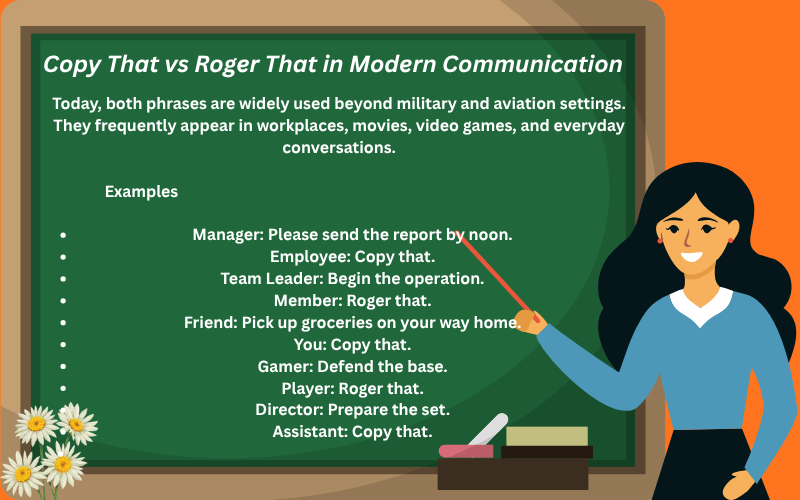
Today, both phrases are widely used beyond military and aviation settings. They frequently appear in workplaces, movies, video games, and everyday conversations.
Examples
- Manager: Please send the report by noon.
Employee: Copy that. - Team Leader: Begin the operation.
Member: Roger that. - Friend: Pick up groceries on your way home.
You: Copy that. - Gamer: Defend the base.
Player: Roger that. - Director: Prepare the set.
Assistant: Copy that.
For More: Its vs It’s
Modern-Day Usage of “Copy That” and “Roger That” in Everyday Communication
Over time, these phrases have expanded beyond military and aviation contexts and are now commonly used in workplaces, casual conversations, movies, and video games. They add clarity, efficiency, and a professional tone to modern communication.
Examples:
- Manager: Submit the report by noon.
Employee: Copy that. - Friend: Meet me at the café at 6 PM.
You: Copy that. - Team Leader: Begin the presentation.
Member: Roger that. - Gamer: Defend the base.
Player: Roger that. - Parent: Pick up groceries on your way home.
Child: Copy that.
Differences in Tone, Formality, and Professional Context
Although similar, these phrases differ in tone and formality. “Roger that” sounds more formal and is typically associated with military or radio communication, while “copy that” is more versatile and commonly used in both professional and informal settings.
Examples:
- Formal: Roger that, we will proceed as instructed.
- Professional: Copy that, I will complete the task promptly.
- Informal: Copy that, see you soon.
- Operational: Roger that, maintaining position.
- Workplace: Copy that, the deadline is confirmed.
Common Alternatives to “Copy That” and “Roger That”
In modern communication, several alternatives convey similar meanings depending on context and tone. These expressions are widely used in professional, academic, and casual environments.
Examples:
- Understood: Understood, I’ll handle it immediately.
- Received: Received, thank you for the update.
- Got it: Got it, I’ll take care of it.
- Acknowledged: Acknowledged, proceeding as instructed.
- Noted: Noted, I will review the details.
Common Mistakes with Copy That and Roger That
| Incorrect Usage | Correct Usage |
|---|---|
| Roger that, I understand everything clearly. | Copy that, I understand everything clearly. |
| Copy that, message received only. | Roger that, message received. |
| Using “roger that” excessively in casual texting | Use “copy that” in informal contexts. |
| Assuming both phrases always mean the same | Understand their subtle differences. |
| Using them interchangeably in technical communication | Use the precise term for clarity. |
Copy That vs Roger That in Popular Culture
These phrases are widely recognized due to their frequent use in movies, television shows, and video games, especially in action and military genres.
Examples
- Action films often feature characters saying, “Roger that.”
- Police dramas commonly use “Copy that” during dispatch calls.
- Video games like military shooters use both phrases for realism.
- Sci-fi movies frequently include radio-style acknowledgments.
- Animated series incorporate them for dramatic effect.
Tips to Remember the Difference Between Copy That and Roger That
Helpful Tips
- Copy That = Received and Understood.
- Roger That = Received.
- Use “copy that” when confirming comprehension.
- Use “roger that” when acknowledging receipt.
- Both phrases originated from radio communication.
Memory Trick
Copy = Comprehend
Roger = Received
Real-Life Conversation Examples
Example 1
Manager: Submit the report by 3 PM.
Employee: Copy that.
Example 2
Pilot: Adjust altitude to 10,000 feet.
Co-pilot: Roger that.
Example 3
Friend: Call me when you arrive.
You: Copy that.
Example 4
Commander: Hold your position.
Soldier: Roger that.
Why People Confuse Copy That and Roger That
People often confuse these phrases because:
- They originate from similar communication systems.
- They are frequently used interchangeably in movies.
- Both serve as acknowledgments.
- Their meanings overlap in modern usage.
- Many users are unaware of their technical distinctions.
Why People Search “Copy That vs Roger That”
Users search for this topic to:
- Understand radio communication terminology.
- Improve professional and workplace communication.
- Learn the differences between similar phrases.
- Enhance writing and speaking skills.
- Satisfy curiosity sparked by movies and games.
Should You Use Copy That or Roger That?
- Use copy that to confirm understanding and readiness.
- Use roger that to acknowledge receipt of a message.
- Choose the phrase based on context and formality.
- Prefer “copy that” in everyday communication.
- Use “roger that” in formal or radio-style scenarios.
See Also: Heros or Heroes
FAQs
Is “copy that” the same as “roger that”?
They have nearly the same meaning in many situations. Both can confirm that you received and understood a message.
Is “roger that” more formal than “copy that”?
Not necessarily. “Roger that” often sounds more traditional, radio-related, or military-style. Neither phrase is especially formal in standard business writing.
What does “copy that” mean in texting?
In texting, “copy that” usually means “got it,” “understood,” or “I received your message.”
What does “roger that” mean in texting?
“Roger that” usually means “understood” or “message received.” People may also use it playfully because of its radio and military associations.
Which sounds more natural: copy that or roger that?
It depends on the situation. “Copy that” often sounds more natural in modern casual communication, while “roger that” can sound more radio-style or playful.
Can I use “copy that” at work?
Yes. You can use it in casual workplace communication, especially when acknowledging an instruction. For formal emails, “Understood” or “Received” may sound more appropriate.
Is “roger” a person’s name in “roger that”?
No. In “roger that,” the word “roger” comes from historical radio communication rather than referring to a person named Roger.
Can I say “roger” without “that”?
Yes. “Roger” can work by itself as an acknowledgment, especially in radio-style communication.
What is another way to say “copy that”?
You can say “Got it,” “Understood,” “Received,” or “Message received,” depending on the situation.
What is another way to say “roger that”?
You can use “Understood,” “Got it,” “Affirmative,” or “Message received,” although the exact meaning can vary slightly by context.
Conclusion
The difference between copy that vs roger that is mostly about style, history, and context. Both phrases can tell someone that you received and understood their message.
Use “copy that” for a straightforward acknowledgment, especially in modern radio-style or casual communication. Use “roger that” when you want a traditional radio or military-style expression.
Neither phrase is usually necessary in formal writing. In a professional email, “Understood” or “Received” will often sound clearer.
The easiest way to remember the difference is simple: copy that means “I received and understood your message,” while roger that carries the same basic meaning with a stronger connection to traditional radio communication.