Have you ever paused while writing and wondered whether to use afterward or afterwards? Both words can cause confusion because they look different but carry the same basic meaning.
Both afterward and afterwards mean “later” or “after that.” You can use either word when talking about something that happens following an earlier event.
The main difference comes from regional preference. Afterward appears more often in American English, while afterwards is more common in British English.
So, you do not need to worry about choosing a wrong form. The right choice usually depends on your audience, writing style, and regional preference.
Quick Answer
Afterward and afterwards are both correct. They have the same meaning and can usually replace each other in a sentence.
American English tends to favor afterward, while British English often uses afterwards.
For example, both sentences are correct: “We went for dinner afterward” and “We went for dinner afterwards.”
If you write for a specific audience, follow its usual spelling. Otherwise, choose either form and use it consistently.
Related Guide: Scrap vs Scrape
📊 Quick Overview Table
| Word | Part of Speech | Meaning | Regional Preference | Example |
| Afterward | Adverb | At a later time | American English | We met afterward. |
| Afterwards | Adverb | At a later time | British English | We met afterwards. |
📖 What Does “Afterward” Mean?
Afterward is an adverb that refers to something happening at a later time or following a particular event. It is commonly used in American English and appears frequently in both formal and informal writing.
Common Uses of “Afterward”
- To describe events occurring later
- To indicate sequence in a narrative
- To provide chronological clarity
- To connect ideas smoothly
Examples:
- We had dinner and talked afterward.
- She completed her assignment and relaxed afterward.
- He apologized afterward for his mistake.
- The meeting ended, and we discussed the plan afterward.
- They watched a documentary afterward.
📖 What Does “Afterwards” Mean?
Afterwards carries the same meaning as afterward, indicating something that happens later. It is more commonly used in British English and is equally correct in grammar and usage.
Common Uses of “Afterwards”
- To describe events occurring later
- To maintain a British English writing style
- To express sequence in storytelling
- To connect actions chronologically
Examples:
- She went for a walk afterwards.
- They celebrated afterwards.
- He called me afterwards to explain the situation.
- We visited the museum and had lunch afterwards.
- The guests left, and the hosts cleaned up afterwards.
🔍 Afterward vs. Afterwards: Key Differences
| Feature | Afterward | Afterwards |
| Meaning | At a later time | At a later time |
| Part of Speech | Adverb | Adverb |
| Usage | American English | British English |
| Formality | Formal and Informal | Formal and Informal |
| Example | We spoke afterward. | We spoke afterwards. |
🔹 Easy Way to Remember the Difference Between Afterward and Afterwards
Remembering the distinction between afterward or afterwards is simple with these tips:
- Afterward (No “S”) → Preferred in American English.
- Afterwards (With “S”) → Preferred in British English.
- Both words share identical meanings.
- Choose one based on your audience and maintain consistency.
Examples:
- She completed her work and rested afterward. (American English)
- She completed her work and rested afterwards. (British English)
Visit Also: Run or Ran
💬 How to Use Afterward and Afterwards in Sentences
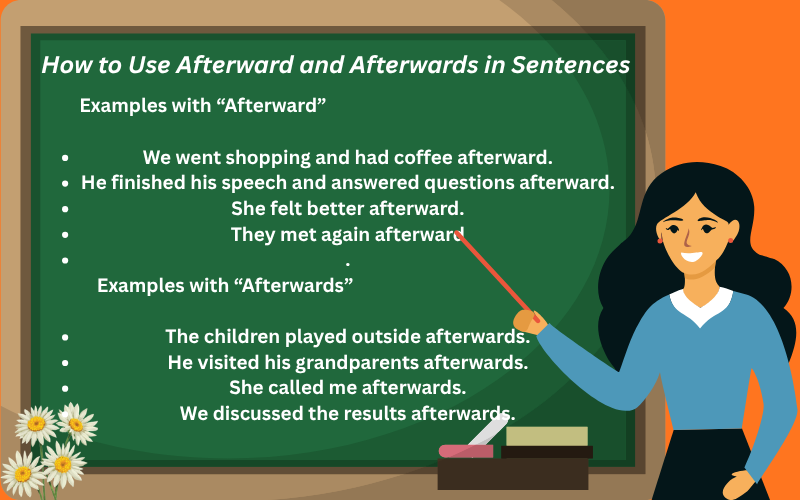
Examples with “Afterward”
- We went shopping and had coffee afterward.
- He finished his speech and answered questions afterward.
- She felt better afterward.
- They met again afterward.
Examples with “Afterwards”
- The children played outside afterwards.
- He visited his grandparents afterwards.
- She called me afterwards.
- We discussed the results afterwards.
🔹 Common Situations Where Afterward and Afterwards Are Used
These adverbs are widely used in various contexts to indicate sequence or time.
Everyday Uses:
- Conversations and storytelling
- Academic writing
- Business communication
- News and journalism
- Instructions and narratives
Examples:
- We watched a movie and had dinner afterward.
- She completed her presentation and answered questions afterwards.
- He graduated and found a job afterward.
- They went for dessert afterwards.
🔹 Afterward vs. Afterwards in American and British English
The primary difference between the two lies in regional preference.
| Region | Preferred Form |
| United States | Afterward |
| United Kingdom | Afterwards |
| Canada | Both |
| Australia | Afterwards |
| International English | Either |
Examples:
- The conference ended, and we networked afterward. (American English)
- The conference ended, and we networked afterwards. (British English)
🔹 Pronunciation of Afterward and Afterwards
Both words share nearly identical pronunciations, differing only by the final “s” sound.
| Word | Pronunciation |
| Afterward | /ˈæf.tɚ.wɚd/ |
| Afterwards | /ˈæf.tə.wədz/ |
Examples:
- She spoke to the manager afterward.
- He called me afterwards.
🔹 Afterward vs. Afterwards in Formal and Informal Writing
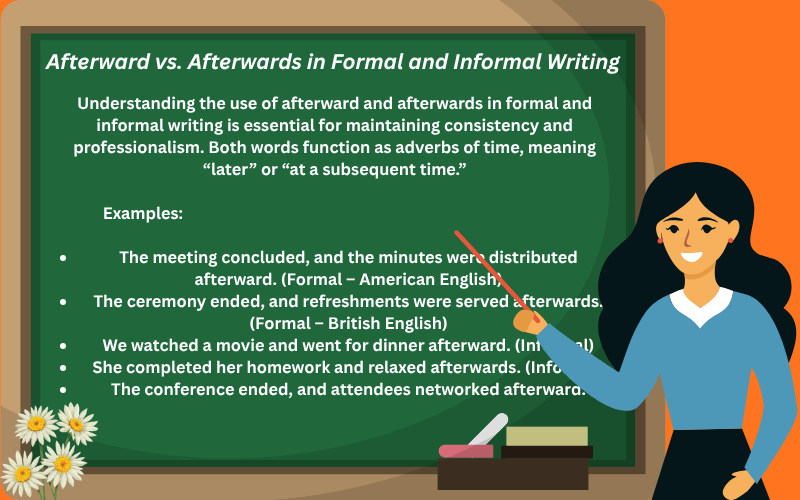
Understanding the use of afterward and afterwards in formal and informal writing is essential for maintaining consistency and professionalism. Both words function as adverbs of time, meaning “later” or “at a subsequent time.”
Examples:
- The meeting concluded, and the minutes were distributed afterward. (Formal – American English)
- The ceremony ended, and refreshments were served afterwards. (Formal – British English)
- We watched a movie and went for dinner afterward. (Informal)
- She completed her homework and relaxed afterwards. (Informal)
- The conference ended, and attendees networked afterward.
For More: To Early or Too Early
🔹 Afterward or Afterwards in Storytelling and Narratives
Both afterward and afterwards play an important role in storytelling by helping writers present events in chronological order. These adverbs improve narrative flow and guide readers through sequences smoothly.
Examples:
- He finished his speech; afterward, the audience applauded.
- She visited her grandmother and felt happier afterwards.
- The hero defeated the villain and celebrated afterward.
- They explored the museum and had lunch afterwards.
- The rain stopped, and a rainbow appeared afterward.
🔹 Synonyms of Afterward and Afterwards
Expanding your vocabulary with synonyms enhances writing variety and prevents repetition.
Common Synonyms:
- Later
- Subsequently
- Thereafter
- Following that
- Next
Examples:
- She completed her training and joined the company later.
- The experiment concluded; subsequently, the results were analyzed.
- He delivered his speech and left thereafter.
- We visited the park and had dinner afterward.
- The announcement was made, and celebrations followed afterwards.
🔹 Afterward vs. Afterwards in American and British Publications
The distinction between afterward and afterwards becomes more evident in global publications. American sources typically prefer afterward, while British publications favor afterwards.
Examples:
- The president addressed the nation and met reporters afterward. (American English)
- The prime minister delivered a speech and spoke to journalists afterwards. (British English)
- The seminar concluded, and certificates were distributed afterward.
- The play ended, and the audience gathered afterwards.
- The training session finished, and feedback was collected afterward.
🔹 Tips to Remember the Difference Between Afterward and Afterwards
Remembering the distinction between afterward or afterwards is simple with practical memory techniques.
Easy Memory Tips:
- Afterward (without “S”) is preferred in American English.
- Afterwards (with “S”) is common in British English.
- Both words function as adverbs and mean “later.”
- Choose one style and use it consistently.
- Follow your audience’s regional language standards.
Examples:
- She completed her assignment and rested afterward. (American English)
- She completed her assignment and rested afterwards. (British English)
- We attended the meeting and discussed the results afterward.
- He finished his presentation and answered questions afterwards.
- The guests arrived late and apologized afterward.
🔹 Afterward and Afterwards in Digital Communication and Social Media
In modern communication, these adverbs are widely used to describe sequences of events clearly and concisely.
Examples:
- I’ll text you afterward.
- Let’s discuss this afterwards.
- She posted the photos afterward.
- He shared the update afterwards.
🔹 Common Mistakes When Using Afterward and Afterwards
Avoid these common errors:
❌ Using both forms inconsistently in the same document.
✅ Choose one style and maintain consistency.
❌ Assuming one is incorrect.
✅ Both are grammatically correct.
❌ Adding redundant words.
✅ Use them as standalone adverbs.
Examples:
- Incorrect: We met afterwards later.
- Correct: We met afterwards.
- Incorrect: We met afterward later.
- Correct: We met afterward.
🔹 Afterward and Afterwards in Academic and Professional Writing
These adverbs are commonly used in formal contexts to maintain chronological clarity.
Examples:
- The experiment was conducted, and the results were analyzed afterward.
- The meeting concluded, and a report was prepared afterwards.
- The interview was completed, and feedback was provided afterward.
- The presentation ended, and discussions continued afterwards.
🔹 Real-Life Conversation Examples
Example 1:
Friend: What did you do after the movie?
You: We went for dinner afterward.
Example 2:
Colleague: Did you talk to the manager?
You: Yes, I spoke to him afterwards.
Example 3:
Teacher: Did the students ask questions?
Student: Yes, they asked questions afterward.
Example 4:
Parent: What did you do after school?
Child: I finished my homework and played afterwards.
🔹 Why People Confuse Afterward and Afterwards
These words are commonly confused because:
- They share identical meanings.
- Their spellings differ by only one letter.
- They follow regional language preferences.
- Both are grammatically correct.
- Writers often seek stylistic consistency.
📈 Why People Search “Afterward or Afterwards?”
People frequently search for this keyword because:
- They want to understand the difference.
- They seek correct grammar usage.
- They aim to improve their writing skills.
- They need clarity on American vs. British English.
- They want consistency in professional documents.
🎯 Should You Use Afterward or Afterwards?
👉 Use Afterward for American English.
👉 Use Afterwards for British English.
👉 Both are grammatically correct.
👉 Maintain consistency throughout your writing.
👉 Choose based on your audience and style guide.
See Also: Unaccessible vs Inaccessible
FAQs
Is afterward or afterwards correct?
Both afterward and afterwards are correct. They mean “later” or “after that,” so you can use either one depending on your preferred style or regional English.
Is afterward American or British English?
Afterward is more common in American English. However, British speakers and writers also understand and use it.
Is afterwards American or British English?
Afterwards is especially common in British English. American English generally favors afterward, although both forms remain understandable.
Do afterward and afterwards have the same meaning?
Yes. Afterward and afterwards have the same basic meaning and usually work in the same places in a sentence.
Which one should I use in formal writing?
Both forms work in formal writing. If you follow American English, afterward may feel more natural. For British English, afterwards is often the preferred choice.
Can I use afterward and afterwards interchangeably?
In most situations, yes. They function in the same way and express the same idea. Your choice mainly depends on regional and personal style.
Conclusion
Choosing between afterward or afterwards does not have to be difficult. Both words are correct and both mean “later” or “after that.”
The main difference is regional preference. American English generally favors afterward, while British English commonly uses afterwards.
If you know your audience, choose the form that matches its usual English style. If you are writing for a general audience, either form works.
Most importantly, do not treat one as incorrect. Choose one spelling, use it naturally, and keep your writing consistent.