Choosing between among or amongst can make a simple sentence feel more complicated than it needs to be. The two words look slightly different, but they usually carry the same meaning.
Both words describe something within a group or surrounded by several people or things. You can use them when you talk about someone or something as part of a larger group.
The main difference comes from usage and style rather than meaning. Among appears far more often in everyday English, while amongst can sound more traditional or formal.
For most writing, among is the simpler choice. However, amongst remains correct and works naturally in certain contexts.
Quick Answer
Among and amongst are both correct. They generally have the same meaning and can often replace each other without changing the meaning of a sentence.
Among is much more common in modern English, especially in everyday speech and writing. Amongst appears less often and can give a sentence a more formal or traditional feel.
For example, you can say, “She was sitting among her friends” or “She was sitting amongst her friends.”
If you want the most natural choice for general writing, among is usually the better option.
Related Guide: Simpler or More Simple
📊 Quick Overview Table
| Word | Part of Speech | Meaning | Regional Preference | Example |
| Among | Preposition | Surrounded by or in the middle of | American & Modern English | She sat among friends. |
| Amongst | Preposition | Surrounded by or in the middle of | British & Formal English | He stood amongst the crowd. |
📖 What Does “Among” Mean?
Among is a preposition that describes a person or thing surrounded by several people, objects, or ideas. Modern English speakers use among more often, especially in the United States.
Common Uses of “Among”
- To indicate inclusion within a group
- To express distribution
- To show association
- To describe something surrounded by others
Examples:
- She found comfort among her friends.
- The teacher distributed the books among the students.
- He felt relaxed among nature.
- The secret was shared among the team.
- The house was hidden among the trees.
📖 What Does “Amongst” Mean?
Amongst has the same meaning as among but carries a more traditional, formal, or literary tone. It is commonly used in British English and historical or poetic contexts.
Common Uses of “Amongst”
- In formal or classical writing
- In British English contexts
- In literature and storytelling
- To add stylistic elegance
Examples:
- She was seated amongst distinguished guests.
- He walked calmly amongst the crowd.
- The castle stood amongst the hills.
- The rumor spread amongst the villagers.
- Peace was restored amongst the nations.
🔍 Among vs. Amongst: Key Differences
| Feature | Among | Amongst |
| Meaning | Surrounded by or in the middle of | Same meaning |
| Part of Speech | Preposition | Preposition |
| Usage | Modern and widely used | Formal and traditional |
| Regional Preference | American English | British English |
| Tone | Neutral and contemporary | Formal and literary |
| Example | She stood among friends. | She stood amongst friends. |
Easy Way to Remember the Difference Between Among and Amongst
Remembering the distinction between among or amongst is simple with these tips:
- Among is shorter and more commonly used.
- Amongst includes “-st,” giving it a traditional and formal tone.
- Use among for modern and everyday writing.
- Use amongst for formal, poetic, or British English contexts.
Examples:
- He shared the prize among the winners. (Modern English)
- He shared the prize amongst the winners. (Formal English)
💬 How to Use Among and Amongst in Sentences
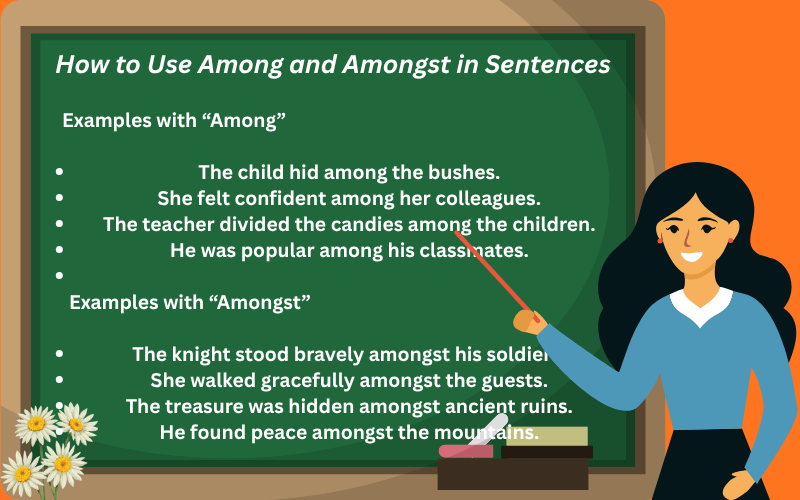
Examples with “Among”
- The child hid among the bushes.
- She felt confident among her colleagues.
- The teacher divided the candies among the children.
- He was popular among his classmates.
Examples with “Amongst”
- The knight stood bravely amongst his soldiers.
- She walked gracefully amongst the guests.
- The treasure was hidden amongst ancient ruins.
- He found peace amongst the mountains.
Visit Also: Disfunction vs Dysfunction
Among or Amongst in American and British English
The primary distinction between the two lies in regional usage.
| Region | Preferred Form |
| United States | Among |
| United Kingdom | Amongst |
| Canada | Among |
| Australia | Amongst |
| International English | Either |
Examples:
- The organizers distributed the funds among the participants. (American English) The organizers distributed the funds amongst the participants. (British English)
Common Situations Where Among and Amongst Are Used
These prepositions are widely used in various contexts.
Everyday Uses:
- Social interactions
- Academic writing
- Literature and storytelling
- Business communication
- Historical and poetic texts
Examples:
- She shared the news among her friends.
- The discussion continued amongst the scholars.
- The prize was divided among the winners.
- The legend spread amongst the villagers.
Among vs. Between: Understanding the Difference
One of the most common grammar confusions involves among and between.
| Word | Usage |
| Among | Used for three or more people or things |
| Between | Used for two people or things |
Pronunciation of Among and Amongst
| Word | Pronunciation |
| Among | /əˈmʌŋ/ |
| Amongst | /əˈmʌŋst/ |
Examples:
- She stood among the audience.
- He sat amongst the delegates.
Among or Amongst in Formal and Informal Writing
Understanding how among and amongst function in formal and informal contexts is essential for maintaining clarity and stylistic consistency. Both words share the same meaning but differ in tone. Among is widely used in modern communication, while amongst carries a more formal and literary feel.
For More: Heros or Heroes
Among or Amongst in Literature and Poetry
In literature and poetry, amongst is often used to evoke elegance and rhythm. It enhances the classical tone of a text, although among remains suitable for modern writing.
Examples:
- The knight wandered amongst ancient ruins.
- A whisper echoed amongst the silent trees.
- She walked gracefully among blooming flowers.
- The legend lived amongst the people.
- The melody floated gently among the hills.
Among or Amongst in Idioms and Common Expressions
Both words appear in idiomatic expressions that enrich vocabulary and improve fluency.
Common Expressions:
- Among friends
- Among ourselves
- Among the best
- Among the living
- Amongst the chaos
Examples:
- This restaurant is among the best in the city.
- The secret must remain among ourselves.
- She felt at ease among friends.
Among or Amongst in Academic and Research Writing
In academic contexts, among is generally preferred due to its clarity and modern tone. However, amongst may appear in British academic publications.
Examples:
- The research teams received the data.
- The committee members shared the responsibility.
- Scholars discussed the findings amongst themselves. (British English)
- The researchers conducted the survey among university students.
- International institutions encouraged collaboration amongst their members.
Tips to Remember the Difference Between Among and Amongst
Remembering the distinction between among and amongst is simple with practical memory techniques.
Easy Memory Tips:
- Among is modern, concise, and widely used.
- Amongst is traditional and more formal.
- Use among in American and contemporary English.
- Use amongst in British, literary, or formal contexts.
- Avoid mixing both forms within the same document.
Examples:
- She divided the gifts among the children. (Modern English)
- He walked amongst the historic monuments. (Formal English)
- The responsibility was shared among the team members.
- The hero stood bravely amongst his warriors.
- Trust was built among the partners.
Among and Amongst in Academic and Professional Writing
In professional contexts, writers generally prefer “among” because of its simplicity, while British publications and formal documents sometimes use “amongst.
Among and Amongst in Literature and Historical Texts
Writers often use amongst to evoke elegance and a classical tone in literary and historical narratives.
Examples:
- The hero wandered amongst ancient ruins.
- A whisper spread amongst the crowd.
- The legend lived amongst the people.
- The kingdom flourished amongst its allies.
Common Mistakes When Using Among and Amongst
Avoid these frequent errors:
Using “among” with only two items.
Use “between” instead.
Mixing “among” and “amongst” inconsistently.
Choose one style and remain consistent.
Assuming one is incorrect.
Both forms are grammatically correct.
Examples:
- Incorrect: The prize was divided among the two winners.
- Correct: The prize was divided between the two winners.
- Incorrect: She stood amongst her colleagues. (In American English style)
- Correct: She stood among her colleagues.
Real-Life Conversation Examples
Example 1:
Teacher: Where did you sit?
Student: I sat among my friends.
Example 2:
Historian: Where was the artifact discovered?
Archaeologist: It was found amongst ancient ruins.
Example 3:
Manager: How were the bonuses distributed?
Employee: They were shared among the team members.
Example 4:
Writer: Where was the hero standing?
Editor: He stood amongst the warriors.
Why People Confuse Among and Amongst
These words are commonly confused because:
- They share identical meanings.
- Their spellings differ slightly.
- They follow regional preferences.
- Both are grammatically correct.
- “Amongst” sounds more formal and archaic.
📈 Why People Search “Among or Amongst?”
People frequently search for this keyword because:
- They want to understand the difference.
- They seek correct grammar usage.
- They aim to improve their writing skills.
- They need clarity on British vs. American English.
- They want to write professionally and accurately.
🎯 Should You Use Among or Amongst?
👉 Use Among for modern, everyday, and American English.
👉 Use Amongst for formal, literary, or British English contexts.
👉 Both words have identical meanings.
👉 Choose based on your audience and writing style.
👉 Maintain consistency throughout your content.
See Also: Blond or Blonde
FAQs
Is among or amongst correct?
Both among and amongst are correct. They usually have the same meaning and can often be used in the same sentence.
What is the difference between among and amongst?
The main difference is usage and style. Among is much more common, while amongst can sound more formal, literary, or traditional.
Is among more common than amongst?
Yes. Among is considerably more common in modern English and works well in both casual and formal writing.
Is amongst grammatically correct?
Yes. Amongst is grammatically correct. It has been used in English for a long time and remains common in some varieties and styles of English.
Should I use among or amongst?
Use among if you want the most common and straightforward choice. You can use amongst when it suits your style or the tone of your writing.
Do among and amongst mean the same thing?
In most situations, yes. Both words can mean being in, surrounded by, or part of a group.
Is amongst more formal than among?
Amongst can sound more formal or literary to many readers, but it is not inherently more correct. Among works perfectly well in formal writing too.
Conclusion
The choice between among or amongst comes down mainly to style and frequency. Both forms are correct, and both usually express the same idea.
Most modern writers prefer among because it sounds natural and appears much more often in everyday English. It also works well in professional, academic, and formal writing.
You can still choose amongst when you want a slightly traditional or literary tone. The word remains grammatically acceptable and clear to readers.
When in doubt, go with among. It is the simpler and more widely used option, while amongst can add a different tone when the context calls for it.