Passed or past can look confusing because both words sound similar, but they play different roles in a sentence. The good news is that you can tell them apart with a simple rule.
Use passed when you talk about an action, especially when someone moves by something or successfully completes something. Use past when you talk about an earlier time, place, or position.
For example, you can say, “She passed me on the street,” but you would say, “We walked past the store.” The meaning changes because the two words do different jobs.
Once you understand this difference, choosing between passed and past becomes much easier. Therefore, looking at the role of the word in the sentence can help you pick the correct one.
⚡ Quick Answer
Use “passed” when you need a verb for an action. Use “past” when you refer to an earlier time, a previous point, or movement beyond something.
😊 “He passed the exam.”
😊 “We walked past the school.”
Related Guide: Anyone Has or Anyone Have
📊 Quick Overview Table
| Word | Part of Speech | Meaning | Usage |
| Passed | Verb (past tense) | Moved, went by, succeeded | Action |
| Past | Noun/Adj/Prep/Adverb | Time before now | Description/time |
📖 What Does Passed Mean?
The word passed is the past tense of the verb “pass.” It describes an action that has already happened.
It can mean:
- To move from one place to another
- To go by something
- To succeed in a test or exam
- To give something to someone
📖 What Does Past Mean?
The word past is not a verb. It is used in different grammatical forms, including noun, adjective, preposition, and adverb.
It generally refers to:
- Time before the present
- Something that has already happened
- Movement beyond a point
Examples:
- That happened in the past.
- We walked past the store.
- It is past midnight.
🔍 Passed vs Past – What’s the Difference?
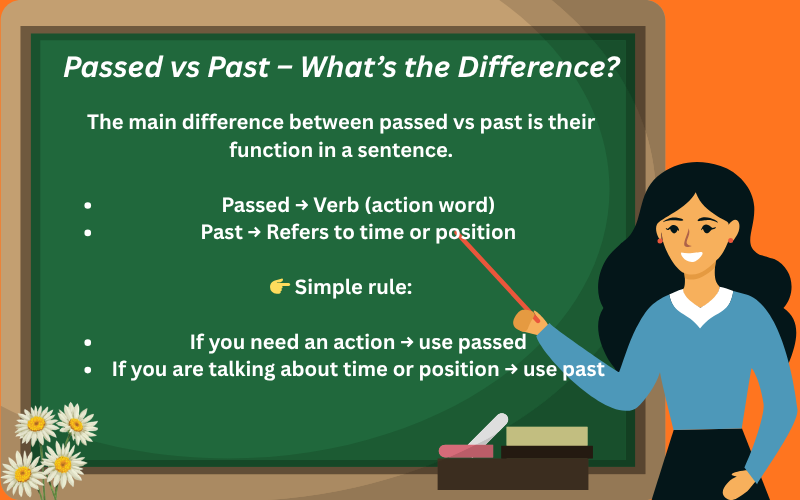
The main difference between passed vs past is their function in a sentence.
- Passed → Verb (action word)
- Past → Refers to time or position
👉 Simple rule:
- If you need an action → use passed
- If you are talking about time or position → use past
Visit Also: Disfunction vs Dysfunction
🧠 Easy Trick to Remember the Difference
A simple trick is to look at the letter “ed” in “passed.”
👉 Words ending in “-ed” usually show actions (verbs)
So:
- Passed = action happened
- Past = time or place
Example:
- I walked past the shop (position)
🔹 Easy Way to Check Whether to Use Passed or Past
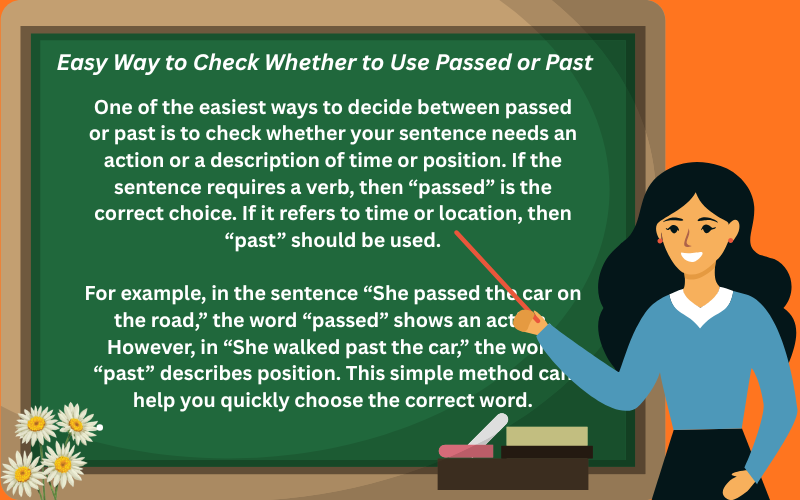
One of the easiest ways to decide between passed or past is to check whether your sentence needs an action or a description of time or position. If the sentence requires a verb, then “passed” is the correct choice. If it refers to time or location, then “past” should be used.
For example, in the sentence “She passed the car on the road,” the word “passed” shows an action. However, in “She walked past the car,” the word “past” describes position. This simple method can help you quickly choose the correct word.
💬 How to Use Passed in Sentences
Use passed when describing an action.
Examples:
- She passed her driving test.
🔹 Passed in Different Contexts and Meanings
The word passed can have several meanings depending on the context, but it always represents an action. It can refer to movement, success, or transferring something.
💬 How to Use Past in Sentences
Use past when referring to time or position.
Examples:
- In the past, things were different.
- We walked past the park.
- It is past your bedtime.
🔹 Past in Different Parts of Speech
The word past can function in multiple grammatical roles, which makes it flexible but sometimes confusing.
For example, in “The past cannot be changed,” it acts as a noun. In “We walked past the shop,” it is a preposition. In “It is past noon,” it works as an adverb. Understanding these roles helps improve accuracy in writing.
🔹 Common Situations Where “Passed” Is Used
The word passed is commonly used when describing actions such as movement, success, or completion.
🔹 Common Situations Where “Past” Is Used
The word past is commonly used to describe time or position.
For example, “In the past, people wrote letters” refers to time. In “She walked past the building,” it describes position.
🔍 Passed and Past in Grammar Rules
- Passed → Verb (past tense of pass)
- Past → Noun, adjective, preposition, or adverb
Examples:
- I passed the test.
- That is in the past.
For More: What Happen or What Happened
📊 Comparison Table
| Feature | Passed | Past |
| Type | Verb | Noun/Adj/Prep/Adverb |
| Meaning | Action | Time/Position |
| Usage | Movement, success | Time reference |
| Example | She passed me | In the past |
💡 Real-Life Usage Examples
- I walked past the store yesterday.
⚠️ Common Mistakes When Using Passed or Past
One of the most common mistakes is confusing “passed” and “past” in sentences involving action.
For example, “She past the test” is incorrect. The correct sentence is “She passed the test.” Similarly, “He walked passed the building” is incorrect, while “He walked past the building” is correct.
🔹 Common Sentence Patterns Using Passed and Past
Learning common sentence patterns can help you use passed and past correctly. Many sentences follow simple structures that make it easier to identify the right word.
For example, “I passed the test” follows a subject + verb pattern, where “passed” is the action. In contrast, “In the past, people wrote letters” uses “past” to describe time. Recognizing these patterns can improve your writing accuracy.
🔹 Passed or Past in Academic and Formal Writing
In formal writing, using the correct word is very important. Mistakes between “passed” and “past” can make sentences unclear.
🔹 Passed or Past in Everyday Conversations
In everyday conversations, both words are used frequently, but they can be confusing because they sound similar.
For example, “I walked past your house” refers to position, while “I passed your house” refers to movement. Both are correct depending on context.
🔹 Why Small Mistakes Between Passed and Past Matter
Small mistakes between passed or past can change the meaning of a sentence or make it incorrect.
For example, “He past the exam” is wrong because it lacks a proper verb. The correct sentence is “He passed the exam.” Similarly, “She walked passed the store” is incorrect, while “She walked past the store” is correct.
🔹 The Impact of Using the Wrong Word
Using the wrong word can affect clarity and make writing confusing.
For example, “Time passed quickly” is correct, while “Time past quickly” is incorrect. Similarly, “In the past, things were different” is correct, while “In the passed, things were different” is wrong.
📈 Why This Topic Confuses People
People often get confused because:
- Both words sound similar
- They are used frequently
- Their meanings are closely related
🎯 Which One Should You Use?
👉 Use passed for actions
👉 Use past for time or position
See Also: Will Be Send or Will Be Sent
FAQs
What is the difference between passed and past?
Passed usually describes an action, while past refers to an earlier time, place, or position.
Is passed a verb?
Yes, passed is usually the past tense or past participle of the verb “pass.”
Is past a verb?
No, past usually works as a noun, adjective, adverb, or preposition.
Should I say passed or past the house?
Use “past the house” when you mean moving beyond the house.
Is it passed time or past time?
Use “past time” when you refer to time that has already gone by.
Is it passed away or past away?
The correct expression is “passed away.”
Is it passed the store or past the store?
Use “past the store” when describing movement beyond the store.
When should I use passed?
Use passed when someone or something performs the action of passing.
When should I use past?
Use past for earlier time or when something moves beyond a particular point.
How can I remember passed vs past?
Remember that passed shows an action, while past usually points to time, place, or position.
Conclusion
Choosing between passed or past becomes easier when you focus on what the word does in the sentence. If you need an action, passed will often be the right choice.
On the other hand, use past when you talk about an earlier time or describe movement beyond something. This simple distinction can prevent many common grammar mistakes.
For example, “She passed the test” describes an action, while “She walked past the test center” describes movement beyond a place.
In short, remember passed = action and past = time, place, or position. With a little practice, you can choose the right word confidently.