To early is usually grammatically incorrect in English. Too early means excessively early or earlier than needed. Use too early when describing extra amount or excess timing.
In most situations, “too early” is the correct phrase.
The confusion between to early or too early happens because “to” and “too” sound the same. However, “too” means “excessively” or “more than needed.”
Therefore, “too early” is correct when something happens earlier than expected.
Many English learners struggle with to early or too early because both phrases sound identical in speech. However, only one phrase works correctly in normal grammar. Additionally, spelling mistakes often happen quickly while typing or texting.
Understanding this rule improves writing accuracy immediately. Moreover, native speakers almost always use “too early” in conversations, emails, and daily communication. In short, remembering the meaning of “too” solves the confusion easily.
To Early or Too Early
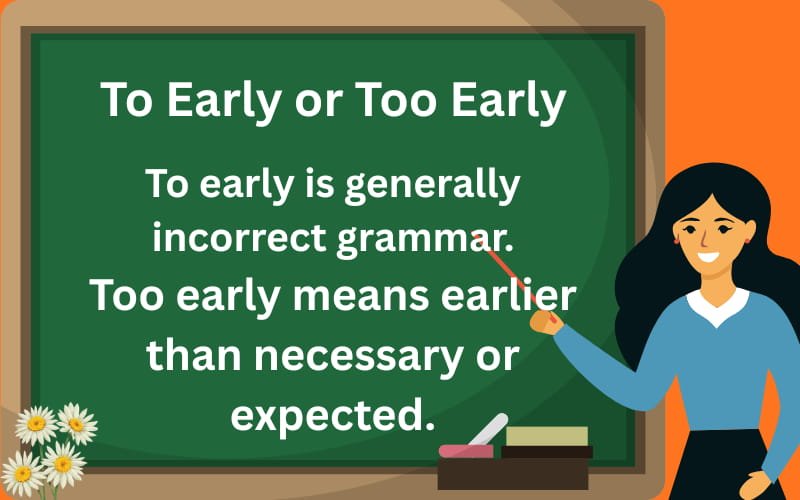
To early is generally incorrect grammar.
Too early means earlier than necessary or expected.
People use “too early” when something feels inconveniently early. Additionally, the phrase appears in daily conversations and writing very often.
😊 “I woke up too early today.”
- “It’s too early for dinner.”
- “She arrived too early.”
- “The store opened too early.”
- “We started the meeting too early.”
What Does To Early Mean?
The phrase “to early” usually has no correct meaning in English grammar. Specifically, “to” cannot normally describe the adjective “early” in this way.
However, people often type “to early” accidentally because “to” and “too” sound alike during pronunciation.
| Word | Part of Speech | Meaning |
| To | Preposition/Infinitive marker | Shows direction or verb form |
😊 ❌ “I came to early.”
- ❌ “She woke up to early.”
- ❌ “We arrived to early.”
- ❌ “It is to early now.”
- ❌ “The class started to early.”
- ❌ “You called me to early.”
What Does Too Early Mean?
The phrase “too early” means excessively early or before the correct time. Moreover, “too” acts as an adverb that increases the meaning of “early.”
People commonly use this phrase while talking about schedules, waking up, arrivals, and timing problems.
😊 “The bus arrived too early.”
- “It’s too early to leave.”
- “She called too early.”
- “The movie started too early.”
- “We reached the airport too early.”
- “He woke up too early today.”
To Early or Too Early: The Core Difference
| Phrase | Correct? | Meaning | Usage |
| To early | ❌ | Usually incorrect | Grammar mistake |
| Too early | ✅ | Excessively early | Correct phrase |
| To school | ✅ | Direction/place | Correct use of “to” |
| Too loud | ✅ | Excess amount | Correct use of “too” |
| To run | ✅ | Infinitive verb | Correct grammar |
| Too fast | ✅ | More than needed | Correct grammar |
| Too late | ✅ | Excessively late | Correct grammar |
The biggest difference between to early or too early involves grammar roles. Therefore, remembering that “too” means “extra” helps greatly.
😊 “It’s too early to decide.”
- “The train arrived too early.”
- “You came too early.”
- “Breakfast feels too early today.”
- “The meeting started too early.”
Is To Early or Too Early Formal or Informal?
The phrase “too early” works correctly in both formal and informal English. However, “to early” remains incorrect in nearly all writing situations.
| Situation | To Early | Too Early |
| Academic writing | ❌ | ✅ |
| Business emails | ❌ | ✅ |
| Text messages | ❌ | ✅ |
| Social media | ❌ | ✅ |
| Professional reports | ❌ | ✅ |
😊 ✅ “The presentation started too early.”
- ✅ “We arrived too early.”
- ❌ “The interview began to early.”
- ✅ “The interview began too early.”
- ✅ “It’s too early for conclusions.”
How to Use To Early Correctly
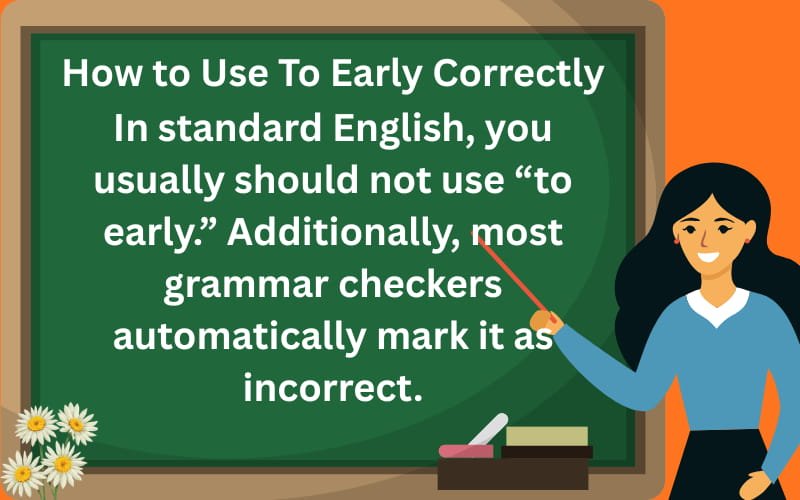
In standard English, you usually should not use “to early.” Additionally, most grammar checkers automatically mark it as incorrect.
The only correct option in normal writing is “too early.” Therefore, replacing “to” with “too” fixes the mistake immediately.
😊 ❌ “I woke up to early.”
- ❌ “She arrived to early.”
- ❌ “It happened to early.”
- ❌ “The game started to early.”
- ❌ “You spoke to early.”
See Also: Will Be Send or Will Be Sent? Correct Usage Guide
How to Use Too Early Correctly
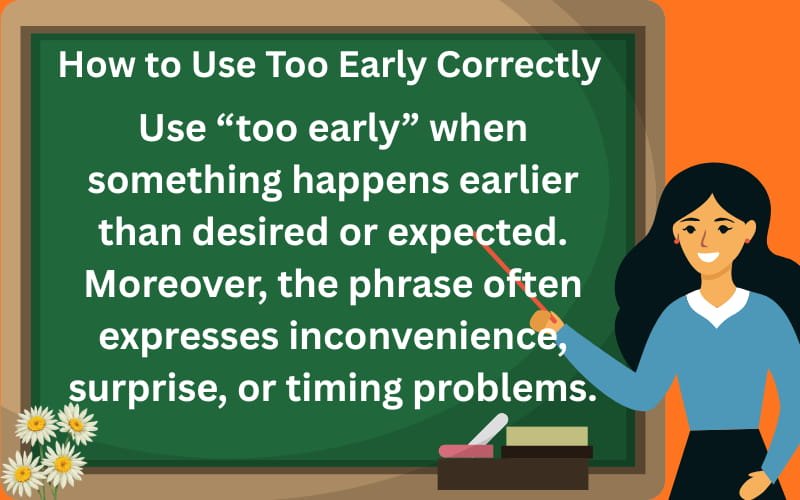
Use “too early” when something happens earlier than desired or expected. Moreover, the phrase often expresses inconvenience, surprise, or timing problems.
😊 “You arrived too early for the appointment.”
- “It’s too early to sleep.”
- “The baby woke up too early.”
- “We left too early.”
- “Dinner feels too early tonight.”
- “The alarm rang too early.”
Common Situations Where To Early or Too Early Is Used
People often use to early or too early while discussing schedules, alarms, school times, travel plans, and meetings. Furthermore, this phrase appears frequently in spoken English.
😊 “I reached school too early.”
- “The flight landed too early.”
- “You called too early.”
- “The class started too early.”
- “It’s too early for lunch.”
- “She showed up too early.”
- “The train came too early.”
- “We woke up too early.”
Why Spellcheck Often Misses This Mistake
One interesting issue with to early or too early involves typing speed and autocorrect systems. Sometimes writers type “to” automatically because it appears more commonly than “too.”
Additionally, speech creates confusion because both words sound exactly alike. Therefore, many learners make this spelling mistake even after understanding the grammar rule.
😊 “Typing quickly caused the too/to mistake.”
- “Autocorrect sometimes changes too.”
- “Speech makes both words sound equal.”
- “Fast texting creates grammar errors.”
- “Proofreading helps catch mistakes.”
To Early or Too Early Right vs Wrong Examples
| Wrong Sentence | Correct Sentence |
| I arrived to early. | I arrived too early. |
| She woke up to early. | She woke up too early. |
| The bus came to early. | The bus came too early. |
| We left to early. | We left too early. |
| It’s to early to eat. | It’s too early to eat. |
| He called to early. | He called too early. |
| They showed up to early. | They showed up too early. |
| The class started to early. | The class started too early. |
😊 “The movie started too early.”
- “Breakfast feels too early.”
- “You arrived too early.”
- “The meeting ended too early.”
- “It’s too early to worry.”
Common Mistakes People Make with To Early or Too Early
Many learners confuse “to” and “too” because pronunciation sounds identical. Consequently, spelling errors happen very frequently in casual writing.
😊 ❌ “You came to early.”
😊 ✅ “You came too early.”
- ❌ “It’s to early now.”
- ✅ “It’s too early now.”
- ❌ “We woke up to early.”
- ✅ “We woke up too early.”
- ❌ “Dinner started to early.”
- ✅ “Dinner started too early.”
Memory Trick Never Confuse To Early or Too Early Again
An easy memory trick connects “too” with the idea of “extra.” Since “too” has an extra “o,” it also means something extra or excessive.
Too = Extra
Too early = Extra early
Another helpful trick asks a simple question: “Can I replace the word with ‘excessively’?” If yes, use “too.”
Simple Test Formula:
Excessively early = Too early
😊 “Too has an extra letter for extra meaning.”
- “Too means more than needed.”
- “Too early means excessively early.”
- “To usually shows direction.”
- “Extra timing needs too.”
To Early or Too Early in Formal vs Informal Writing
| Context | To Early | Too Early |
| Emails | ❌ | ✅ |
| School essays | ❌ | ✅ |
| Texting | ❌ | ✅ |
| Business writing | ❌ | ✅ |
| Social media | ❌ | ✅ |
| Professional speeches | ❌ | ✅ |
The phrase “too early” works naturally in every writing style. However, “to early” remains grammatically incorrect everywhere.
😊 “The report arrived too early.”
- “It’s too early for results.”
- “The meeting began too early.”
- “You responded too early.”
- “The event started too early.”
To Early or Too Early with Specific Phrases
Always use to with:
- To school
- To eat
- To run
- To work
- To sleep
Always use too with:
- Too early
- Too late
- Too fast
- Too loud
- Too expensive
Additionally, these common phrases help learners remember the grammar difference naturally.
😊 “It’s too early to leave.”
- “She went to school.”
- “The music is too loud.”
- “He likes to read.”
- “This bag is too heavy.”
If you enjoyed reading this article, you might also like the ones below.
- Accept or Except Which One Is Correct?
- Could Of or Could Have Which One Is Correct?
- Fewer or Less Which One Is Correct?
- Everyday or Every Day: Meaning, Difference & Examples
- Principal or Principle: Meaning, Difference & Examples
FAQs
Is “to early” correct English?
No, “to early” is usually incorrect grammar.
Which is correct: to early or too early?
“Too early” is the correct phrase.
What does “too early” mean?
It means excessively early or earlier than expected.
Why do people write “to early”?
People confuse “to” and “too” because they sound alike.
Is “too early” formal English?
Yes, it works in both formal and informal writing.
Can “to early” ever be correct?
Almost never in standard English sentences.
What part of speech is “too”?
“Too” works as an adverb.
How can I remember the difference?
Remember that “too” has an extra “o” for extra meaning.
Is “too early” common in conversation?
Yes, native speakers use it very frequently.
Does autocorrect cause this mistake?
Yes, typing quickly and autocorrect often create the error.
See Also: Should Of or Should Have Which One Is Correct?
Conclusion
Understanding to early or too early becomes easy once you remember the meaning of “too.” The word “too” means excessively or more than needed. Therefore, “too early” is the correct phrase in almost every situation.
Many English learners accidentally write to early or too early incorrectly because both words sound identical. However, the extra “o” memory trick makes the rule much easier. In short, always choose “too early” when talking about excessive timing.