Accept means to receive or agree to something willingly. Except means to exclude or leave something out. Use accept when you mean yes to something and use except when you mean everything apart from something.
Accept and except sound almost identical when spoken aloud but they have completely different meanings. Accept is always a verb that signals agreement and reception. Except is most commonly a preposition that signals exclusion and exception. Choosing the wrong word is one of the most common grammar mistakes in everyday English writing.
Understanding accept or except helps you write with more confidence in every situation. In addition, knowing the exact difference prevents an embarrassing mistake in professional and academic writing. As a result, your writing sounds cleaner and more polished every single day.
Understanding Accept or Except in Simple English
Many people confuse accept or except because both words sound almost identical in everyday conversation. In reality, they are completely different parts of speech with different meanings. Furthermore, once you understand the simple distinction, choosing the right word becomes automatic every time.
Once you understand the difference completely, you will never hesitate again in any writing situation. Therefore, this guide covers clear examples, practical tips, and a memory trick that makes the correct choice obvious every single time you write.
Accept or Except: Simple Definition
Accept = to receive, agree to, or welcome something willingly. Except = to exclude, leave out, or make an exception of something.
Example:
😊 She decided to accept the job offer without any hesitation.
- Everyone was invited to the party except her closest colleague.
- He chose to accept the terms before proceeding any further.
- All documents were signed except the final agreement at the bottom.
- The team agreed to accept the new policy starting from Monday.
What Does Accept Mean?
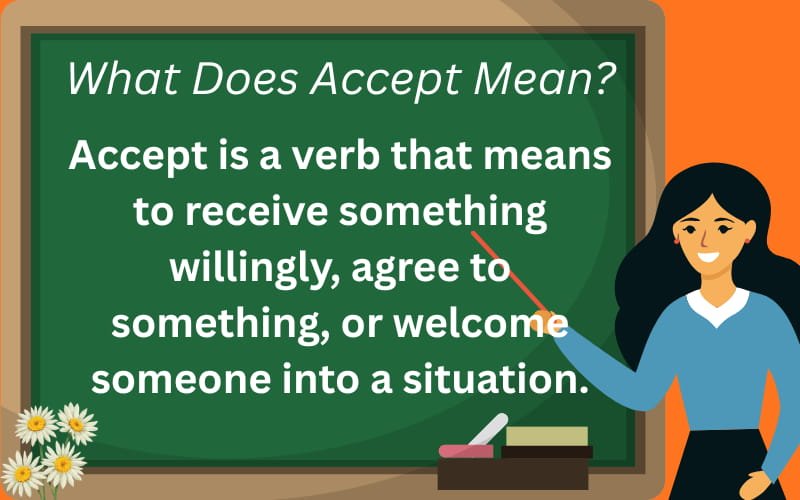
Accept is a verb that means to receive something willingly, agree to something, or welcome someone into a situation. Moreover, it always carries a willing and positive tone — it signals that someone is saying yes to something offered. In short, whenever you want to express agreement or willing acknowledgement, accept is the correct choice.
| Letter | Meaning |
| A | Agree to something |
| C | Choose to receive |
| C | Confirm willingness |
| E | Embrace what is offered |
| P | Put into agreement |
| T | Take in willingly |
Example:
😊 She was thrilled to accept the award on behalf of her team.
- He finally decided to accept the apology after thinking it through.
- They chose to accept the generous offer from the new client.
- The university agreed to accept her application for the autumn intake.
- She had to accept that some things are completely beyond her control.
What Does Except Mean?
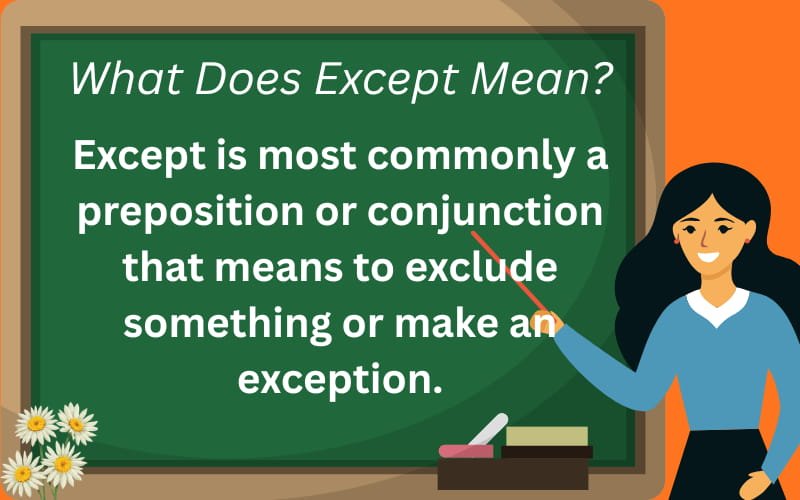
Except is most commonly a preposition or conjunction that means to exclude something or make an exception. Moreover, it always signals that something or someone is being left out of a general statement. In short, whenever you want to express exclusion or indicate something does not apply, except is the correct choice.
Example:
😊 Everyone passed the exam except the two students who missed it.
- The store is open every day except Sunday when it remains closed.
- She remembered everything about that day except what was said.
- All team members attended the meeting except the project manager.
- He ate everything on the menu except the soup which he disliked.
See Also: Complement or Compliment: Meaning, Difference & Examples
Accept or Except: The Core Difference
The most important distinction between accept or except is their grammatical function and meaning. Furthermore, understanding this core difference makes the choice completely automatic in every writing situation you encounter.
| Feature | Accept | Except |
| Part of Speech | Verb | Preposition / Conjunction |
| Meaning | Receive or agree willingly | Exclude or leave out |
| Signals | Agreement and reception | Exclusion and exception |
| Tone | Positive — saying yes | Exclusive — leaving out |
| Opposite | Reject | Include |
Is Accept or Except Formal or Informal?
Both words appear in formal and informal English. However, choosing the wrong word in formal writing is considered a significant error that damages your credibility seriously.
| Situation | Accept | Except |
| Academic writing | ✅ Accept the hypothesis | ✅ All except one result |
| Business email | ✅ Accept the proposal | ✅ All terms except clause 3 |
| Casual conversation | ✅ Accept the invite | ✅ Everyone except him |
| Legal document | ✅ Accept the terms | ✅ All parties except the vendor |
| Social media | ✅ Accept the challenge | ✅ Everything except that one |
Example:
😊 I am happy to accept your invitation to the conference next week.
- ❌ I am happy to except your invitation to the conference.
- ✅ Everyone enjoyed the event except the guest speaker who arrived late.
- ❌ Everyone enjoyed the event accept the guest speaker who arrived late.
How to Use Accept Correctly
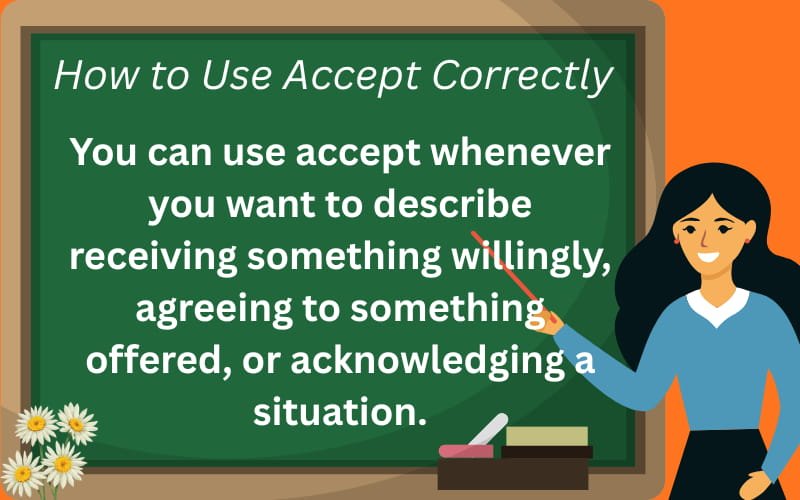
You can use accept whenever you want to describe receiving something willingly, agreeing to something offered, or acknowledging a situation. Furthermore, it always functions as a verb and needs a subject doing the accepting.
Example:
😊 She was the first in her family to accept a scholarship to university.
- He found it difficult to accept that the project had completely failed.
- They were grateful to accept the donation from the local community.
- The manager agreed to accept full responsibility for what happened.
- She chose to accept the criticism gracefully and learn from it.
How to Use Except Correctly
You can use except whenever you want to exclude something from a general statement. Furthermore, it most commonly functions as a preposition followed by a noun or pronoun in everyday writing.
Example:
😊 The whole family came to the reunion except her youngest brother.
- She knew everything about the plan except the exact starting time.
- All rooms were cleaned except the one at the very end of the hall.
- He was available every day except Friday afternoon consistently.
- Everything went perfectly except one minor unexpected detail at the end.
Common Situations Where Accept or Except Is Used
People use both words constantly in everyday English. Additionally, they appear in formal letters, casual messages, academic papers, and professional emails every single day.
Example:
📱 She decided to accept the friend request after thinking carefully.
- Everyone was present at the meeting except the regional sales director.
- He found it hard to accept that the relationship had completely ended.
- All applications were approved except those submitted after the deadline.
- She was proud to accept the promotion she had worked so hard to earn.
- Nobody knew about the change except the immediate leadership team.
- He accepted the challenge because he believed completely in his abilities.
Except as a Verb — The Rare Usage Most Guides Miss
This section is completely missing from most grammar guides and it covers an important nuance. Specifically, except can also function as a verb in formal and legal writing — though this usage is very rare in everyday communication.
When used as a verb, except means to formally exclude someone from a rule or agreement.
Example:
😊 The board voted to except the chairman from the new attendance policy.
- She was excepted from the general requirement due to unique circumstances.
- The regulations excepted certain workers from the new requirements.
- He was specifically excepted from the mandatory training by management.
- The contract excepted certain liabilities from the standard terms.
Accept or Except — Right vs Wrong Examples
| ❌ Wrong | ✅ Correct | Reason |
| I except your apology | I accept your apology | Receive willingly = accept |
| Everyone accept him left | Everyone except him left | Exclusion = except |
| She excepted the offer | She accepted the offer | Agree to = accept |
| All accept one were present | All except one were present | Leaving out = except |
| He couldn’t except failure | He couldn’t accept failure | Acknowledge = accept |
| Accept for one mistake | Except for one mistake | Exclusion phrase = except |
| I will except your terms | I will accept your terms | Agree to = accept |
| Everyone accepted John | Everyone except John | Leaving out = except |
Common Mistakes People Make with Accept or Except
Many people make the same mistakes repeatedly in everyday writing. Consequently, these errors appear constantly in messages, emails, and even published content every day.
Example:
❌ Writing except when someone received or agreed to something.
- ✅ Instead, always use accept when the meaning is to receive or agree willingly.
- ❌ Writing accept when you want to exclude something from a statement.
- ✅ Instead, always use except when the meaning is exclusion or exception.
- ❌ Confusing “accept for” with “except for” in casual everyday writing.
- ✅ Instead, remember that “except for” always signals exclusion — never agreement.
Memory Trick — Never Confuse Accept or Except Again
The simplest way to remember the difference is to use one quick association that works every single time.
👉 ACCEPT starts with AC — think ACknowledge or ACquire
✅ Acknowledging or acquiring something → Use ACCEPT
👉 EXCEPT starts with EX — think EXclude or EXcept out
✅ Excluding something or someone → Use EXCEPT
Another trick:
👍 Replace with “receive” — sentence makes sense → Use ACCEPT
💬 Replace with “excluding” — sentence makes sense → Use EXCEPT
One final test:
🌟 Can you replace it with “agree to”? → Use ACCEPT
🌟 Can you replace it with “apart from”? → Use EXCEPT
Accept or Except in Formal vs Informal Writing
| Context | Accept Example | Except Example |
| Academic paper | Accept the null hypothesis | All results except one outlier |
| Business email | Accept the revised proposal | All clauses except section 4 |
| Legal document | Accept full liability | All parties except the vendor |
| News article | Accept the resignation | All members except the chair |
| Casual chat | Accept the invite | Everyone except her |
| Social media | Accept the challenge | Everything except that one |
Accept or Except with Specific Phrases
Some phrases always use accept and some always use except. Learning these combinations makes the choice easier in every situation.
Always use ACCEPT with:
😊 Accept responsibility, accept an offer, accept an apology, accept a challenge.
👍 Accept criticism, accept a nomination, accept terms, accept a gift.
💬 Accept defeat, accept reality, accept an invitation, accept a proposal.
Always use EXCEPT with:
😊 Except for, all except, everyone except, everything except.
👍 Except when, except that, except in cases, except where noted.
💬 Present except, included except, valid except, applicable except.
If you enjoyed reading this article, you might also like the ones below.
- Fewer or Less Which One Is Correct?
- Everyday or Every Day: Meaning, Difference & Examples
- Principal or Principle: Meaning, Difference & Examples
- Will Be Send or Will Be Sent? Correct Usage Guide
- Than or Then: Meaning, Difference & Examples
FAQs
What is the simple rule for accept or except?
Accept means to receive or agree willingly. Except means to exclude or leave something out.
Is it accept or except an apology?
Always accept an apology — because accepting means receiving something willingly.
Is it accept or except for one person?
Always except for one person — because except for signals exclusion and leaving someone out.
Can except be used as a verb?
Yes — but rarely. In formal writing, except means to formally exclude someone from a rule.
What is the difference between accept and except in grammar?
Accept is always a verb meaning to receive. Except is most commonly a preposition meaning to exclude.
Is it all accept or all except?
Always all except — because this phrase signals exclusion from a general group or statement.
How do I remember the difference?
ACCEPT has AC — think ACknowledge. EXCEPT has EX — think EXclude.
Which is more commonly confused?
Both are equally confused — people write one when they mean the other because they sound identical.
Which is correct — except or accept the terms?
Always accept the terms — because agreeing to terms is an act of willing reception and agreement.
Can accept and except appear in the same sentence?
Yes — “She chose to accept all feedback except the last comment she disagreed with.”
See Also: Could Of or Could Have Which One Is Correct?
Conclusion
Accept or except is one of the most commonly confused word pairs in English — but the solution is simple once you understand the core distinction. In summary, use accept when you mean to receive or agree willingly, and use except when you mean to exclude something from a general statement.
By remembering AC for ACknowledge and EX for EXclude, you can eliminate this mistake from your writing permanently. Ultimately, choosing correctly between accept or except every single time makes your English cleaner, more precise, and more professional in every situation.