
Could have is always correct. Could of is always wrong. People write could of because the contraction could’ve sounds exactly like could of when spoken aloud. Moreover, this single pronunciation confusion causes one of the most common grammar mistakes in English writing every single day.
Understanding could of or could have helps you write with more confidence and accuracy in everyday English. In addition, knowing why could of sounds right but is completely wrong prevents an embarrassing grammar mistake that even native speakers make regularly. As a result, your writing looks more polished and professional in every situation.
Understanding Could Of or Could Have in Simple English
Many people write could of without realising it is grammatically incorrect in every situation without exception. In reality, could of or could have has one simple answer — could have is always the only correct version. Furthermore, the confusion exists entirely because of how English contractions sound when spoken aloud in everyday conversation.
Once you understand could of or could have completely, you will never make this mistake again in any piece of writing. Therefore, this guide explains could of or could have in simple language with clear examples, common mistakes, and a memory trick that makes the correct choice obvious every single time.
Could Of or Could Have: Simple Definition
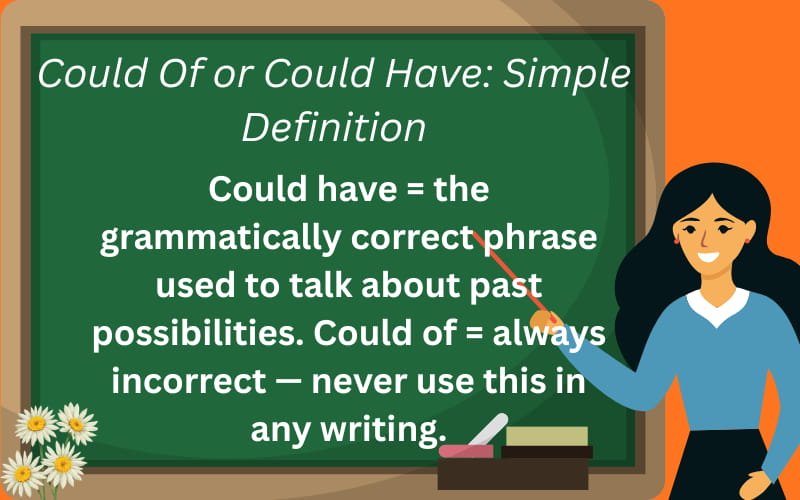
Could have = the grammatically correct phrase used to talk about past possibilities. Could of = always incorrect — never use this in any writing.
Example:
😊 I could have finished the work earlier if I had started on time.
- She could have called instead of sending that message.
- We could have won the match with a little more effort.
- He could have been a doctor if he had studied harder.
- You could have told me before I made that mistake.
Why Do People Write Could Of Instead of Could Have?
Could of is one of the most common grammar mistakes in English writing. Moreover, the reason people write could of is entirely based on how the contraction could’ve sounds when spoken aloud in everyday conversation.
When someone says could’ve quickly in speech, it sounds almost identical to could of in pronunciation. Furthermore, many people learn English primarily through listening and speaking rather than reading and writing. As a result, they naturally write what they hear rather than what is grammatically correct.
Example:
😊 Could’ve sounds like “could of” when spoken quickly in conversation.
- This is called an eggcorn — a word or phrase mistaken for another because of similar sound.
- Could of appears frequently in text messages, social media, and informal writing.
- Native speakers make this mistake just as often as non-native speakers.
- Even published articles and news reports sometimes contain this error.
Full Breakdown of Could Have
Could have is a modal verb phrase made up of two separate parts that always work together. Specifically, could is a modal verb and have is an auxiliary verb that together express past possibility, missed opportunity, or an unrealised action.
| Part | Word | Type |
| Could | Could | Modal verb |
| Have | Have | Auxiliary verb |
| Past Participle | Gone / Done / Said | Main verb |
Example:
😊 I could have gone to the party but I was too tired.
- She could have done better if she had more time.
- They could have said something earlier about the problem.
- He could have taken a different route to avoid the traffic.
- We could have saved more money if we had planned ahead.
Is Could Of or Could Have Formal or Informal?
Could have is correct in both formal and informal English. However, could of is incorrect in every context — formal, informal, academic, and professional writing without exception.
| Situation | Could Have | Could Of |
| Academic writing | ✅ Always correct | ❌ Always wrong |
| Professional email | ✅ Always correct | ❌ Always wrong |
| Casual conversation | ✅ Always correct | ❌ Always wrong |
| Social media | ✅ Always correct | ❌ Always wrong |
| Text messages | ✅ Always correct | ❌ Always wrong |
| Novel or story | ✅ Always correct | ❌ Always wrong |
Example:
😊 I could have handled that situation much better. (correct — all contexts)
- ❌ I could of handled that situation much better. (always wrong)
- ✅ She could have arrived earlier if she had left on time.
- ❌ She could of arrived earlier if she had left on time.
- ✅ We could have avoided this problem with better planning.
How to Use Could Have Correctly

You can use could have correctly whenever you want to talk about something that was possible in the past but did not happen. Furthermore, could have always needs a past participle immediately after it to form a complete and grammatically correct sentence.
Example:
😊 I could have been a professional athlete when I was younger.
- She could have passed the exam if she had revised properly.
- He could have apologised but chose not to say anything.
- They could have arrived on time if they had left earlier.
- You could have asked me for help instead of struggling alone.
See Also: To Fast or Too Fast Which One Is Correct?
Common Situations Where Could Have Is Used
People use could have constantly in everyday English to talk about past possibilities, missed opportunities, and unrealised actions. Additionally, could have appears in personal conversations, professional discussions, and academic writing every single day across all contexts.
Example:
📱 I could have sworn I left my keys on the table this morning.
- She could have been promoted if she had stayed with the company.
- We could have booked cheaper tickets if we had planned ahead.
- He could have finished the project on time with better organisation.
- They could have avoided the argument if they had communicated clearly.
- You could have told me you were not coming to the meeting today.
- I could have handled the whole situation very differently in hindsight.
Can Could Of Ever Be Correct?
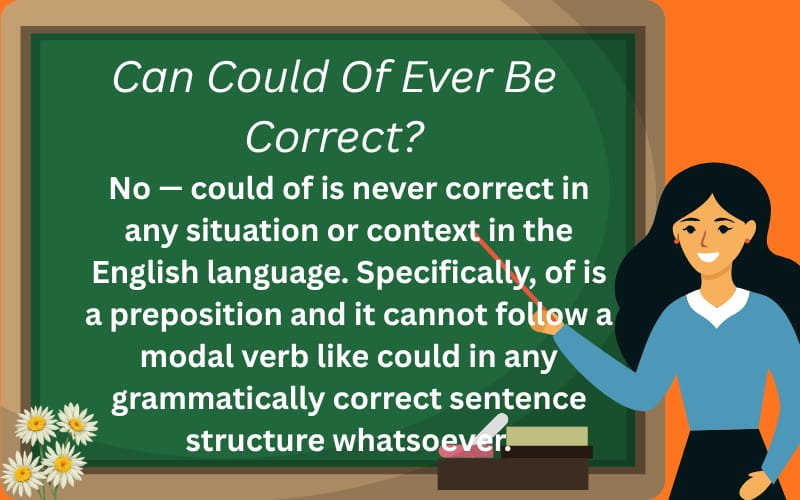
No — could of is never correct in any situation or context in the English language. Specifically, of is a preposition and it cannot follow a modal verb like could in any grammatically correct sentence structure whatsoever.
Example:
😊 Could have is always the only correct version without exception.
- ❌ I could of done that differently. (always wrong — no exceptions)
- ✅ I could have done that differently. (always correct)
- ❌ She could of been there on time. (always wrong)
- ✅ She could have been there on time. (always correct)
Could Have as a Contraction — Could’ve
Could have is often shortened to the contraction could’ve in informal writing and everyday speech. Moreover, this contraction is perfectly correct and widely accepted in casual communication though it should be avoided in formal academic writing.
| Full Form | Contraction | Example |
| Could have | Could’ve | I could’ve done better |
| Should have | Should’ve | She should’ve called |
| Would have | Would’ve | He would’ve agreed |
| Might have | Might’ve | They might’ve known |
Example:
😊 I could’ve finished earlier but I took a break in the afternoon.
- She could’ve told me about the change in plans beforehand.
- We could’ve saved so much time with a better system in place.
- He could’ve been there but something came up at the last minute.
- You could’ve asked me — I would have helped you right away.
Could Of or Could Have — Right vs Wrong
| ❌ Wrong | ✅ Correct |
| I could of done it | I could have done it |
| She could of been there | She could have been there |
| We could of won | We could have won |
| He could of told me | He could have told me |
| They could of helped | They could have helped |
| You could of called | You could have called |
| I could of gone | I could have gone |
| She could of stayed | She could have stayed |
Could Of vs Should Of vs Would Of
Could of, should of, and would of are all incorrect. Moreover, all three phrases exist only because their contractions sound similar to of when spoken quickly in everyday conversation.
| ❌ Wrong | ✅ Correct | Contraction |
| Could of | Could have | Could’ve |
| Should of | Should have | Should’ve |
| Would of | Would have | Would’ve |
| Might of | Might have | Might’ve |
| Must of | Must have | Must’ve |
Example:
😊 I should have listened to you from the very beginning.
- ❌ I should of listened to you from the very beginning.
- ✅ She would have come if she had known about the event.
- ❌ She would of come if she had known about the event.
- ✅ He must have forgotten about our meeting this afternoon.
Common Mistakes People Make with Could Of or Could Have
Many people make the could of mistake repeatedly because it sounds completely natural in speech. Consequently, the error appears constantly in text messages, social media posts, emails, and even published written content every day.
❌ Writing could of in any formal or informal written communication.
✅ Instead, always write could have or the contraction could’ve in its place.
❌ Assuming could of is acceptable in casual writing because it sounds right.
✅ Instead, remember that could of is never correct in any written context.
❌ Confusing could’ve with could of when writing quickly or typing fast.
✅ Instead, slow down and always expand the contraction to could have first.
Memory Trick — Never Write Could Of Again
The simplest way to remember could of or could have is to use one quick test every single time before you write. Furthermore, this trick works in every situation without exception.
👉 Replace “could” with “can” in your sentence.
✅ If the sentence still makes sense — use could have.
✅ If the sentence sounds wrong — rethink the whole structure.
Example:
😊 I can have done that. (sounds wrong — but confirms “have” is the right word)
- Try: I could have done that. ✅ (correct)
- Try: I could of done that. ❌ (of never works with modal verbs)
Another trick:
👍 Could of = Could + preposition = ❌ Always wrong
💬 Could have = Could + auxiliary verb = ✅ Always correct
🌟 Could’ve = Could have shortened = ✅ Always correct informally
Could Of or Could Have in Formal vs Informal Writing
| Context | Correct Form | Notes |
| Academic paper | Could have | Never use could’ve in academic writing |
| Business email | Could have | Always write the full form professionally |
| Novel or story | Could have / Could’ve | Both acceptable depending on character voice |
| Social media | Could have / Could’ve | Both correct — never could of |
| Text message | Could’ve | Contraction perfectly acceptable here |
| News article | Could have | Full form preferred in journalism |
If you enjoyed reading this article, you might also like the ones below.
- On Time or In Time Meaning, Difference, Rules & Examples
- Your vs You’re: Simple Difference, Rules & Examples
- Wish vs Hope: Difference, Rules & Easy Examples
- Its vs It’s: Simple Difference, Rules & Examples
- My Wife and I or My Wife and Me: Which One Is Correct?
FAQs
Is could of ever correct?
No — could of is never correct in any situation or context in English writing.
Why do people write could of instead of could have?
Because the contraction could’ve sounds identical to could of when spoken quickly in everyday speech.
What is the correct form — could of or could have?
Could have is always the correct form. Could of is always wrong without exception.
Can I write could’ve instead of could have?
Yes — could’ve is the correct contraction of could have and is perfectly acceptable in informal writing and speech.
Is should of also wrong?
Yes — should of is always wrong. The correct form is always should have or the contraction should’ve.
Is would of correct?
No — would of is always incorrect. The correct form is always would have or the contraction would’ve.
How do I remember could have vs could of?
Remember that of is a preposition and can never follow a modal verb like could. Always use have or the contraction could’ve instead.
Is could of used in any dialect of English?
No — could of is not a recognised or accepted form in any dialect or variety of English anywhere in the world.
What type of error is could of?
Could of is called an eggcorn — a word or phrase that is mistakenly substituted for another because of how similar it sounds in speech.
Can could of appear in dialogue in fiction writing?
Yes — fiction writers sometimes use could of in dialogue intentionally to show how a character speaks informally. However, it should never appear in narration or formal writing.
See Also: At the End or In the End Meaning, Difference & Examples
Conclusion
Could of or could have has one clear and permanent answer — could have is always correct and could of is always wrong without a single exception in any context. In summary, the mistake exists only because could’ve sounds like could of when spoken aloud and many people write what they hear rather than what grammar requires.
By understanding could of or could have completely and remembering the simple rule that of can never follow a modal verb, you can eliminate this mistake from your writing permanently. Ultimately, choosing could have every single time keeps your English clean, professional, and grammatically correct in every piece of writing and every context you encounter every day.