Who or Whom Which One Is Correct? Who is used for the person doing the action, while whom is used for the person receiving the action. Use who as the subject of a sentence and use whom as the object. In simple words, if someone performs the action, choose “who.” However, if someone receives the action, choose “whom.”
The confusion between who or whom happens because both words refer to people. However, the grammar rule is easier than most learners think.
Use “who” when someone performs an action. Use “whom” when someone receives the action. Consequently, the he/him trick helps you choose the correct word quickly.
Many English learners struggle with who or whom because both words sound similar in fast conversations. Moreover, native speakers also avoid “whom” in casual speaking. However, formal English still uses it regularly.
Understanding this grammar rule improves your emails, essays, interviews, and daily communication. In addition, learning the subject-object difference makes your English sound more natural.
Who or Whom: Simple Definition
Who means “the person doing the action.”
Whom means “the person receiving the action.”
Use “who” when someone performs an action in the sentence. However, use “whom” when the action happens to someone.
This small grammar difference changes sentence structure completely. Therefore, understanding subjects and objects helps you avoid common mistakes.
😊 “Who baked the cake?”
- “Whom did you choose?”
- “Who answered the phone?”
- “To whom should I complain?”
- “Who broke the glass?”
Is It Who or Whom
Many learners ask, is it who or whom, because modern English often sounds informal. However, grammar still follows clear subject and object rules.
If the word pIserforms the action, use “who.” If the word receives the action, use “whom.” Furthermore, “whom” appears more often in formal communication.
| Sentence | Correct Choice |
| ___ called me? | Who |
| You invited ___? | Whom |
| ___ wants coffee? | Who |
| To ___ was the letter sent? | Whom |
😊 “Who called this morning?”
- “Whom did you invite?”
- “Who solved the problem?”
- “With whom are you traveling?”
- “Who cleaned the kitchen?”
When to Use Who or Whom
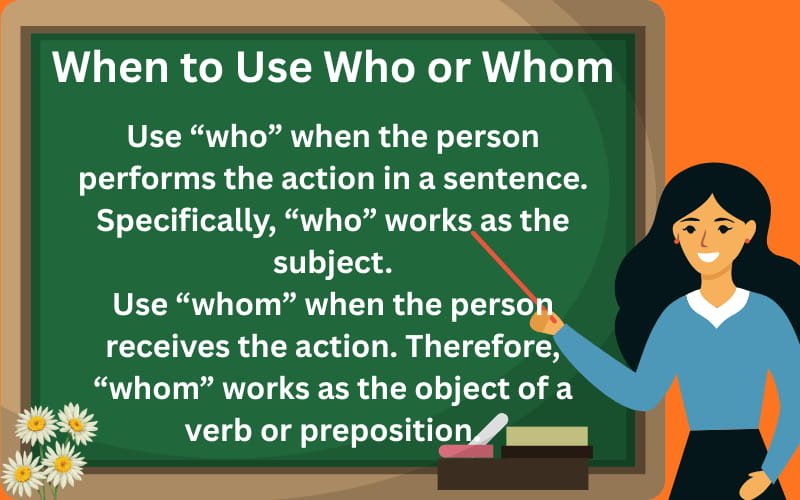
Use “who” when the person performs the action in a sentence. Specifically, “who” works as the subject.
Use “whom” when the person receives the action. Therefore, “whom” works as the object of a verb or preposition.
The easiest trick is simple:
- If “he” or “she” fits, use who
- If “him” or “her” fits, use whom
| Sentence Test | Correct Word |
| He called me | Who |
| I called him | Whom |
| She invited us | Who |
| We invited her | Whom |
😊 “Who is coming tonight?”
- “Whom did you call?”
- “Who finished the homework?”
- “To whom should I speak?”
- “Who opened the window?”
What Does Who Mean?
The word “who” is a subject pronoun. Consequently, it identifies the person performing the action.
Moreover, “who” appears naturally in both formal and informal English.
| Word | Part of Speech | Meaning |
| Who | Subject pronoun | Person doing the action |
😊 “Who left the lights on?”
- “Who called you?”
- “Who cleaned the room?”
- “Who finished first?”
- “Who wants ice cream?”
- “Who made breakfast?”
What Does Whom Mean?
The word “whom” is an object pronoun. Therefore, it refers to the person receiving the action.
Additionally, “whom” often follows prepositions like “to,” “with,” and “for.”
| Word | Part of Speech | Meaning |
| Whom | Object pronoun | Person receiving the action |
😊 “Whom did you invite?”
- “To whom should I send this?”
- “Whom are they supporting?”
- “With whom did she travel?”
- “Whom did the teacher praise?”
- “For whom is this package?”
Who or Whom: Core Difference
| Feature | Who | Whom |
| Grammar role | Subject | Object |
| Replaces | He/She | Him/Her |
| Performs action | ✅ | ❌ |
| Receives action | ❌ | ✅ |
| Common in speech | Very common | Less common |
| Used after prepositions | Rarely | Often |
| Formal writing | Yes | Yes |
The main difference between who or whom depends on sentence role. Specifically, “who” performs actions, while “whom” receives actions.
😊 “Who opened the door?”
- “Whom did you choose?”
- “Who made coffee?”
- “To whom was the package sent?”
- “Who forgot the tickets?”
Is Who or Whom Formal or Informal?
“Who” sounds natural in both casual and formal English. However, “whom” sounds more formal in everyday conversation.
| Situation | Who | Whom |
| Text messages | ✅ | Rare |
| Academic essays | ✅ | ✅ |
| Business emails | ✅ | ✅ |
| Casual conversation | ✅ | Less common |
| Interviews | ✅ | ✅ |
| Formal letters | ✅ | ✅ |
😊 ✅ “Who is coming with us?”
- ✅ “Whom should I contact?”
- ❌ “Whom wants pizza?”
- ✅ “Who wants pizza?”
- ✅ “To whom it may concern.”
How to Use Who Correctly
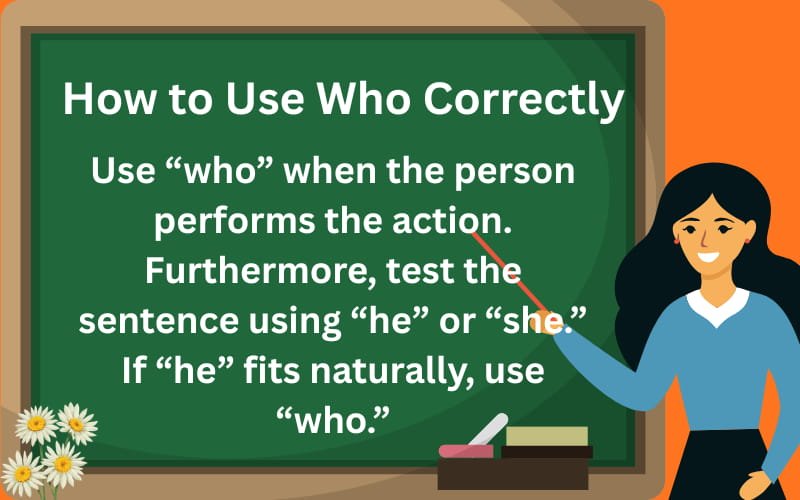
Use “who” when the person performs the action. Furthermore, test the sentence using “he” or “she.”
If “he” fits naturally, use “who.”
😊 “Who called last night?”
- “Who cleaned the office?”
- “Who made this coffee?”
- “Who wants dessert?”
- “Who helped your brother?”
- “Who opened the gate?”
How to Use Whom Correctly
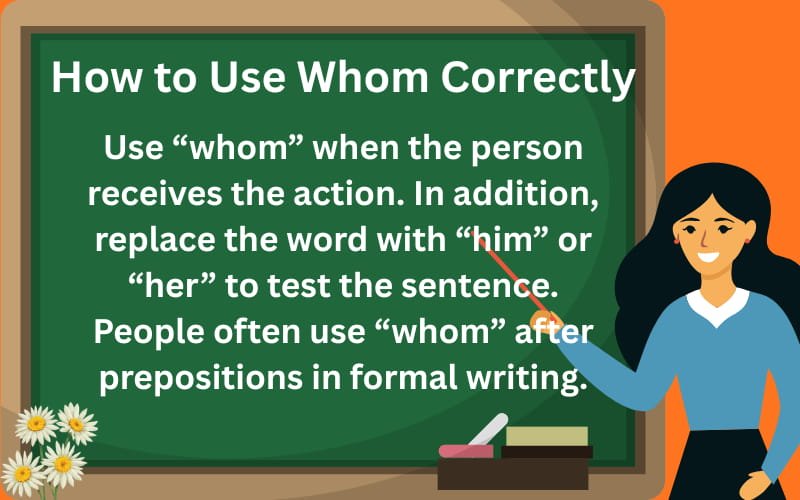
Use “whom” when the person receives the action. In addition, replace the word with “him” or “her” to test the sentence.
People often use “whom” after prepositions in formal writing.
😊 “Whom did you invite?”
- “To whom should I complain?”
- “Whom are they watching?”
- “With whom did you travel?”
- “Whom did the company hire?”
- “For whom is this letter?”
See Also: Accept or Except Which One Is Correct?
Whom + To + Verb Structure
Many grammar websites ignore this important structure. However, formal English often uses “whom + to + verb.”
| Structure | Example |
| Whom to ask | “I know whom to ask.” |
| Whom to trust | “She knows whom to trust.” |
| Whom to call | “They know whom to call.” |
😊 “I forgot whom to invite.”
- “She knows whom to contact.”
- “We learned whom to trust.”
- “He remembered whom to message.”
- “They discussed whom to hire.”
- “I understand whom to follow.”
Whom vs Very Formal Language — Important Difference
Some learners believe “whom” always sounds smarter. However, modern English usually prefers natural wording.
| Phrase | Style | Example |
| Who are you meeting? | Casual | Common speech |
| Whom are you meeting? | Formal | Formal speech |
| To whom should I speak? | Very formal | Business writing |
😊 “Who are you talking to?”
- “Whom are you talking to?”
- “To whom should I address this?”
- “Who invited Sarah?”
- “Whom did the manager hire?”
Whom in Questions
The word “whom” appears regularly in formal questions. Moreover, it often follows prepositions.
😊 “Whom did you meet yesterday?”
- “To whom should I send this?”
- “Whom are they supporting?”
- “With whom are you staying?”
- “Whom did she choose?”
- “For whom was this prepared?”
Common Situations Where Who or Whom Is Used
People use who or whom in schools, offices, interviews, travel situations, and business communication. Furthermore, these words appear regularly in questions.
😊 “Who is your teacher?”
- “Whom did you call?”
- “Who answered the phone?”
- “To whom should I complain?”
- “Who forgot the tickets?”
- “Whom are they waiting for?”
- “Who cleaned the room?”
- “With whom did you travel?”
Advanced Usage of Whom
The word “whom” also appears in advanced grammar structures. Additionally, formal writing still uses these patterns regularly.
Whom with Prepositions
😊 “To whom was the package delivered?”
- “With whom are you speaking?”
- “For whom is this gift?”
- “By whom was this article written?”
- “From whom did you hear this?”
Whom in Formal Writing
😊 “Whom should the company contact?”
- “Whom did the manager select?”
- “To whom does this belong?”
- “Whom should we invite?”
- “Whom did they recommend?”
One morning, my friend wrote, “Whom is coming today?” Our teacher smiled and said, “Try replacing it with ‘he.’” Since then, we never forgot the rule again.
Synonyms of Whom
- Which person — “Which person did you invite?”
- Him/Her — “I called her yesterday.”
- That person — “That person received the message.”
- The individual — “The individual answered quickly.”
- The person — “The person received the award.”
😊 “Whom did you select?”
- “Which person did you select?”
- “I contacted him yesterday.”
- “The person replied quickly.”
- “That individual helped us.”
- “Her manager called later.”
Opposite of Whom
The closest opposite of “whom” is “who” because both words perform opposite grammar functions.
😊 “Who called you?”
- “Whom did you call?”
- “Who opened the door?”
- “Whom are they supporting?”
- “Who wants coffee?”
- “Whom did she invite?”
Who or Whom — Right vs Wrong
| Wrong Sentence | Correct Sentence |
| Whom is calling? | Who is calling? |
| Who did you invite? | Whom did you invite? |
| To who was it sent? | To whom was it sent? |
| Whom wants pizza? | Who wants pizza? |
| Who are they waiting for? | Whom are they waiting for? |
| Whom cleaned the room? | Who cleaned the room? |
| Who did she praise? | Whom did she praise? |
| Whom made breakfast? | Who made breakfast? |
😊 “Who called this morning?”
- “Whom did you invite?”
- “Who cleaned the kitchen?”
- “To whom should I complain?”
- “Who forgot the keys?”
Common Mistakes People Make
😊 ❌ “Whom is at the door?”
😊 ✅ “Who is at the door?”
- ❌ “Who did they invite?”
- ✅ “Whom did they invite?”
- ❌ “Whom wants dessert?”
- ✅ “Who wants dessert?”
- ❌ “To who should I speak?”
- ✅ “To whom should I speak?”
- ❌ “Whom opened the shop?”
- ✅ “Who opened the shop?”
- ❌ “Who are they waiting for?”
- ✅ “Whom are they waiting for?”
Memory Trick — Never Confuse Who or Whom Again
The easiest grammar trick uses the he/him test.
Who = He/She
Whom = Him/Her
If “he” sounds correct, choose “who.” If “him” sounds correct, choose “whom.”
Another fun memory trick works well:
- “Who” sounds strong like a subject.
- “Whom” sounds softer like an object.
😊 “Who called him?” → He called him.
- “Whom did you invite?” → You invited him.
- “Who opened the door?”
- “Whom did they choose?”
- “Who finished first?”
Quick Practice Section
Fill in the blanks:
- ___ called you yesterday?
- To ___ should I send this email?
- ___ wants coffee?
- ___ did you invite to dinner?
- With ___ are you traveling?
Answers
- Who
- Whom
- Who
- Whom
- Whom
Who or Whom in Formal vs Informal Writing
| Context | Who | Whom |
| Daily texting | ✅ | Rare |
| Academic writing | ✅ | ✅ |
| Business communication | ✅ | ✅ |
| Casual speaking | ✅ | Less common |
| Public speeches | ✅ | ✅ |
| Legal writing | ✅ | ✅ |
Modern English usually prefers “who” in casual conversation. Nevertheless, “whom” still appears in formal writing.
😊 “Who is joining the meeting?”
- “Whom should we contact?”
- “Who answered earlier?”
- “To whom was the letter addressed?”
- “Who completed the report?”
Who or Whom with Specific Phrases
Always use who with:
- Who are you?
- Who called?
- Who wants coffee?
- Who made this?
- Who is there?
Always use whom with:
- To whom it may concern
- With whom
- For whom
- Whom did you invite?
- From whom
😊 “To whom should I send this package?”
- “Who is speaking?”
- “Whom did they choose?”
- “Who opened the gate?”
- “With whom are you staying?”
If you enjoyed reading this article, you might also like the ones below.
- Lay or Lie What’s the Difference and Which One Is Correct?
- Of or Off Which One Is Correct?
- To Early or Too Early Which One Is Correct?
- Bring or Take Which One Is Correct?
- Should Of or Should Have Which One Is Correct?
FAQs
What is the difference between who and whom?
“Who” is the subject, while “whom” is the object.
When should I use whom?
Use “whom” when the person receives the action.
Is it who or whom after a preposition?
Use “whom” after prepositions like to, for, and with.
Why is whom less common today?
Modern English prefers casual and simple speech.
Is “To whom it may concern” correct?
Yes, it is grammatically correct.
How can I remember who or whom easily?
Use the he/him grammar trick.
Can I use who instead of whom?
Many people do in casual English.
Is whom formal?
Yes, “whom” sounds more formal.
Do native speakers still use whom?
Yes, especially in formal writing.
What is the easiest rule for who and whom?
Who performs the action, while whom receives it.
See Also: Swifty or Swiftie Which One Is Correct?
Conclusion
Understanding who or whom becomes much easier once you identify the subject and object. Use “who” for the person doing the action. However, use “whom” for the person receiving the action.
Many learners search “when to use who or whom” and “is it who or whom” because the words sound confusing at first. Nevertheless, the he/him trick solves most grammar problems quickly. In short, “who” performs the action, while “whom” receives it.