
Some English words look almost identical but carry completely different meanings. Loose or lose is one of those confusing pairs that can easily cause mistakes, especially when you are writing quickly or speaking without thinking about the spelling.
Loose usually describes something that is not tight or firmly fixed. Lose, on the other hand, talks about no longer having something, failing to win, or being unable to find something.
The difference becomes much easier once you connect each word with its meaning. For example, you can wear a loose shirt, but you can lose your shirt if you cannot find it.
Many learners mix these words up because they sound somewhat similar and differ by only one letter. However, they work differently in a sentence, so choosing the right word depends on what you want to say.
Quick Answer
Loose or lose? Use loose when something is not tight, secure, or firmly attached. Use lose when you misplace something, no longer have it, or fail to win.
For example, your shirt can be loose, but you can lose your shirt. You might also lose a game, lose weight, or lose your keys. The easiest way to choose the right word is to focus on what you are trying to say.
Related Guide: MW Meaning in Text
📊 Quick Overview Table
| Word | Part of Speech | Meaning | Pronunciation | Example |
| Loose | Adjective | Not tight or free | /luːs/ | My shirt is loose. |
| Lose | Verb | To misplace or fail to win | /luːz/ | Don’t lose your keys. |
📖 What Does “Loose” Mean?
Loose is primarily used as an adjective and describes something that is not tight, firmly fixed, or securely attached. It can also refer to freedom, lack of control, or relaxation.
Common Meanings of Loose:
- Not tight or securely fastened
- Free or unattached
- Relaxed or not strict
- Unrestricted or flexible
Examples:
- My shoes are too loose.
- She prefers wearing loose clothing.
- There is a loose screw in the chair.
- The dog escaped because the leash was loose.
- He likes a loose and comfortable fit.
📖 What Does “Lose” Mean?
Lose is a verb that refers to losing possession of something, failing to win, or being deprived of something valuable.
Common Meanings of Lose:
- To misplace something
- To fail to win
- To be deprived of something
- To miss an opportunity
Examples:
- Be careful not to lose your wallet.
- Our team might lose the match.
- She doesn’t want to lose her job.
- I always lose my keys.
- He hopes not to lose the competition.
🔍 Loose vs. Lose: Key Differences
| Feature | Loose | Lose |
| Part of Speech | Adjective | Verb |
| Meaning | Not tight or free | To misplace or fail |
| Pronunciation | Ends with an “S” sound | Ends with a “Z” sound |
| Usage | Describes nouns | Indicates actions |
| Example | The bolt is loose. | Don’t lose the bolt. |
🔹 Easy Way to Remember the Difference Between Loose and Lose
Memorizing the difference between loose or lose becomes simple with these tricks:
- Loose has two “O’s”—just like loose clothing with extra room.
- Lose has one “O”—imagine losing an “O.”
- Loose ends with an “S” sound, while lose ends with a “Z” sound.
Examples:
- The knot is loose.
- Don’t lose the knot.
- My ring is loose.
- I don’t want to lose my ring.
💬 How to Use Loose and Lose in Sentences
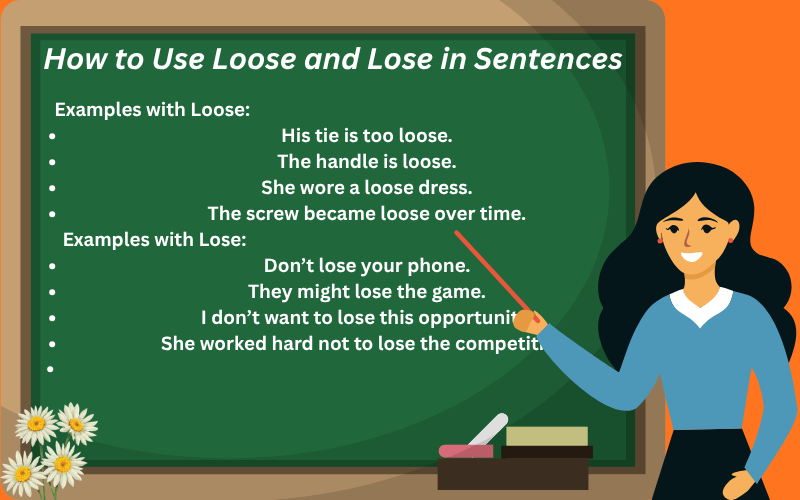
Examples with Loose:
- His tie is too loose.
- The handle is loose.
- She wore a loose dress.
- The screw became loose over time.
Examples with Lose:
- Don’t lose your phone.
- They might lose the game.
- I don’t want to lose this opportunity.
- She worked hard not to lose the competition.
Visit Also: GM Meaning in Text
🔹 Common Situations Where Loose and Lose Are Used
Everyday Uses of Loose:
- Clothing and accessories
- Mechanical objects
- Relaxed rules or structures
- Freedom or flexibility
Everyday Uses of Lose:
- Misplacing belongings
- Sports and competitions
- Emotional or personal loss
- Financial or professional setbacks
Examples:
- My bracelet is loose.
- Don’t lose your bracelet.
- The screw is loose.
- We might lose the match.
🔹 Pronunciation Differences Between Loose and Lose
| Word | Phonetic Spelling | Sound |
| Loose | /luːs/ | Ends with an “S” sound |
| Lose | /luːz/ | Ends with a “Z” sound |
Examples:
- The shirt is loose.
- Try not to lose the shirt.
🔹 Common Mistakes When Using Loose and Lose
Avoid these frequent errors:
Incorrect: I don’t want to loose the match.
Correct: I don’t want to lose the match.
Incorrect: My shoes are too lose.
Correct: My shoes are too loose.
Incorrect: Be careful not to loose your wallet.
Correct: Be careful not to lose your wallet.
Incorrect: The screw is lose.
Correct: The screw is loose.
🔹 Loose vs. Lose in Everyday Conversations
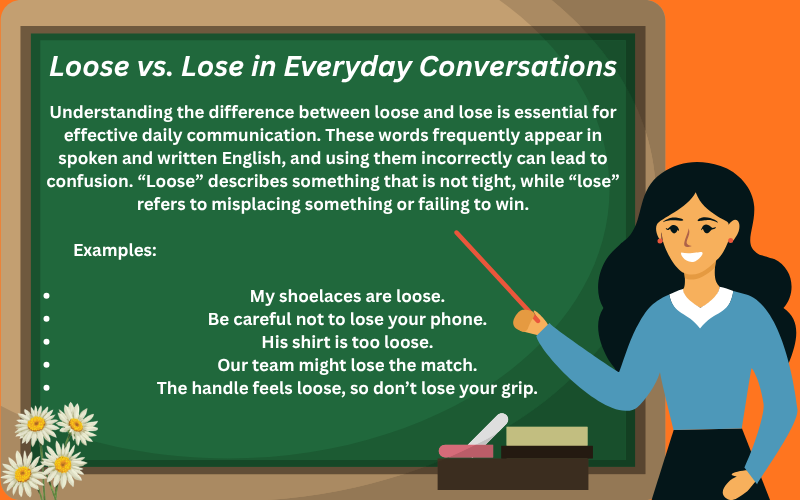
Understanding the difference between loose and lose is essential for effective daily communication. These words frequently appear in spoken and written English, and using them incorrectly can lead to confusion. “Loose” describes something that is not tight, while “lose” refers to misplacing something or failing to win.
Examples:
- My shoelaces are loose.
- Be careful not to lose your phone.
- His shirt is too loose.
- Our team might lose the match.
- The handle feels loose, so don’t lose your grip.
For More: LYK Meaning in Text
🔹 Loose vs. Lose in Academic and Professional Writing
Using loose and lose correctly is crucial in academic and professional settings. Errors involving these words can affect credibility and create misunderstandings in formal documents, emails, and reports.
Examples:
- Ensure that no bolts are loose before operating the equipment.
- The company cannot afford to lose valuable clients.
- Wear loose clothing for comfort during long shifts.
- She worked hard to avoid losing the scholarship.
- A loose argument may cause you to lose marks in an exam.
🔹 Common Idioms and Expressions Using Loose and Lose
Both words appear in widely used English idioms and expressions, enhancing fluency and vocabulary.
Examples:
- Loose Ends: Unfinished tasks.
She tied up all the loose ends before leaving. - On the Loose: Free or escaped.
The suspect is still on the loose. - Lose Track of Time: To forget the time.
I lose track of time while reading. - Lose Heart: To become discouraged.
Don’t lose heart after failure. - Lose Your Temper: To become angry.
He tends to lose his temper easily.
🔹 Loose vs. Lose in Digital Communication and Social Media
In fast-paced digital communication, confusion between loose and lose is common due to typing errors and autocorrect mistakes. Correct usage enhances credibility online.
Examples:
- ❌ I don’t want to loose this opportunity.
✅ I don’t want to lose this opportunity. - ❌ My jacket feels too lose.
✅ My jacket feels too loose. - Don’t lose your login password.
- These sweatpants are comfortably loose.
- We might lose the game tonight.
🔹 Tips to Remember the Difference Between Loose and Lose
Remembering the distinction between loose or lose becomes easy with simple memory tricks.
Easy Memory Tricks:
- Loose has two “O’s”—representing extra space.
- Lose has one “O”—you’ve lost an “O.”
- Loose describes, while lose shows action.
- Loose rhymes with “moose.”
- Lose rhymes with “choose.”
Examples:
- My ring is too loose.
- I don’t want to lose my ring.
- The knot is loose.
- Try not to lose the rope.
- His grip became loose, causing him to lose control.
🔹 Loose vs. Lose in Digital Communication and Social Media
These words are often confused in online conversations due to fast typing and autocorrect errors. Using the correct form improves clarity and professionalism.
Examples:
- Don’t lose your password.
- This hoodie feels loose.
- We might lose the game tonight.
- Her sweater looks loose and comfortable.
🔹 Loose vs. Lose in Academic and Professional Writing
Correct usage is essential in formal communication.
Examples:
- Ensure that no bolts are loose before operating the machine.
- The company cannot afford to lose its reputation.
- Wear loose clothing for comfort during travel.
- The organization may lose valuable clients.
🔹 Real-Life Conversation Examples
Example 1:
Friend: Your watch looks loose.
You: Yes, I need to tighten it.
Example 2:
Coach: Don’t lose focus during the match.
Player: I won’t!
Example 3:
Customer: These shoes feel loose.
Shopkeeper: Let me get you a smaller size.
Example 4:
Parent: Don’t lose your school ID.
Child: I’ll keep it safe.
🔹 Why People Confuse Loose and Lose
These words are commonly mixed up because:
- They look similar in spelling
- They sound alike in pronunciation
- Typing errors occur frequently
- Autocorrect sometimes replaces them incorrectly
- Many learners are unfamiliar with their grammatical roles
Understanding their differences helps eliminate confusion.
📈 Why People Search “Loose or Lose?”
People frequently search for this keyword because:
- It is a common grammar mistake
- Students and writers want clarity
- It appears frequently in exams and assignments
- Professionals seek accurate communication
- Content creators aim to improve writing skills
🎯 Should You Use Loose or Lose?
👉 Use Loose when describing something that is not tight.
👉 Use Lose when referring to misplacing something or failing.
👉 Always check the context before using either word.
👉 Correct usage enhances clarity and credibility.
See Also: SFS Meaning in Text
FAQs
What is the difference between loose and lose?
Loose means not tight or firmly fixed, while lose means to misplace something, no longer have it, or fail to win.
Is it loose or lose a game?
The correct phrase is “lose a game.” For example, “We could lose the game if we stop trying.”
Is it loose or lose weight?
The correct phrase is “lose weight.” For example, “She wants to lose weight through regular exercise.”
What does loose mean?
Loose means something is not tight, firmly attached, or controlled. For example, “The button is loose.”
What does lose mean?
Lose means to misplace something, no longer have something, or fail to win. For example, “I don’t want to lose my phone.”
Is loose a verb?
No. Loose is mainly an adjective, although it can also work as a verb in less common contexts. In everyday English, you will most often use it to describe something that is not tight.
Is lose a verb?
Yes. Lose is a verb. You can use it when you misplace something, stop having something, or fail to win.
How can I remember loose vs lose?
Think of the extra “o” in loose as giving the word more space. Loose means not tight, while lose means something is gone or no longer yours.
Is “loose your mind” correct?
No. The correct phrase is “lose your mind.” Here, lose means to stop being calm or rational.
Is “loose weight” correct?
No. The correct phrase is “lose weight.” Use lose because weight is something you want to reduce or no longer carry.
Conclusion
Loose or lose may look like a small spelling issue, but the two words have clearly different meanings. Loose describes something that is not tight, secure, or firmly attached, while lose describes misplacing something, no longer having it, or failing to win.
A simple way to remember the difference is to focus on the extra “o” in loose. The word has more room in it, which can remind you of something that is not tight. Lose has one fewer “o” and works as a verb.
Once you learn these basic meanings, common phrases become much easier to recognize. You lose a game, lose your keys, and lose weight, but you wear loose clothes and deal with a loose button.
When you are unsure which word to choose, look at the role it plays in your sentence. If you are describing something that is not tight, choose loose. If something has gone missing or you fail to keep or win something, choose lose.