
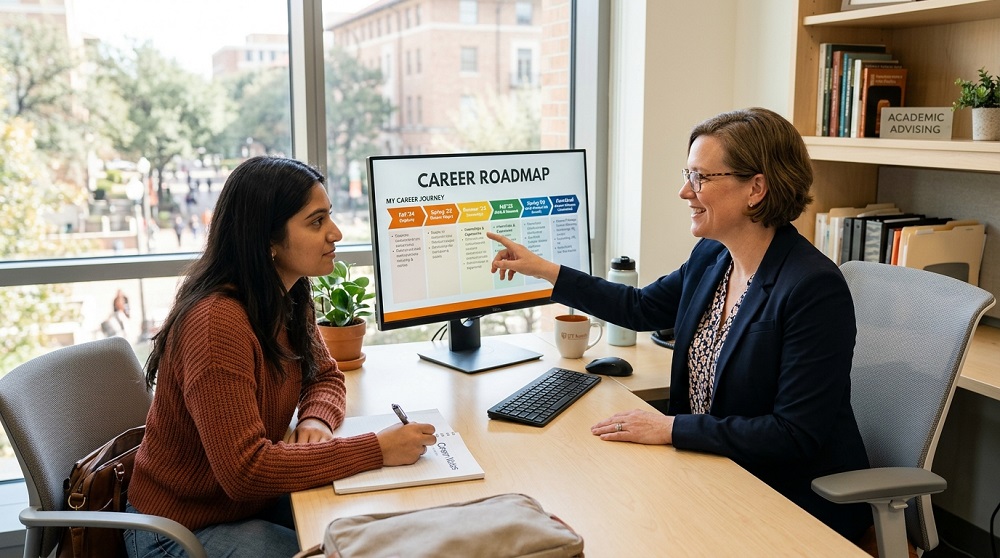
The transition from secondary education to university marks one of the most consequential forks in a young adult’s life path. Selecting a college major is frequently presented as an all-or-nothing decision—a binding commitment that dictates one’s professional identity, socioeconomic trajectory, and daily happiness for decades to come. Faced with glossy campus brochures, parental expectations, and hundreds of potential academic tracks, students often experience intense decision paralysis.
Yet choosing a college major does not require gazing into a crystal ball or locking yourself into an inescapable corner. Rather than viewing an academic major as an unyielding life sentence, forward-thinking students treat it as a strategic launchpad: an environment to cultivate high-value competencies, build durable networks, and develop intellectual agility. By systematically balancing personal strengths, genuine curiosities, and labor market realities, you can select an academic discipline that aligns with your professional aspirations and adapts to an evolving global economy.
1. Conducting Rigorous Self-Assessment: Aptitude vs. Passion
Before examining job boards or starting salary indexes, an effective major search begins with honest internal reflection.
Dissecting Natural Strengths and Working Styles
A widespread misconception in career guidance is that passion alone should dictate your life path. While enthusiasm provides essential fuel, sustainable career fulfillment requires aptitude—a natural alignment between how your mind works and what a discipline demands.
Take inventory of how you solve problems and process information:
- Do you thrive when manipulating quantitative data, uncovering logical inconsistencies, and solving concrete puzzles?
- Do you draw energy from interpersonal communication, persuasive debate, and synthesizing qualitative human perspectives?
- Do you prefer solitary, deep-focus analytical tasks, or do you flourish in collaborative, team-oriented environments?
Excelling in coursework and career environments requires working in harmony with your cognitive strengths. A field that constantly works against your natural inclinations quickly becomes an uphill struggle, regardless of how lucrative or prestigious it might appear from the outside.
Differentiating Fleeting Hobbies from Sustainable Careers
Enjoying an activity as a casual hobby does not necessarily mean you will enjoy doing it as a $40\text{- to }50\text{-hour}$ weekly vocation. For instance, an enthusiasm for playing video games does not automatically translate into a passion for software development, which requires thousands of hours debugging intricate code.
Look past the surface appeal of a subject and examine the day-to-day realities of its professional practitioners. Does the foundational work—reading legal briefs, running wet-lab assays, reconciling balance sheets, or drafting project proposals—spark your curiosity? If you cannot tolerate the mundane, daily mechanics of a discipline, it is unlikely to sustain long-term career satisfaction.
2. Mapping College Majors to Labor Market Realities
Higher education represents a major financial and temporal investment. Assessing how specific degree tracks intersect with economic opportunity protects your return on investment.
Direct-Track vs. Transferable-Skill Majors
College majors generally fall along a spectrum between specialized vocational pathways and broad conceptual fields:
- Direct-Track Majors: Disciplines such as nursing, mechanical engineering, computer science, and accounting prepare students for specific licensure exams and defined entry-level roles. These degrees offer clear recruitment pipelines, predictable career milestones, and strong initial compensation.
- Transferable-Skill Majors: Fields in the humanities, social sciences, and liberal arts—such as philosophy, political science, history, and communications—do not funnel into a single job title. Instead, they cultivate high-order transferable skills: complex reading comprehension, clear written argumentation, critical research analysis, and ethical reasoning.
Understanding this distinction clarifies your educational strategy. Direct-track majors demand early technical mastery, whereas transferable-skill majors require students to be proactive about acquiring technical internships and practical credentials alongside their coursework.
Researching Industry Trajectories and Compensation Floors
While passion should guide your interests, economic viability cannot be ignored. Research labor market trends using objective data sources, such as the Bureau of Labor Statistics (BLS) or institutional career outcome reports:
- What is the median entry-level compensation for graduates in this field (e.g., evaluating salary ranges like $\$45,000\text{ to }\$70,000$)?
- What is the projected $10\text{-year}$ growth rate for related occupations compared to the national average?
- Does entry into this industry require expensive graduate school or professional certifications ($2\text{ to }4\text{ additional years}$ of study) to achieve financial independence?
Evaluating these metrics enables you to take on student loan obligations with realistic, data-informed repayment plans.
3. Testing Hypotheses Before Committing
Declaring a major should never rely on abstract guesswork; it should be the culmination of targeted, experiential testing.
Auditing Introductory Classes Across Disciplines
Most colleges do not require students to formally declare a major until the end of their second year. Use your general education prerequisites strategically. Rather than selecting the easiest elective to fill a timeslot, enroll in rigorous introductory surveys in areas that intrigue you—such as microeconomics, introductory Python programming, cognitive neuroscience, or international relations. Pay attention to how you feel during lectures: Are you eager to explore assigned readings, or are you merely counting down the minutes until class concludes?
Conducting Informational Interviews and Job Shadowing
One of the most underutilized resources available to undergraduates is the institutional alumni network. Reach out to alumni working in your target industries via professional networking platforms for brief, $15\text{-minute}$ informational interviews. Ask practical questions:
- “What does a typical Tuesday afternoon look like in your role?”
- “Which skills from your college major do you actually rely on daily?”
- “If you were in my shoes today, what courses or internships would you prioritize?”
Firsthand accounts from working professionals reveal the unfiltered day-to-day reality of a career, cutting through idealized corporate marketing.
4. Strategic Academic Structuring: Combining Depth and Breadth
Modern employers rarely seek one-dimensional specialists; they seek adaptable professionals who combine specialized depth with versatile problem-solving breadth.
The “T-Shaped” Skillset: Minors and Dual Specializations
Rather than treating your major as your sole academic identity, construct a complementary academic portfolio. A “T-shaped” professional possesses deep knowledge in one vertical discipline, supported by a horizontal foundation of broad, interdisciplinary competencies.
Pairing distinct fields creates a distinctive professional advantage:
- An English or History major paired with a Minor in Data Science produces a communicator capable of translating complex quantitative findings into compelling narratives.
- A Biology major combined with a Minor in Business Administration prepares a graduate for healthcare management, biotechnology venture capital, or pharmaceutical logistics.
- A Fine Arts major paired with Computer Science provides an ideal foundation for modern UI/UX design and video game architecture.
The Major Does Not Equal the Destination
It is essential to remember that your major is not your destiny. Research consistently demonstrates that over $70\%$ of college graduates work in fields unrelated to their undergraduate degree within ten years of graduation. The labor market does not buy a degree title; it hires capabilities: communication clarity, grit, analytical rigor, technical competence, and collaborative reliability.
Conclusion: Focusing on Direction Over Destination
Choosing a college major is not a final destination; it is an educated hypothesis about where your interests and the needs of the world intersect. Do not pressure yourself to outline the next four decades of your life before your sophomore year of college. Instead, focus on taking the next logical step that expands your intellectual capacity, provides marketable skills, and preserves your options. By combining honest self-assessment, practical market research, and active real-world exploration, you can choose a major that grounds your academic journey and propels you toward a dynamic, rewarding career.