Whichever is used when there are limited or specific options to choose from, while whatever means anything at all with no limits.
Use whatever for open and unlimited choices (e.g., “Do whatever you want”). Use whichever when options are already mentioned or few (e.g., “Choose whichever color you like from these two”). “Whatever” is more casual and flexible, whereas “whichever” sounds more precise and polite.
Many English learners get confused between whichever and whatever. These two words look quite similar and both start with “wh-”, yet they are not interchangeable. Using the wrong word can make your sentence sound slightly unnatural, less precise, or even unprofessional in some situations.
In this comprehensive and detailed guide, we will break down the exact meanings of whichever and whatever, highlight their key differences, explain important grammar rules, provide plenty of real-life examples, discuss tone and formality, and show common mistakes that learners often make. Whether you are writing emails, chatting with friends, preparing for exams, or improving your overall English skills, this article will help you understand and use both words correctly and confidently.
Table of Contents
- What Does “Whatever” Mean?
- What Does “Whichever” Mean?
- Key Differences Between Whichever and Whatever
- Grammar Rules and Sentence Structures
- Whichever vs Whatever: Side-by-Side Examples
- Tone and Formality – Casual vs Professional Use
- Additional Uses and Contexts
- Common Mistakes Learners Make
- Whichever and Whatever in Emails and Writing
- Frequently Asked Questions (FAQ)
- Conclusion
What Does “Whatever” Mean?
“Whatever” is one of the most flexible words in English. It primarily means “anything at all” or “no matter what”. This word indicates complete freedom with no restrictions, limits, or specific boundaries on the choice or situation. It gives a sense of generality and openness, allowing the listener or reader to understand that any possibility is acceptable.
In many cases, “whatever” can also express indifference or a relaxed attitude, especially in casual conversations. It works perfectly when the options are completely open-ended, unknown, or unlimited. This makes it very useful in everyday speaking and writing where flexibility is needed.
Examples:
- You can eat whatever you want for dinner tonight — there are no restrictions at all.
- Whatever happens in life, staying positive always helps you move forward.
- She is ready to do whatever it takes to achieve her dreams and career goals.
- “Just bring whatever snacks you have at home; anything is perfectly fine.”
- Whatever the weather is like tomorrow, we will still go for the planned trip.
What Does “Whichever” Mean?
“Whichever” is more specific and precise compared to “whatever”. It means “any one from a limited or already known set of options”. This word points to a selection from things that have been mentioned earlier or are clearly available in the given context. It is commonly used when the speaker wants to highlight a choice within a defined group without preferring one over another.
“Whichever” makes the sentence sound thoughtful and exact because it refers to known or restricted choices. It is especially helpful in situations where only a few options exist, and you are giving permission to pick any one of them.
Examples:
- We have two different routes to the office. Take whichever is less crowded during rush hours.
- Choose whichever dress looks best on you from these four beautiful options.
- Whichever team scores more goals in the final will win the match without any doubt.
- You can pick whichever book interests you the most from the library shelf.
- Whichever date and time suits you better, we will schedule the important meeting accordingly.
Key Differences Between Whichever and Whatever
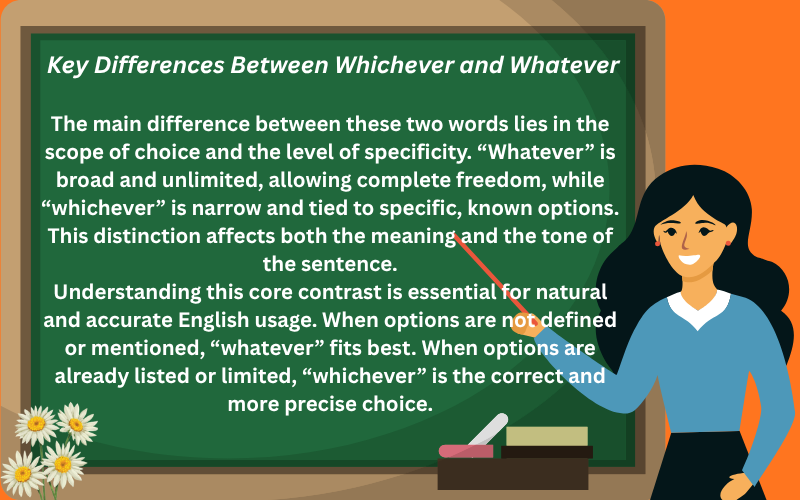
The main difference between these two words lies in the scope of choice and the level of specificity. “Whatever” is broad and unlimited, allowing complete freedom, while “whichever” is narrow and tied to specific, known options. This distinction affects both the meaning and the tone of the sentence.
Understanding this core contrast is essential for natural and accurate English usage. When options are not defined or mentioned, “whatever” fits best. When options are already listed or limited, “whichever” is the correct and more precise choice.
Examples:
- Unlimited choice: “Do whatever makes you happy in your free time.”
- Limited choice: “Choose whichever shirt fits you better from these two.”
- General situation: “Buy whatever you need from the supermarket.”
- Specific situation: “From these two laptops, buy whichever has better performance.”
Grammar Rules and Sentence Structures
Both “whichever” and “whatever” function as relative pronouns or determiners. They can introduce dependent clauses and connect ideas smoothly. However, their grammar patterns differ slightly depending on the context and the level of specificity required.
“Whatever” is often used alone or directly with a verb to express broad generality. It can start a clause without needing an immediate noun after it. On the other hand, “whichever” frequently appears with a noun when referring to a specific group of items. Both words usually take a singular verb even when they seem to refer to multiple possibilities.
These rules help maintain clarity, natural flow, and grammatical accuracy in both spoken and written English.
Examples:
- Whatever you decide to do next will be respected by everyone in the group.
- Whichever option you select from the given list, the final result will still be successful.
- Whatever problem arises, we have a strong team to solve it quickly.
- Whichever method you prefer, make sure it is efficient and cost-effective.
Whichever vs Whatever: Side-by-Side Examples
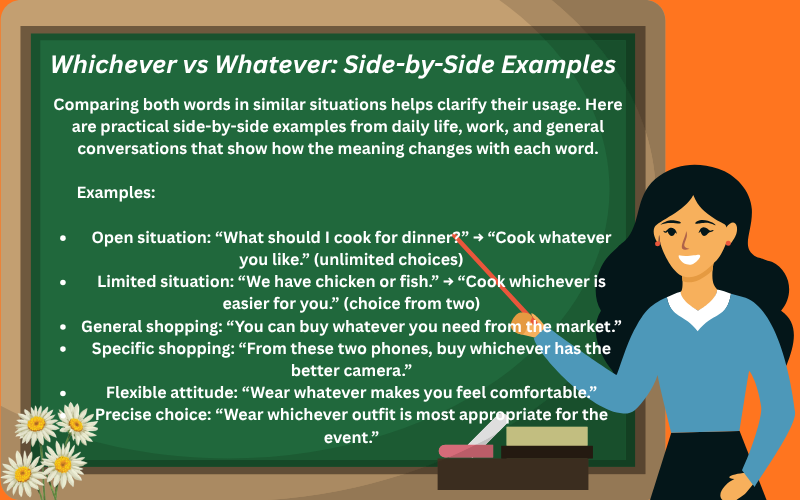
Comparing both words in similar situations helps clarify their usage. Here are practical side-by-side examples from daily life, work, and general conversations that show how the meaning changes with each word.
Examples:
- Open situation: “What should I cook for dinner?” → “Cook whatever you like.” (unlimited choices)
- Limited situation: “We have chicken or fish.” → “Cook whichever is easier for you.” (choice from two)
- General shopping: “You can buy whatever you need from the market.”
- Specific shopping: “From these two phones, buy whichever has the better camera.”
- Flexible attitude: “Wear whatever makes you feel comfortable.”
- Precise choice: “Wear whichever outfit is most appropriate for the event.”
See Also: Loose or Lose? Meaning, Differences, Uses & Examples
Tone and Formality – Casual vs Professional Use
“Whatever” generally carries a casual and relaxed tone. It is very common in friendly conversations, texting, and informal settings. However, in some cases, it can come across as indifferent or even slightly dismissive, especially when used as a short reply like “Whatever!”
In contrast, “whichever” has a neutral and polite tone. It sounds more professional, thoughtful, and exact, which makes it a safer and better choice in formal writing, business communication, and academic contexts where clarity and respect matter.
Examples:
- Casual: “I don’t mind, do whatever you want this weekend.”
- Professional: “Please choose whichever option is more convenient for the client.”
- Short reply (casual): “Whatever!” (can sound rude)
- Polite version: “Whichever one you prefer is fine with me.”
Additional Uses and Contexts
Beyond basic choices, both words appear in various other contexts such as conditional sentences, relative clauses, and expressions of indifference or permission. “Whatever” is often seen in motivational or general statements, while “whichever” frequently appears in decision-making scenarios, offers, and comparisons.
In longer texts or conversations, these words help connect ideas smoothly and add flexibility without losing meaning. They are also useful in creative writing, storytelling, and everyday problem-solving situations where options need to be discussed.
Examples:
- Conditional: Whatever the difficulty level is, keep practicing every day.
- Decision-making: Whichever plan gets more votes will be implemented next month.
- Indifference: “Whatever you say, I’m okay with the decision.”
Common Mistakes Learners Make
One of the most frequent mistakes is using “whatever” when the options are clearly limited and already mentioned in the conversation. Another common error is applying “whichever” in completely open or unlimited situations where no specific choices exist. Some learners also add unnecessary words, making sentences wordy and less natural.
To avoid these issues, always evaluate the context first: check whether the choices are limited and known (use whichever) or completely open with no boundaries (use whatever). Paying close attention to context significantly improves accuracy and confidence in English usage.
Examples of Mistakes & Corrections:
- Wrong: We have red and blue. Take whatever you like. Correct: We have red and blue. Take whichever you like.
- Wrong: Eat whichever you want. (no options mentioned) Correct: Eat whatever you want.
Whichever and Whatever in Emails and Writing
In professional emails, reports, articles, and formal writing, “whichever” usually creates a better and more polished impression due to its precise and respectful tone. “Whatever” can still be used effectively when you want to express complete flexibility or openness, but it should be applied carefully to prevent sounding too casual or indifferent.
Using the correct word in written communication helps convey clarity, confidence, and professionalism to the reader.
Examples:
- Email: “Submit the report whatever time you finish it.” (acceptable but casual)
- Better: “Submit the report using whichever format is easier for you.”
If you enjoyed reading this article, you might also like the ones below.”
- Passed or Past: What’s the Difference? Easy Guide
- Separate or Seperate: Which Spelling Is Correct?
- Dreamt or Dreamed: Which One Is Correct? Full Guide
- Ageing or Aging – What’s the Difference and Which to Use?
- Heros or Heroes – Which Spelling Is Correct? Guide
FAQ
1. What is the main difference between whichever and whatever?
“Whatever” means anything at all with no limits, while “whichever” means any one from a limited or known set of options.
2. Can whichever and whatever be used interchangeably?
Not always. They are similar in some situations but differ in scope, so they are not completely interchangeable.
3. Is “whatever” rude in formal English?
It can sound rude or careless if used as a short reply. In formal contexts, “whichever” is usually a safer choice.
4. What is the difference in negative sentences?
“Whatever” is more commonly used in negative constructions, while “whichever” works when limited choices are involved.
5. What is the difference between whatever, whichever, and whatsoever?
“Whatsoever” adds strong emphasis in negative sentences. “Whatever” is general, and “whichever” is for specific choices.
6. How can I remember the difference easily?
Limited or known choices = whichever. Unlimited or open choice = whatever.
7. Can we use “whichever” without mentioning the options?
It is possible but sounds less natural. It still implies some context of selection.
8. Which one is better for professional emails?
“Whichever” usually sounds more polished, precise, and professional.
9. Is “whatever” acceptable in formal writing?
Yes, but only when the context is open and unlimited. In most formal cases, prefer “whichever”.
10. Which word is more common in daily speaking?
“Whatever” is more frequently used in casual daily conversations and texting.
See Also: Blond or Blonde: What’s the Difference? Easy Guide
Conclusion
Mastering the difference between whichever and whatever will make your English sound more natural, precise, and confident. Remember to use whatever for unlimited choices and whichever when options are limited or already known.
Observe these words in books, articles, movies, and real conversations. The more you notice correct usage, the easier it becomes to apply them naturally in your own speaking and writing.