If you have seen swap vs swop and wondered which spelling you should use, the answer depends largely on where you are writing. Both forms exist in English, but swap is much more common, especially in American English and general international usage.
“Swap” means to exchange one thing for another. You can swap clothes with a friend, swap seats, or swap one item for another.
“Swop” has the same basic meaning, but it is mainly associated with British English. It appears less often than “swap,” so many readers may find “swap” more familiar.
For most everyday writing, swap is the safer choice. If you follow British English and your context uses “swop,” that spelling can also be acceptable.
Quick Answer
Swap and swop both mean to exchange or trade something, but swap is the more common spelling.
| Word | Meaning | Usage |
|---|---|---|
| Swap | To exchange something | Common in American and British English |
| Swop | To exchange something | Less common, mainly British English |
Simple rule: Use swap in most situations. Use swop if you specifically follow a British English style that accepts the spelling.
Related Guide: Simpler or More Simple
Quick Overview of Swap vs Swop
| Word | Meaning | Usage | Status | Example |
| Swap | To exchange one thing for another | Modern English worldwide | Correct and Preferred | Let’s swap seats. |
| Swop | To exchange one thing for another | Primarily British English (dated) | Rare and Archaic | They swopped books at school. |
What Does “Swap” Mean?
The word “swap” means to exchange one item, service, or position for another. It is widely used in everyday conversations, business transactions, and digital contexts.
Examples of “Swap”
- Let’s swap seats for a better view.
- They decided to swap gifts during the party.
- Can we swap shifts tomorrow?
- She swapped her dress for a new one.
- He swapped his old phone for a newer model.
What Does “Swop” Mean?
The term “swop” is an alternative spelling of “swap” that was historically used in British English. Although still recognized, it is rarely used in modern writing and is generally considered outdated.
Examples of “Swop”
- The children swopped their toys at school.
- He swopped his sandwich for a slice of pizza.
- They swopped places during the game.
- She swopped her ticket with a friend.
- The players swopped jerseys after the match.
Key Differences Between Swap and Swop
| Feature | Swap | Swop |
| Meaning | To exchange something | Same as “swap” |
| Spelling Preference | Modern and universal | Old-fashioned variant |
| Usage | Common worldwide | Rare and dated |
| Acceptance | Standard in modern English | Limited to historical or British usage |
| Popularity | Highly popular | Uncommon |
Historical Origin of Swap and Swop
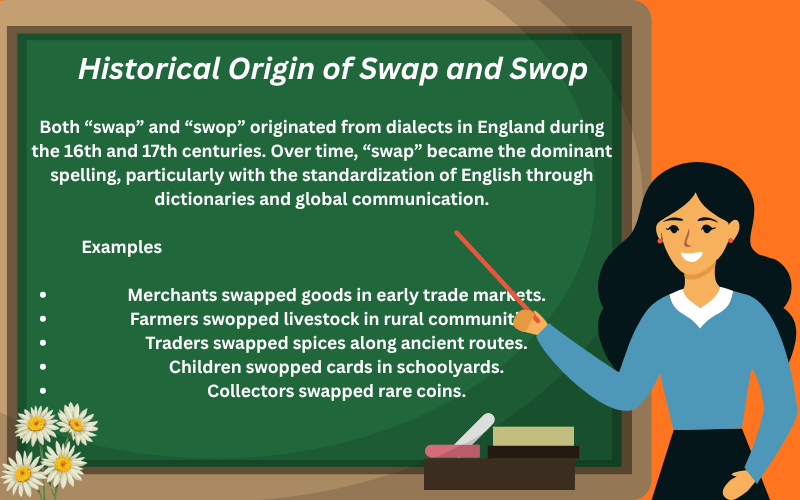
Both “swap” and “swop” originated from dialects in England during the 16th and 17th centuries. Over time, “swap” became the dominant spelling, particularly with the standardization of English through dictionaries and global communication.
Examples
- Merchants swapped goods in early trade markets.
- Farmers swopped livestock in rural communities.
- Traders swapped spices along ancient routes.
- Children swopped cards in schoolyards.
- Collectors swapped rare coins.
Visit Also: Whichever vs Whatever
The Origin and Etymology of “Swap” and “Swop”
The words “swap” and “swop” originated in England during the 16th century, both meaning to exchange one thing for another. Linguists believe these terms evolved from regional dialects used in marketplaces and trade. Over time, “swap” became the standardized spelling, while “swop” gradually fell out of common usage. Today, “swap” is widely accepted across the globe, whereas “swop” is considered archaic or stylistic.
Examples:
- Merchants swapped goods in medieval markets.
- Children swopped toys in old British schoolyards.
- Traders swapped livestock during early trade fairs.
- Collectors swapped rare coins and stamps.
- Villagers swopped produce in rural communities.
Usage of “Swap” and “Swop” in British and American English
Regional preferences have played a significant role in shaping the usage of these spellings. “Swap” is the preferred term in both American and modern British English. In contrast, “swop” was historically used in British English but is now rarely seen in contemporary writing. Most dictionaries and style guides recommend using “swap” in all contexts for clarity and consistency.
Examples:
- American English: Let’s swap phone numbers.
- Modern British English: They swapped seats at the theater.
- Traditional British English: The boys swopped marbles after school.
- Global English: We swapped ideas during the meeting.
- Academic Writing: Students swapped research materials.
Swap vs Swop in British and American English
The primary difference between these spellings lies in regional usage. “Swap” is preferred in both American and modern British English, while “swop” appears mainly in older British texts.
Examples
- American English: Let’s swap numbers.
- British English (modern): Let’s swap numbers.
- Traditional British English: They swopped seats.
- Global English: We swapped ideas during the meeting.
- Modern writing favors “swap” in all contexts.
For More: Ageing or Aging
The Role of “Swap” in Modern Technology and Finance
In today’s digital and financial world, the term “swap” has become increasingly significant. It is commonly used in technology, computing, and economics to describe exchanges of data, assets, or financial instruments. From memory swaps in computers to currency swaps in global markets, the term plays a vital role in modern industries.
Examples:
- Users can swap files between devices instantly.
- Traders engage in currency swaps in international markets.
- Investors participate in interest rate swaps.
- Computers use swap space to manage memory efficiently.
- Gamers swap characters during gameplay.
When to Use “Swap”
Use “swap” in all modern contexts, including academic, professional, and informal communication.
Examples
- Can we swap our assignments?
- They swapped their tickets at the counter.
- She swapped her car for a hybrid model.
- Let’s swap roles for the presentation.
- He swapped dollars for euros.
When to Use “Swop”
Use “swop” only when referring to historical texts, stylistic British usage, or creative writing that reflects traditional language.
Examples
- The boys swopped marbles after school.
- She swopped her bonnet for a new one.
- They swopped stories by the fireplace.
- The characters swopped identities in the novel.
- He swopped letters with his pen pal.
Swap vs Swop in Modern Communication
In today’s digital world, “swap” is the standard spelling used in technology, finance, and everyday interactions.
Examples
- You can swap files online instantly.
- Traders swap currencies in financial markets.
- Users swap data between devices.
- Gamers swap characters during gameplay.
- Investors engage in interest rate swaps.
Common Synonyms and Alternatives to “Swap” and “Swop”
Several words can be used as alternatives to “swap” depending on context. While “swop” is rarely used today, synonyms such as exchange, trade, barter, switch, and substitute provide suitable replacements in both formal and informal communication.
Examples:
- Let’s exchange seats for a better view.
- Farmers barter goods in local markets.
- She switched her schedule with a colleague.
- He traded his car for a newer model.
- The manager substituted one player for another.
Why “Swap” Is Preferred Over “Swop” in Modern English
Language evolves over time, and standardization plays a crucial role in determining accepted spellings. “Swap” has become the dominant form due to its widespread use in education, media, and global communication. Major dictionaries, academic institutions, and style guides endorse “swap” as the correct and modern spelling, making it the preferred choice in professional and everyday writing.
Examples:
- Let’s swap seats before the movie begins.
- She swapped her old laptop for a new one.
- They swapped contact details at the conference.
- The team swapped strategies during halftime.
- He swapped his shift with a coworker.
Common Mistakes with Swap and Swop
| Incorrect Usage | Correct Usage |
| Let’s swop seats. | Let’s swap seats. |
| She swopped her phone. | She swapped her phone. |
| Can we swop numbers? | Can we swap numbers? |
| They swop gifts every year. | They swap gifts every year. |
| He swopped shifts with me. | He swapped shifts with me. |
Tips to Remember the Difference Between Swap and Swop
Helpful Tips
- Swap is the modern and correct spelling.
- Swop is outdated and rarely used.
- Use “swap” in academic and professional writing.
- Avoid “swop” unless referencing historical or British contexts.
- Dictionaries and style guides prefer “swap.”
Memory Trick
Swap = Standard and Widely Accepted Preferred spelling
Swop = Old-fashioned and Obsolete in modern usage
Real-Life Conversation Examples
Example 1
Friend: Can we swap seats?
You: Sure!
Example 2
Colleague: Let’s swap tasks for today.
You: That works for me.
Example 3
Student: Can we swap notes after class?
Friend: Of course.
Example 4
Reader: Do people still use “swop”?
Teacher: Rarely—“swap” is preferred today.
Why People Confuse Swap and Swop
People often mix up these spellings due to:
- Their identical pronunciation.
- Historical British usage.
- Lack of awareness of modern spelling standards.
- Exposure to older literature.
- Typographical errors.
Why People Search “Swap vs Swop”
Users commonly search for this topic to:
- Understand correct spelling.
- Improve grammar and writing skills.
- Learn differences between British and American English.
- Avoid common language mistakes.
- Enhance academic and professional communication.
Should You Use Swap or Swop?
- Use swap in all modern writing.
- Avoid swop unless referencing historical or stylistic contexts.
- Prefer “swap” for global readability.
- Follow modern dictionaries and grammar guides.
- Ensure clarity and professionalism in communication.
See Also: Among vs Amongst
FAQs
Is it swap or swop?
Both spellings can be correct, but swap is far more common. “Swop” is mainly used in British English.
Is “swop” a real word?
Yes. “Swop” is an accepted English spelling meaning to exchange or trade something. However, it is much less common than “swap.”
What is the difference between swap and swop?
They have essentially the same meaning. The main difference is frequency and regional usage. “Swap” is the standard choice in most English writing, while “swop” appears more often in British usage.
Is swap American or British English?
“Swap” is used in both American and British English. It is the more widely recognized spelling.
Is swop British English?
Yes. “Swop” is primarily associated with British English, although many British speakers and writers also use the more common spelling “swap.”
Which spelling should I use in formal writing?
Swap is usually the better choice because readers across different English-speaking regions recognize it easily.
Does swap mean exchange?
Yes. “Swap” means to exchange one thing for another.
Can I use swop in a sentence?
Yes. For example: “They decided to swop seats.” However, “They decided to swap seats” is more common.
Conclusion
When choosing between swap vs swop, both words can describe an exchange, but they do not have equal levels of usage. “Swap” appears much more frequently in everyday English.
“Swop” is not necessarily wrong. It is a less common alternative that you may encounter in British English.
If you want the spelling that most readers will recognize immediately, choose swap.
So, when in doubt, remember this simple rule: swap is the standard and more widely used choice, while swop is a less common British variant.