Cost of utilities, environmental issues and energy savings have become household priorities for homeowners and renters alike. The municipal power grid and home budgets are subjected to heavy continuous demand when it comes to heating, cooling, water heating, and daily electronics.
The good news is that you don’t need to invest a large sum of money to make your home energy efficient – you can make a number of small and easy improvements. Most energy losses are due to small leaks, old habits, and miscalibration of equipment. Simple, affordable changes can be made throughout your home to cut down on your energy bills, reduce your impact on the environment and increase the comfort of your home year-round.
Reduce heating and cooling dynamics in a favorable manner.
Heating and cooling systems use the most energy in the home, and can consume over 50% of the total energy bill on average. Slightly adjusting the climate control delivers immediate benefits.
Install and Program a Smart Thermostat
Manual thermostats depend on people remembering, often keeping the system on full power when no one’s home. Programming or smart thermostats make temperature control automatic. A smart thermostat gets to know your schedule and turns on heating and cooling systems as necessary when you’re away at work or asleep. Turning your thermostat up or down $7^\circ\text{F} – 10^\circ\text{F}$ from the normal setting for 8 hours a day can save you as much as 10% on your yearly heating and cooling costs. When indoors, try to keep it at $68^\circ\text{F}$ while awake and lower it at night while sleeping, in the summer months use the setting of $78^\circ\text{F}$ when at home.
Seal around windows, doors and baseboards
Your HVAC unit is constantly cycling because of the constant escape of conditioned air through tiny cracks and gaps around doors, window sashes, and electrical baseboards. Check for daylight around the outside door frames. Adding adhesive foam around the perimeter of windows and adhesive foam on the sweeps on drafty exterior doors will eliminate air exchange right away. Cable conduits, plumbing lines and other exterior wall penetrations around window trim should be sealed airtight with silicone-latex caulk.
- Upgrade All of the Everyday Fixtures and Control Electrical Draw
Current appliances and electronics use a considerable amount of electricity when not being used. Improvements in this area are easy, low-cost, and cost-effective within months.
Replace all light fixtures with LED fixtures.Switch 100% to LED lighting.
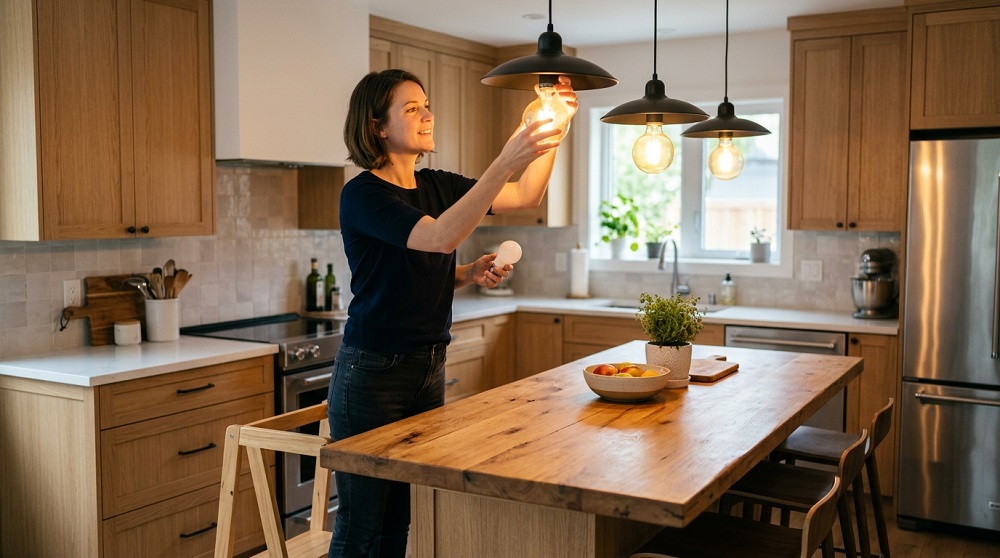
Incandescent bulbs are very inefficient; they convert only $10%$ of the electric power into visible light and the rest is lost as heat. Light-Emitting Diodes (LEDs) have an energy saving of about $75%$ compared to incandescent bulbs and can last up to twenty five times longer. The five most commonly used light fixtures in the home can be replaced with warm-white LED light bulbs, resulting in an immediate savings in electricity consumption and a decrease in heat gain in warm weather.
Use a Smart Power Strip to save Phantom Energy.
Televisions, games, desktop computers, audio soundbars, and many other electronic appliances are in standby mode when they are off. This “phantom load” or “vampire power” adds up to as much as $10%$ to the average residential electric bill. Connect entertainment centers and home-office workstations to smart power strips. When the main device is switched off, these strips automatically switch off peripheral accessories (such as monitors and speakers).
- Tactics for water heating and water conservation
Domestic water heating is usually the second largest energy cost in the home, after space conditioning.
Reduce the temperature of the Water Heater to $120^\circ\text{F}$.
Domestic storage water heaters come from the manufacturer with a setting of an unnecessarily high $140^\circ\text{F}$. This not only raises the risk of scalding at the tap but it also results in high standby heat loss as the tank is constantly keeping the water hot. A $120^\circ\text{F}$ ($49^\circ\text{C}$) hot water heater temperature keeps water hot enough for showers and dishwashers while cutting standby thermal loss up to $5%$ to $10%$ per year.
Use low flow showerheads and aerators.
Water heating is a very energy-intensive process and energy is saved if water is saved. Older showerheads often flow at the rate of more than $2.5\text{ gallons per minute}$ (GPM). WaterSense certified low-flow showerheads (which use $1.5\text{ to }1.8\text{ GPM$$) save up to $30\text{–}50%$ hot water from being used, and do not compromise water pressure. Likewise, bathroom and kitchen faucet aerators with a plug that screws on to the nozzle limit flow rates and add air to the stream to ensure high cleaning power.
Utilize passive climate control.Use passive climate control.
Using natural components in place of mechanical components decreases stress on mechanical systems.
Use Thermal Curtains & Window Coverings
Windows are thermal bridges, letting undesirable outdoor temperatures into the building. Severe solar heat gain can occur through unshaded windows during the peak summer afternoon hours. Medium to heavy curtains or cellular shades block direct sunlight, helping to keep rooms cooler naturally. During the winter, open south-facing window treatments on sunny mornings to benefit from passive solar gain and ensure that the window is closed and insulated at night to reduce the effects of nighttime cooling.
Change Ceiling Fan Rotations Seasonally – Rotations for ceiling fans should be adjusted seasonally.
People are cooled by the convective airflow of ceiling fans, not the room. During summer months adjust fan blades to rotate counter-clockwise at medium to high speed to produce a gentle downward airflow that has a cooling effect on the skin, due to the wind chill. During the winter months, turn the motor around to turn clockwise at low speed to draw cool air up and gently push hot air — which naturally rises towards the ceiling — down into the used living area.
Conclusions: Compounding Rewards With Small Adjustments
Energy efficiency at home doesn’t require a complete transformation or all or nothing. Taking these little steps, one by one, such as sealing air leakage, setting your thermostat, replacing incandescent lights with LED lights, and reducing hot water usage, can help you protect your finances from unpredictable utility costs. These simple practices accumulate into big money savings, and make your house more sustainable and resilient over time.