

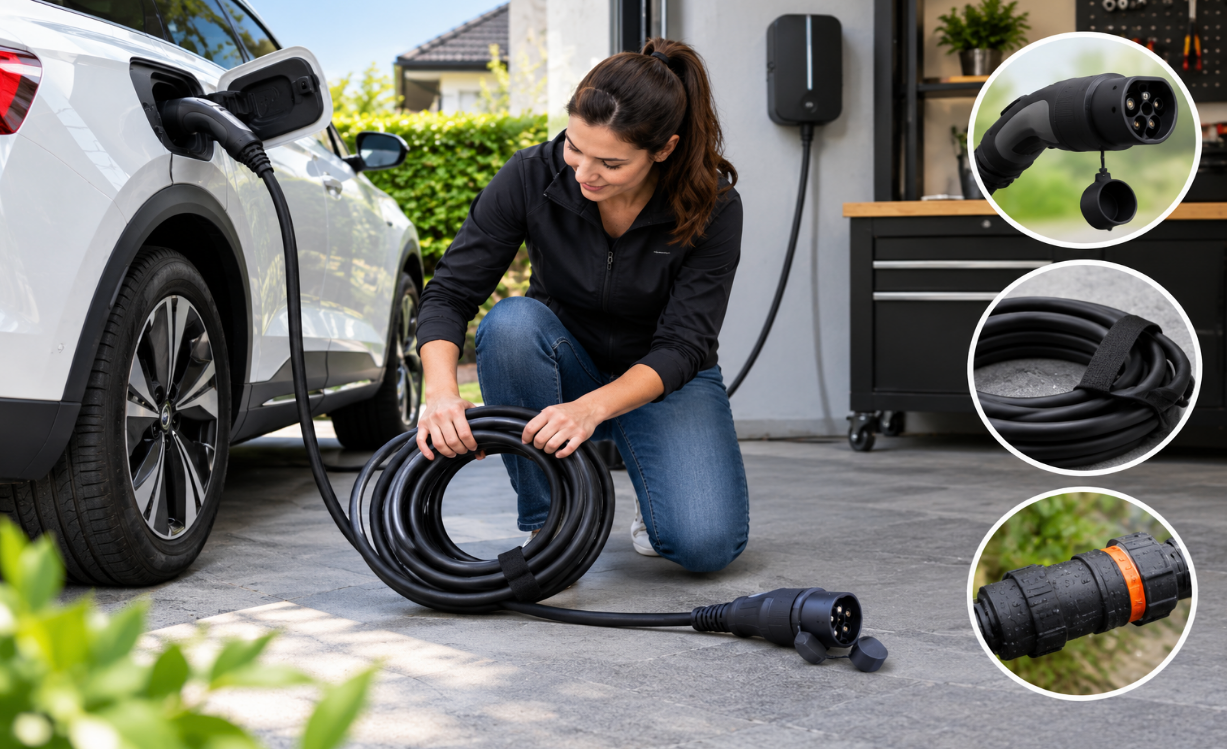
You’ve just switched to an electric vehicle, but the power outlet in your garage is at the back, seven metres away from where you park your car. Or perhaps you’re staying with friends on holiday, with no charging station nearby, and the cable supplied with your vehicle is a little too short. In these situations, it can be tempting to grab the first extension cord you find in the garden shed.
That is precisely what you should avoid. An electric car draws a high current for many hours while charging, something most household extension cords are not designed to handle. If you have no other option, you need to choose a heavy-duty extension cord for an electric car carefully and use it under the right conditions. Here are the key criteria to consider and the pitfalls to avoid.
Why an Ordinary Extension Cord Can Be a Problem
A hair dryer or vacuum cleaner may consume a lot of power, but usually only for a few minutes. An electric car plugged into a household outlet, on the other hand, can draw 8 to 10 amps or even more for ten, twelve or fifteen hours at a time. This extended duration makes all the difference.
A high current passing through an undersized cable generates heat. Over a short period, this may not be a serious issue. However, over an entire night, heat can build up, the cable insulation can soften, and the plug contacts can deteriorate, creating a genuine risk of melting or fire. The weakest points are almost always the connections: the plug, the female socket and the connection between them.
This is why many car manufacturers discourage or even explicitly prohibit the use of extension cords for charging in their vehicle manuals. Before purchasing anything, take the time to check what your car’s manual says. If an extension cord is permitted, it should be treated as a temporary solution rather than a permanent installation.
The Criteria That Really Matter
A suitable extension cord essentially extends the charging cable supplied with your electric vehicle, the one designed to connect to a household outlet. It must therefore provide at least equivalent performance. Here is what to look for on the label.
Conductor Cross-Section
This is the number-one criterion. A standard 3 × 1.5 mm² extension cord is not sufficient. You need at least a 3 × 2.5 mm² cable capable of supporting 16 amps continuously. The larger the conductor cross-section, the less heat the cable generates and the lower the voltage drop over its length.
Length
Keep it as short as possible. Every additional metre increases resistance and, consequently, heat generation. Measure the exact distance you need rather than buying a 25-metre model “just in case”. In most situations, 5 to 10 metres is more than enough.
Outer Sheath
For outdoor use or in a garage, choose a rubber cable sheath such as H07RN-F. It is resistant to water, UV exposure and oils, and remains flexible even in cold weather. Lightweight PVC sheaths, commonly found on indoor extension cords, can harden and crack when exposed to outdoor conditions.
Protection Rating
The female socket, where the vehicle’s charger plugs in, must be protected against moisture. An IP44 rating is the minimum for a sheltered connection, while IP54 or higher is preferable if the connection remains outdoors in the rain. A protective flap or enclosure is a valuable additional feature.
Plugs, Sockets and Standards
Look for high-quality plugs and sockets with sturdy contacts and clearly indicated NF or CE markings. Be cautious of unbranded models sold online at extremely low prices: these are often the products where the actual wire cross-section does not match the advertised specifications.
Safe Practices When Using an Extension Cord
Even the best extension cord on the market can become dangerous if used incorrectly. A few simple rules can make a significant difference.
- Always unwind the cable completely. A cable left coiled cannot dissipate heat properly and can behave like a heating coil. Many cable reel melting incidents occur for this reason.
- Never connect a second extension cord or a power strip. Every additional connection creates another potential hot spot.
- Use a properly maintained, grounded outlet protected by a 30 mA residual-current device (RCD). An old socket with loose contacts can overheat regardless of the quality of the extension cord.
- Reduce the charging current if your portable charger allows it. Charging will take longer, but the setup may be safer when the equipment and installation are suitable for the reduced current.
- Check the plug and socket after an hour of charging and again the following morning. Slight warmth may be normal, but if either component becomes uncomfortably hot, disconnect the equipment and stop using that setup.
- Keep connections out of puddles and make sure the cable cannot be crushed by a door or a wheel.
What About a Permanent Charging Solution?
If you charge your car in the same place every day, an extension cord is clearly not the right long-term solution. Several alternatives are available and may be less expensive than you think.
The first option is to have a reinforced socket, such as a Green’Up outlet, installed where you park your vehicle. Designed to handle higher currents over extended periods, it can provide faster and safer charging than a conventional household outlet. Installation by an electrician generally takes a few hours.
The second option is a wall-mounted charging station, commonly known as a wallbox. It offers significantly higher power output, typically around 7 kW for a single-phase installation, and can considerably reduce charging times. Financial incentives may be available depending on your country and circumstances, so check what applies before arranging installation.
Finally, if you are charging at a public or dedicated charging station and only the Type 2 cable is too short, do not attempt to extend it. Simply purchase a longer Type 2 charging cable, such as a 7- or 10-metre model, that is approved for the intended use. This is the simplest and by far the safest solution.
Key Takeaways
Choosing an extension cord for an electric car should never be a matter of guesswork. A conductor cross-section of at least 2.5 mm², the shortest practical length, a rubber outer sheath, a moisture-protected socket and recognised certification markings are important criteria for reducing risks. Above all, check whether your vehicle manufacturer permits this type of setup.
A carefully selected and properly used heavy-duty extension cord may serve as a temporary solution while travelling or waiting for electrical work to be completed. However, for everyday electric vehicle charging, nothing replaces a dedicated installation carried out by a qualified professional. It is faster, more convenient and, above all, much safer for your home.
If you are unsure, a qualified electrician can recommend the solution best suited to your electrical installation.




1 thought on “How to Choose a Heavy-Duty Extension Cord for an Electric Car”