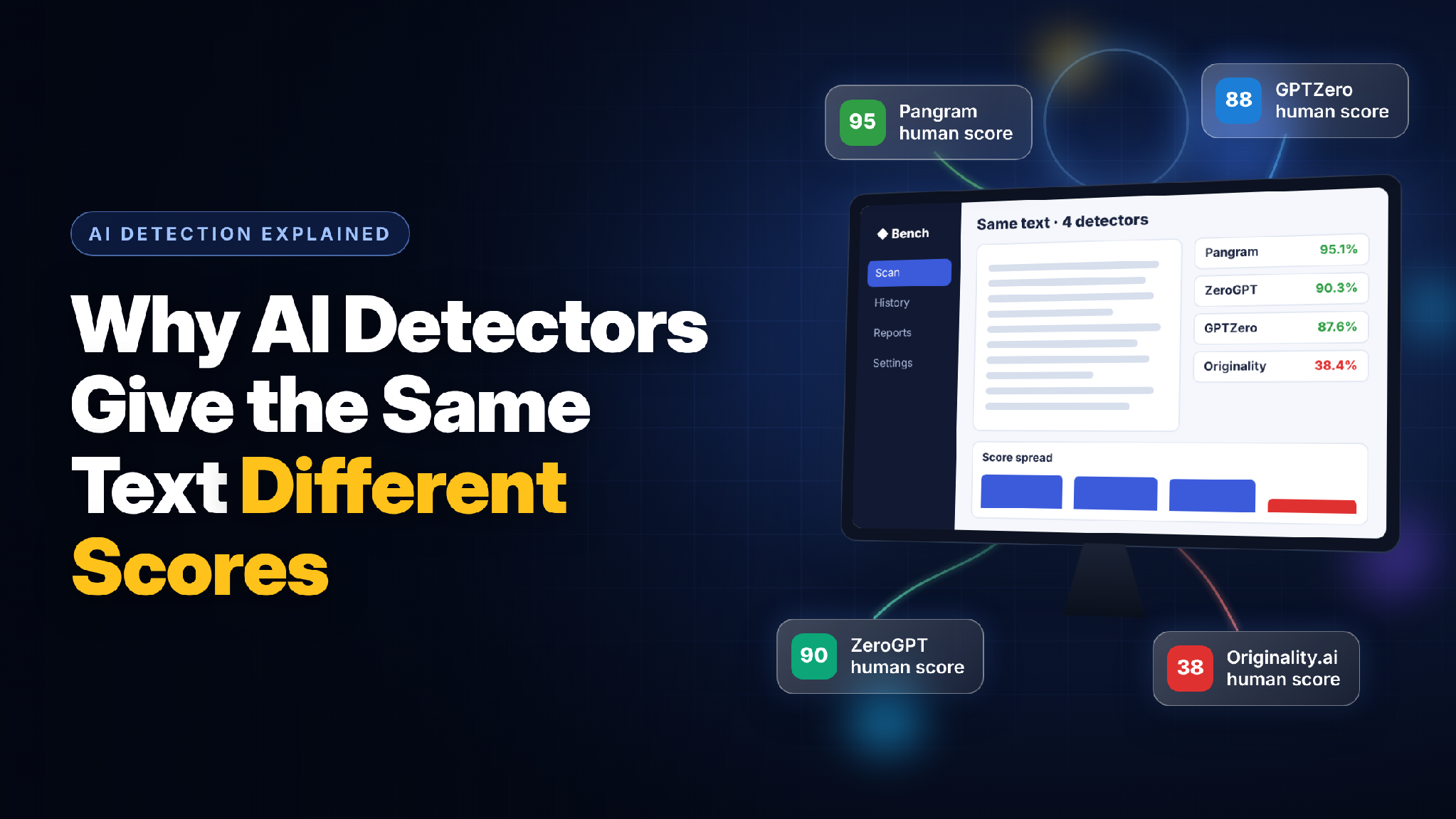
Paste one essay into four AI detectors and you might get four different answers. Not small differences, either. Think 95% human from one tool and 38% from another, on exactly the same words.
If you’ve ever had that happen, you probably assumed one of the tools was broken. Usually none of them is. They’re measuring different things, in different ways, against different thresholds. Once you see how, the disagreement stops looking random, and you can decide which numbers to trust.
A Real Example of Four Detectors Disagreeing
Same 60 texts, four verdicts
Phrasly’s November 2026 Benchmarks offers a clean illustration. It rewrote 60 fresh AI texts with its Lite model, then sent each rewrite to four detectors through their APIs. Every detector saw the same 60 outputs.
The average human scores came back as:
- Pangram: 95.1%
- GPTZero: 87.6%
- ZeroGPT: 90.3%
- Originality.ai: 38.4%
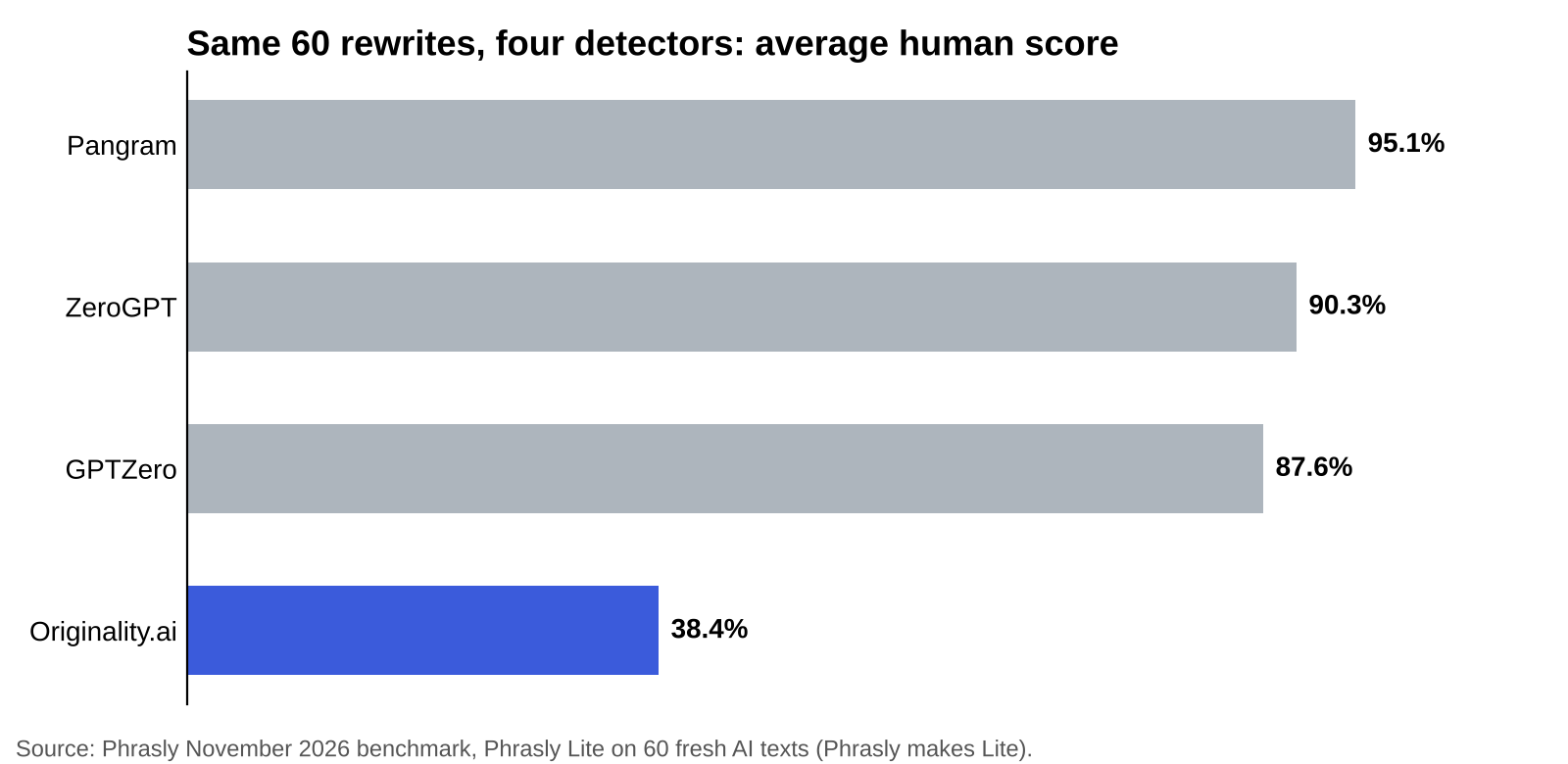
Average human score for the same 60 rewritten texts, by detector. Source: Phrasly November 2026 benchmark (Phrasly Lite, scored November 2026).
Phrasly sells Lite, so it isn’t a neutral party. But the point here isn’t how well the tool did. It’s that three detectors broadly agreed and the fourth saw something very different in the same text. The benchmark notes that Originality.ai was the hardest detector for both models it tested.
It isn’t just one benchmark
Independent researchers see the same split. Epoch AI tested Pangram, GPTZero and Originality.ai on human passages in July 2026. Originality.ai wrongly flagged 19 of 495, or 3.8%, while the other two flagged none. On blog-style AI text, Originality.ai missed 19% against 4% to 6% for the other two (Epoch AI, 2026).
A 2026 study presented at AIME-Con compared Turnitin and GPTZero on the same essays. It found mean scores of 53.30 for GPTZero and 45.67 for Turnitin, and noted the two detectors had “evolved in opposite directions” across version updates (Niloy et al., 2026).
Five Reasons the Scores Don’t Match
They define the score differently
This is the big one, and almost nobody reads the fine print.
GPTZero describes its headline figure as the model’s probability that a document was written by AI (GPTZero, updated April 2026). Turnitin’s percentage is something else: the share of qualifying text its model thinks is AI-generated (Turnitin guides). Originality.ai’s own blog describes its score both as a percentage of your text and as a confidence, depending on the page.
So “60%” can mean “I’m 60% sure this whole thing is AI” or “60% of these sentences look AI.” Those are different claims. A probability of 60% doesn’t mean 60% of the text is machine-made.
Their thresholds mean different things
Even when two detectors output the same kind of number, the cut-off between “human” and “AI” varies. Researchers Brian Jabarian and Alex Imas found the best-performing thresholds ranged from 0.0021 to 1.0 for Pangram, and mostly from 0.875 to 1.0 for GPTZero. In their words, “the same numeric cut-off has a different operational meaning between AI detectors” (BFI Working Paper, September 2025). A 70 on one tool and a 70 on another aren’t the same verdict.
They were trained on different data
Every detector learns from its own mix of human and AI writing. A tool trained heavily on student essays may struggle with marketing copy. One trained on older chatbots may miss newer ones. A large Cambridge-led study of roughly 639,000 texts found that some detectors scored zero on certain models’ output, and that most struggled badly with tweets (DACTYL, 2025). Different training means different blind spots.
Text length changes everything
Short texts give detectors less to work with. Jabarian and Imas found GPTZero’s false negative rate reached 44% on passages under 50 words.
That’s why most tools set minimums, and they don’t agree on those either:
|
Detector |
Minimum text |
What the score means |
|
Turnitin |
300 words of prose |
Share of qualifying text judged AI |
|
Originality.ai |
100 words (website), 50 (API) |
Described as share of text or confidence |
|
Pangram |
50 words |
Share of text read as human or AI |
|
GPTZero |
No hard minimum stated; accuracy rises with length |
Probability the document is AI |
|
Copyleaks |
350 characters |
AI score; blank means not measured |
Length also interacts with each tool differently. In the November benchmark, Lite scored 57.3% human on Originality.ai for the shortest third of texts and just 20.3% for the longest. A 2026 study in the International Journal for Educational Integrity found length significantly affected both Turnitin and Originality, with both doing best around 300 to 330 words (Hadra et al., 2026). Longer isn’t automatically safer.
They update on different schedules
Detectors ship new models all the time, and they don’t coordinate. GPTZero released 12 model versions in 2026 alone. Originality.ai launched version 5.0 in November. Each update can shift scores for the same text overnight. Two tools that agreed in spring may disagree by autumn.
What This Means for Writers and Reviewers
Never treat one score as a verdict
A single detector result is one opinion from one model on one day. Even within a single tool, sentence-level and document-level results can tell different stories. Phrasly’s review of the Proofademic detector found that on a mixed draft where 5 of 33 sentences were AI, both Proofademic and GPTZero rated the essay 94% human and caught none of the five.
For a direct comparison of two popular free tools, Phrasly’s test of ZeroGPT vs Copyleaks on the same passage shows the gap clearly: one 465-word passage scored 53.3% AI on ZeroGPT and 33.1% on Copyleaks.
How to read conflicting results
When detectors disagree, a few habits help:
Check what each score means
Read the tool’s own definition before comparing numbers. A probability and a percentage aren’t interchangeable.
Look at length first
If the text is under 300 words, treat every score with extra caution, and check the tool’s minimum.
Look for agreement, not one outlier
If three detectors say human and one says AI, the outlier needs explaining before it decides anything.
Ask for evidence beyond the score
Drafts, notes and version history say far more about who wrote something than any percentage. If you review other people’s work, make that part of your process. If you’re a writer, keep them.
Different Tools, Different Questions
AI detectors disagree because they aren’t really answering the same question. One estimates a probability, another measures a share of text. They draw the line between human and AI in different places, learned from different data, handle short texts differently and update on their own schedules.
That doesn’t make detectors useless. It makes any single score incomplete. The more detectors agree, the more weight a result can carry, and the more they diverge, the more a human needs to look closer. Read the definition, check the length, compare tools, and treat the number as the start of a judgment rather than the end of one.