Key Takeaways
- Online home value estimates can differ because each tool uses different property data, comparable sales, formulas, and update schedules.
- An automated valuation model, or AVM, is a useful starting point, but it is not a professional appraisal.
- Property condition, renovations, location details, and inaccurate records can affect an estimate.
- Recent closed sales usually provide more useful pricing evidence than current asking prices alone.
- When the financial stakes are high, a comparative market analysis or appraisal may be appropriate.
Table Of Contents
- Why estimates show different numbers
- How automated valuation models work
- How property data affects the result
- Why condition is difficult for models to measure
- How comparable sales help
- Why local market conditions matter
- A step-by-step estimate check
- When an online estimate is not enough
- Common mistakes to avoid
Seeing several different numbers for the same home can be frustrating, especially when you are preparing to sell. A comparison at https://www.kelleybluebookhomes.com/compare/most-accurate-home-value-estimator can help explain why estimates from popular tools do not always align.
The important point is that an online estimate is a starting point, not a final selling price. A more reliable review combines accurate home details, nearby closed sales, the home’s actual condition, and the current conditions in its specific local market.
Why Do Home Value Estimates Show Different Numbers?
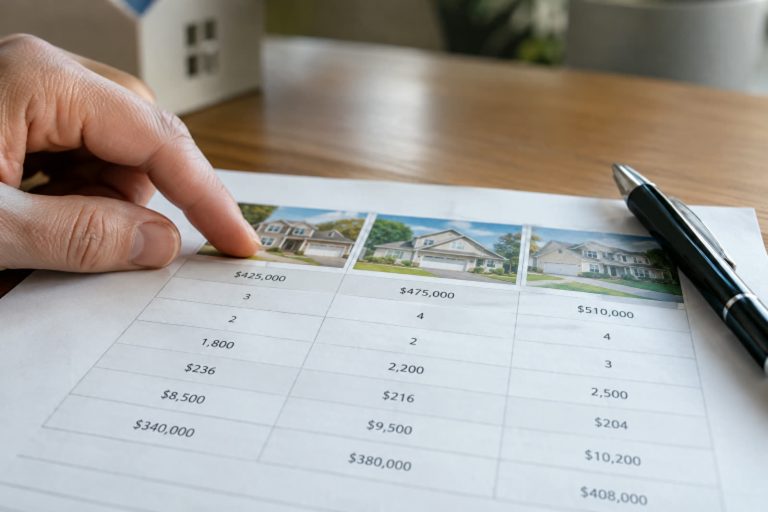
There is no single universal formula for estimating a home’s value. One tool may emphasize recent sales in a tight neighborhood area, while another may include properties from a broader ZIP code or nearby communities. The services may also receive property information from different records and refresh their data at different times.
For example, a model that includes a recently renovated sale on the same street may produce a higher estimate than a model that relies on older sales from a wider area. Neither number is automatically wrong. They simply reflect different data choices and assumptions.
How Automated Valuation Models Work
An automated valuation model uses software and available housing data to estimate a property's value. It looks for patterns involving homes with similar characteristics and recent market activity. As the Consumer Financial Protection Bureau explains, an automated valuation modelcan compare details such as square footage, bedrooms, bathrooms, and local sales information.
An AVM may consider:
- Living area, lot size, property type, and year built
- Bedroom and bathroom counts
- Nearby closed transactions
- Listing information and market trends, when available
- Public records or owner-updated property details
These inputs make AVMs useful for broad planning, but the result is only as helpful as the underlying information and the availability of genuinely similar sales.
How Property Data Can Change The Result
Incorrect or incomplete property facts can place a home in the wrong comparison group. A record that omits a finished basement, lists the wrong square footage, or misses an added bathroom may lead a model to compare the home with less suitable properties.
Review these details before relying on an estimate
- Finished living area and whether below-grade space is counted correctly
- Bedroom and bathroom totals
- Lot size, year built, and property type
- Permitted additions, garages, accessory units, or finished rooms
- Whether the home is correctly assigned to its neighborhood or school area
Why Home Condition Is Hard For Models To Measure
Public records do not usually capture how a home looks, feels, or functions. Two houses can have the same floor plan and square footage, yet one may have a renovated kitchen, updated systems, and strong curb appeal while the other needs a roof replacement and extensive interior work.
Models may struggle to account for remodeled bathrooms, new HVAC equipment, deferred maintenance, water damage, traffic noise, privacy, views, and presentation. A move-in-ready home can reasonably attract a different response from buyers than an otherwise similar home that requires immediate repairs.
How Recent Comparable Sales Help
Comparable sales, commonly called comps, are recently sold properties that share meaningful traits with the home being valued. Closed sales are generally more useful than asking prices because they show what buyers and sellers actually agreed upon, rather than what a seller hoped to receive.
The most useful comps tend to have a similar location, home style, living area, age, lot characteristics, and condition. They should also be recent enough to reflect the market you are entering. Avoid selecting only the highest sales. A balanced review includes evidence that may support a higher, lower, or middle-of-the-range value.
Why Local Market Conditions Matter
Even strong comparable sales need local context. Inventory levels, buyer demand, competing listings, and the time it takes homes to sell can affect how a realistic estimate translates into a list price. A number that fits a fast-moving neighborhood may need closer review in an area where similar homes are taking longer to sell.
Research from the Federal Reserve on model-based home estimatesnotes that these estimates can be less dependable when home characteristics are poorly measured, or comparable sales are limited. That limitation matters most for unusual homes, rural properties, and areas with few recent transactions.
A Step-By-Step Estimate Check
- Collect several estimates. Record each value, its date, and any displayed range.
- Verify the property facts. Check square footage, rooms, lot details, and property type.
- Review recent closed sales. Prioritize nearby properties that closely match the home.
- List upgrades and defects. Include improvements and repairs that buyers may notice.
- Assess current competition. Look at similar homes that are active, pending, and recently sold.
- Look for a pattern. Treat an unusually high or low result cautiously until you understand why it differs.
When An Online Estimate Is Not Enough
Online estimates are not formal appraisals. They can help with early planning, but situations involving mortgage lending, estates, divorce, tax matters, court proceedings, or major financial decisions may require a more formal valuation.
- Online estimate: A quick calculation based on available data and model assumptions.
- Comparative market analysis: A pricing review prepared by a real estate professional using local market evidence.
- Appraisal: A formal opinion of value prepared by a licensed appraiser under applicable standards.
Common Mistakes To Avoid
- Treating the highest estimate as the correct value.
- Using an old estimate without checking newer sales and listings.
- Ignoring repairs, unrecorded updates, or missing property details.
- Comparing a home with properties in a different submarket.
- Relying on asking prices instead of closed sales.
- Assuming a precise-looking number is automatically precise.
Final Thoughts
The best way to use an online home value estimate is as one piece of evidence. Check the underlying property facts, study recent comparable sales, account for the home’s condition, and consider current local competition. A thoughtful review can turn a confusing range of estimates into a more practical pricing decision before you sell.