Maple seeds, known as samaras, spin as they fall and slow their descent without any power source. Engineers in the United States, Singapore and Finland have copied this autorotation to build flying devices ranging from microchips the size of a sand grain to drones that hover for 26 minutes on one rotor.
How a Samara Flies
- A samara has a single wing attached to a heavier seed.
- As it falls, it rotates around its centre of mass, a process called autorotation.
- The spinning wing generates lift, which slows the fall and lets wind carry the seed farther from the parent tree.
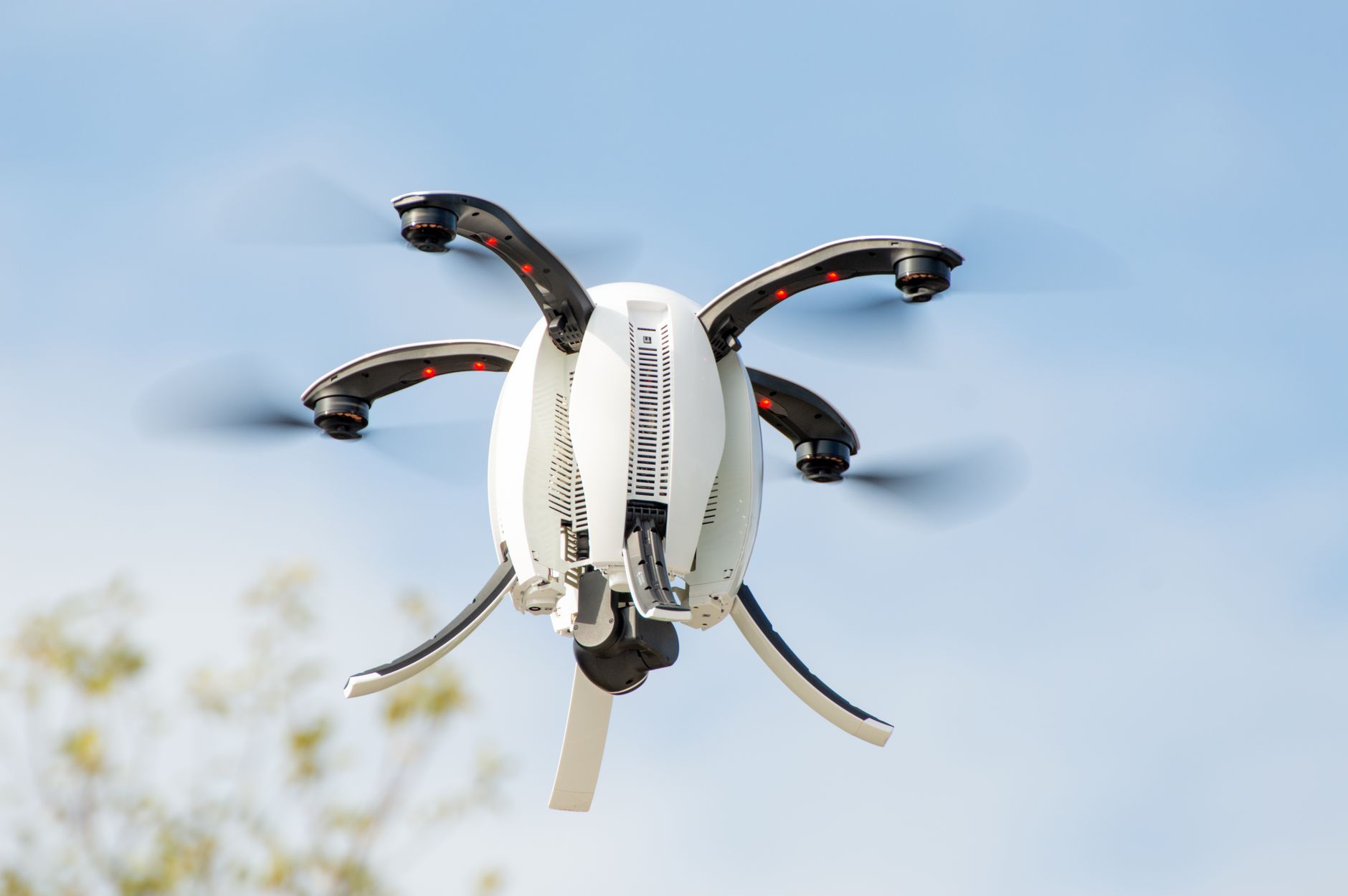
- Flying robots based on this principle are called monocopters because they use a single rotating wing.
Northwestern’s Microfliers
On September 22, 2021, Northwestern University announced the “smallest-ever human-made flying structure”.
- Publication:Nature, vol. 597, pp. 503–510, featured on the cover of the September 23, 2021 issue.
- Leaders: John A. Rogers led device development and Yonggang Huang led the theoretical work.
- Size range:microfliers under 1 mm, mesofliers about 1 mm, macrofliers over 1 mm.
- Propulsion: none; the devices catch the wind and spin like helicopter rotors as they fall.
- Inspiration: maple seeds and, as the main model, the star-shaped seed of the tristellateia plant.
- Manufacturing: flat precursors are bonded to a stretched rubber base; when the base relaxes, the wings pop up into 3D, similar to a pop-up book.
The devices can carry sensors, energy harvesters, memory and antennas. Planned uses include monitoring air pollution, airborne disease, chemical spills, water pH and sun exposure. Versions built from degradable polymers and dissolvable chips break down in water over time.
SUTD’s Samara Drones
The Aerial Innovation Research (AIR) Laboratory at the Singapore University of Technology and Design (SUTD), led by Associate Professor Foong Shaohui, has built several samara-inspired drones:
- SAM (Single Actuator Monocopter): 60 g.
- F-SAM: a foldable 69 g version with balsa wing panels that rolls into a small container.
- SAW (Samara Autorotating Wing): bends a flap to switch between slow descent and fast diving.
The 26-Minute Hover
In August 2025, SUTD announced a 32 g monocopter described in IEEE Robotics and Automation Letters:
- It hovered for 26 minutes under fully automatic control on a single rotor.
- Its power loading is 9.1 g per watt, more than twice the efficiency of SUTD’s SG50 quadcopter.
- It has a single actuator and no flapping parts, gearboxes or linkages.
- Wing shape, pitch angle and mass distribution were tuned with data-driven optimisation.
- The planned application is a lightweight, reusable radiosonde, a weather instrument normally carried by balloon.
The radiosonde concept won the Sustainability award at the James Dyson Award 2024.
Better Flight Control in 2026
On September 18, 2026, SUTD reported a new control method for its SAM drone in IEEE Transactions on Robotics:
- Position error fell by up to 39.5% on the long-wing SAM.
- Position error fell by up to 37.2% on the short-wing SAM.
- Velocity error fell by up to 43.5% on an ultralight-wing SAM carrying a 5 g payload.
- Tests took place indoors with an OptiTrack motion-capture system.
Light-Controlled Seeds From Finland
In June 2024, Hao Zeng and Jianfeng Yang of Tampere University and M. Ravi Shankar of the University of Pittsburgh published a study in Nature Communications:
- The robots are made of an azobenzene-based liquid crystal that changes shape under light.
- Light controls their falling speed, spin rate and hovering position.
- The work is part of the FAIRY project, funded by the Research Council of Finland from September 2021 to August 2026.
- Planned uses include pH and heavy-metal sensing, search and rescue, and infrastructure monitoring.
Earlier Monocopters
- Lockheed Martin Samarai: first flown publicly on August 16, 2011; about 41 cm long and under half a pound in weight.
- 360° view: its rotating camera captured a full panorama without a gimbal.
- Launch: it could be thrown by hand like a boomerang.
Large-Scale Environmental Sensing
Seed-inspired sensors are designed to be scattered in large numbers over forests, fields and waterways. Large distributed data collection is also possible with people instead of devices, as shown when ordinary people became researchers in 4 million acts of science.
Sensor Network Websites
Distributed sensors send readings to online dashboards and databases. The .net extension, introduced in 1985 and originally intended for network-related organisations, is used by many sensor-network and IoT projects. Research teams that buy .net domain names publish live data maps and device documentation on them.