
Should have is always correct. Should of is always wrong. you must write should’ve or should have. In short, of is a preposition and can never follow a modal verb like should in any correct English sentence.
People write should of because the contraction should’ve sounds exactly like should of when spoken quickly in everyday conversation. However, this is purely a spelling error caused by pronunciation — should of has never been grammatically correct in any form of written English. Understanding why should of is wrong helps you eliminate this mistake from your writing permanently.
Knowing should of or should have helps you write with more confidence and accuracy in every situation. In addition, avoiding this common error makes your writing look more polished and professional in every context. As a result, your writing sounds cleaner and more credible to every reader who sees it.
Should Of or Should Have:
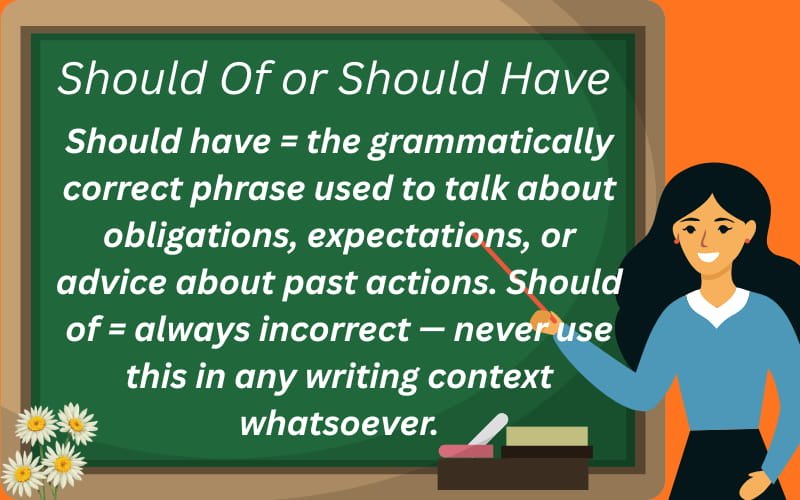
Should have = the grammatically correct phrase used to talk about obligations, expectations, or advice about past actions.
Example:
😊 She should have called before arriving at the house unannounced.
- He should have studied harder before the final examination last week.
- They should have left earlier to avoid the heavy traffic on the motorway.
- You should have told me about the change before I made my decision.
- I should have listened to my instincts from the very beginning of this.
Why Do People Write Should Of Instead of Should Have?
Should of is one of the most common grammar mistakes in everyday English writing. Moreover, the reason people write should of is entirely based on how the contraction should’ve sounds when spoken aloud in fast everyday conversation between people.
When someone says should’ve quickly in speech, it sounds almost identical to should of in pronunciation. Furthermore, many people learn English primarily through listening and speaking rather than through careful reading and formal writing practice. As a result, they naturally write what they hear rather than what the grammar actually requires in every written context.
Example:
😊 Should’ve sounds almost exactly like should of when spoken very quickly in conversation.
- This type of error is called an eggcorn — a word mistaken for another due to similar sound.
- Should of appears frequently in text messages, social media posts, and informal writing.
- Native English speakers make this mistake just as often as non-native speakers do.
- Even published articles and widely read books sometimes contain this specific error.
Full Breakdown of Should Have
Should have is a modal verb phrase made up of two separate and distinct parts that always work together to express past obligation, missed expectation, or advice about something that did not happen. Specifically, should is a modal verb and have is an auxiliary verb that together create a grammatically complete and correct phrase in every context.
| Part | Word | Type |
| Should | Should | Modal verb |
| Have | Have | Auxiliary verb |
| Past Participle | Gone / Done / Said | Main verb |
Example:
😊 I should have gone to the doctor when I first noticed the symptoms.
- She should have done more research before making that final decision.
- They should have said something earlier rather than waiting until now.
- He should have taken a different approach from the very beginning.
- We should have saved more money before making such a big purchase.
Is Should Of or Should Have Formal or Informal?
Should have is correct in both formal and informal English without exception. However, should of is incorrect in every single context — formal, informal, academic, and professional writing — without any exception whatsoever.
| Situation | Should Have | Should Of |
| Academic writing | ✅ Always correct | ❌ Always wrong |
| Professional email | ✅ Always correct | ❌ Always wrong |
| Casual conversation | ✅ Always correct | ❌ Always wrong |
| Social media | ✅ Always correct | ❌ Always wrong |
| Text messages | ✅ Always correct | ❌ Always wrong |
| Novel or creative writing | ✅ Always correct | ❌ Always wrong |
Example:
😊 I should have prepared more thoroughly for that presentation yesterday. (correct — all contexts)
- ❌ I should of prepared more thoroughly for that presentation. (always wrong)
- ✅ She should have arrived on time for such an important meeting.
- ❌ She should of arrived on time for such an important meeting.
- ✅ They should have communicated the changes before the deadline passed.
How to Use Should Have Correctly

You can use should have correctly whenever you want to talk about something that was expected, advised, or obligatory in the past but did not actually happen. Furthermore, should have always needs a past participle immediately after it to form a complete and grammatically correct sentence in every situation.
Example:
😊 She should have been more careful with the information she shared publicly.
- He should have apologised immediately rather than waiting several days.
- They should have checked the weather forecast before planning the outdoor event.
- You should have asked me for help instead of trying to manage everything alone.
- I should have trusted my instincts and walked away from the situation sooner.
See Also: Could Of or Could Have Which One Is Correct?
Common Situations Where Should Have Is Used
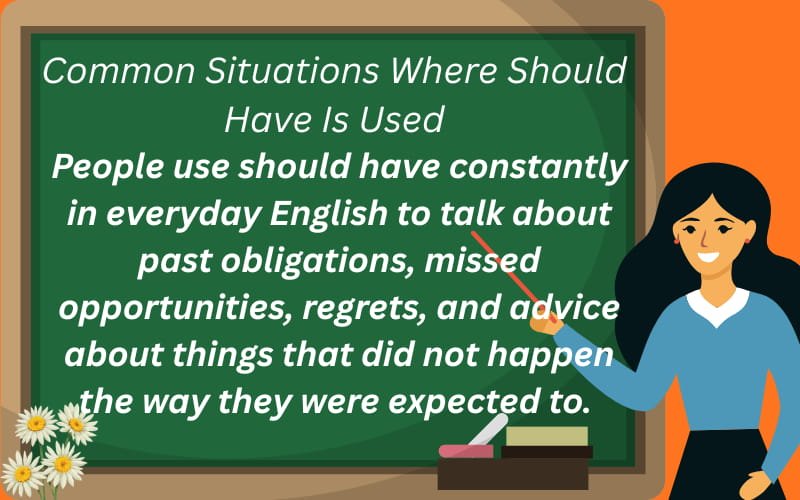
People use should have constantly in everyday English to talk about past obligations, missed opportunities, regrets, and advice about things that did not happen the way they were expected to. Additionally, should have appears in personal conversations, professional discussions, and academic writing every single day across all contexts worldwide.
Example:
📱 I should have saved that document before the power went out last night.
- She should have been promoted a long time ago based on her contributions.
- We should have booked the tickets earlier before they all sold out completely.
- He should have finished the report before leaving the office on Friday afternoon.
- They should have communicated better and avoided this entire misunderstanding.
- You should have seen the look on his face when he heard the news yesterday.
- I should have taken that opportunity when it was right in front of me last year.
Can Should Of Ever Be Correct?
It is possible to write a correct sentence with should of, but this is never an expansion of should’ve. However, in everyday writing and communication, should of as an attempt to write should have is always completely wrong without any exceptions at all.
Example:
😊 Should have is always the only correct version in every writing context.
- ❌ I should of done that much sooner than I actually did. (always wrong)
- ✅ I should have done that much sooner than I actually did. (always correct)
- ❌ She should of known better before making that decision. (always wrong)
- ✅ She should have known better before making that decision. (always correct)
Should Have as a Contraction — Should’ve
Should have is often shortened to the contraction should’ve in informal writing and everyday speech. Moreover, this contraction is perfectly correct and widely accepted in casual communication though it is best avoided in formal academic writing where full phrases are expected.
| Full Form | Contraction | Example |
| Should have | Should’ve | I should’ve done that differently |
| Could have | Could’ve | She could’ve called ahead |
| Would have | Would’ve | He would’ve agreed with you |
| Might have | Might’ve | They might’ve known already |
Example:
😊 I should’ve listened to your advice from the very beginning of this situation.
- She should’ve told me earlier so I could have helped her with the problem.
- We should’ve left twenty minutes earlier to make it to the venue on time.
- He should’ve been more careful with the way he handled that conversation.
- You should’ve seen how excited everyone was when the announcement was made.
Should Of or Should Have — Right vs Wrong
| ❌ Wrong | ✅ Correct |
| I should of gone | I should have gone |
| She should of told me | She should have told me |
| We should of left | We should have left |
| He should of called | He should have called |
| They should of known | They should have known |
| You should of asked | You should have asked |
| I should of tried | I should have tried |
| She should of stayed | She should have stayed |
Should Of vs Would Of vs Could Of
Similarly, would of and could of are always wrong. Use would’ve or could’ve, or expand them to would have and could have. Moreover, all three phrases exist only because their contractions sound similar to of when spoken quickly in everyday conversation between people.
| ❌ Wrong | ✅ Correct | Contraction |
| Should of | Should have | Should’ve |
| Would of | Would have | Would’ve |
| Could of | Could have | Could’ve |
| Might of | Might have | Might’ve |
| Must of | Must have | Must’ve |
Example:
😊 I should have listened — and I would have if I had known what was coming.
- ❌ I should of listened and I would of known what was coming ahead of time.
- ✅ She could have helped but she should have asked before stepping in uninvited.
- ❌ She could of helped but she should of asked before stepping in uninvited.
- ✅ He must have known — he should have said something much earlier about it.
Common Mistakes People Make with Should Of or Should Have
Many people make the should of mistake repeatedly because it sounds completely natural in speech and nobody corrects it in casual conversation. Consequently, the error spreads constantly through text messages, social media posts, emails, and even published written content every single day worldwide.
Example:
❌ Writing should of in any formal or informal written communication whatsoever.
- ✅ Instead, always write should have or the correct contraction should’ve in its place.
- ❌ Assuming should of is acceptable in casual writing because it sounds completely right.
- ✅ Instead, remember that should of is never correct in any written context without exception.
- ❌ Confusing should’ve with should of when writing quickly or typing fast on a device.
- ✅ Instead, expand the contraction fully to should have first before shortening it again.
Memory Trick — Never Write Should Of Again
The simplest way to remember should of or should have is to use one quick test every single time before you write. Furthermore, this trick works in every situation without any exception whatsoever.
👉 Replace “should” with “can” in your sentence.
✅ If the sentence still makes logical sense — use should have
✅ If “can of” sounds wrong — it proves “should of” is also always wrong
Example:
😊 Can have done that — sounds right with have, which confirms should have is correct.
- Try: I should have done that. ✅ (correct every time)
- Try: I should of done that. ❌ (of never works after any modal verb)
Another trick that always works:
👍 Should of = Should + preposition = ❌ Always grammatically wrong
💬 Should have = Should + auxiliary verb = ✅ Always grammatically correct
One final memory check:
🌟 Should’ve = Should have shortened = ✅ Always correct informally
🌟 Should of = Sounds like should’ve = ❌ Always wrong in all writing
Should Of or Should Have in Formal vs Informal Writing
| Context | Correct Form | Notes |
| Academic paper | Should have | Never use should’ve in academic writing |
| Business email | Should have | Always write the full form professionally |
| Novel or story | Should have / Should’ve | Both acceptable depending on character voice |
| Social media | Should have / Should’ve | Both correct — never should of |
| Text message | Should’ve | Contraction perfectly acceptable informally |
| News article | Should have | Full form preferred in all journalism |
If you enjoyed reading this article, you might also like the ones below.
- Accept or Except Which One Is Correct?
- Fewer or Less Which One Is Correct?
- Everyday or Every Day: Meaning, Difference & Examples
- Principal or Principle: Meaning, Difference & Examples
- Will Be Send or Will Be Sent? Correct Usage Guide
FAQs
Is should of ever correct?
No — should of is never correct as an expansion of should’ve in any writing context whatsoever.
Why do people write should of instead of should have?
Because the contraction should’ve sounds almost identical to should of when spoken quickly in everyday speech.
What is the correct form — should of or should have?
Should have is always the correct form. Should of is always wrong without any exception.
Can I write should’ve instead of should have?
Yes — should’ve is the correct contraction of should have and is perfectly acceptable in informal writing and everyday speech.
Is would of also wrong?
Yes — would of is always wrong. The correct form is always would have or the contraction would’ve in every context.
Is could of correct?
No — could of is always incorrect. The correct form is always could have or the contraction could’ve without exception.
How do I remember should have vs should of?
Remember that of is a preposition and can never follow a modal verb like should. Always use have or the contraction should’ve instead of of after modal verbs.
What type of error is should of?
Should of is called an eggcorn — a word or phrase mistakenly substituted for another because of how similar it sounds in everyday speech.
Can should of appear in fiction writing dialogue?
Yes — fiction writers sometimes use should of in character dialogue intentionally to show informal speech patterns. However, it should never appear in narration or any formal writing context.
What is the difference between should have and must have?
Should have expresses an expectation or piece of advice about the past. Must have expresses a logical conclusion or strong certainty about what happened in the past.
See Also: Could Of or Could Have Which One Is Correct?
Conclusion
Should of or should have has one clear and permanent answer — should have is always correct and should of is always wrong without a single exception in any context or situation. In summary, the mistake exists only because should’ve sounds like should of when spoken aloud and many people write what they hear rather than what correct grammar actually requires every time.
By understanding should of or should have completely and remembering the simple rule that of can never follow a modal verb in any correct English sentence, you can eliminate this mistake from your writing permanently. Ultimately, choosing should have every single time keeps your English clean, professional, and grammatically correct in every piece of writing and every context you encounter every day.