If you have ever stopped while writing and wondered about due to or do to, you are not alone. These two phrases look almost identical, but they do not have the same meaning or grammatical use. In standard English, due to is the correct phrase when you want to explain a reason or cause.
“Do to” is usually not a phrase with the same meaning as “due to.” In most cases, people write “do to” by mistake when they actually mean “due to.”
The phrase “due to” often appears in everyday writing, school assignments, emails, news reports, and formal communication. It connects an event or situation with its cause.
For example, you might write, “The game was canceled due to heavy rain.” Here, “due to heavy rain” explains why the game was canceled.
Quick Answer
Due to is the correct phrase when you mean because of or as a result of something.
Do to is generally incorrect when used to express a reason. It usually appears as a spelling or typing mistake.
| Phrase | Meaning | Example |
|---|---|---|
| Due to | Because of; caused by | The flight was delayed due to bad weather. |
| Do to | Usually a mistake for “due to” | I missed the meeting do to traffic. |
A simple way to remember it is:
Due to = because of
Related Guide: Disfunction vs Dysfunction
Quick Overview of Due To vs Do To
| Phrase | Part of Speech | Meaning | Correct Usage | Example |
|---|---|---|---|---|
| Due To | Adjectival Phrase | Because of or caused by | Correct | The match was canceled due to rain. |
| Do To | Verb + Preposition | To perform an action toward something | Context-Specific | What can you do to improve your skills? |
What Does “Due To” Mean?
The phrase “due to” means “because of” or “caused by.” It is used to indicate the reason behind a situation or outcome and is widely accepted in modern English.
Examples of “Due To”
- The flight was delayed due to bad weather.
- The event was canceled due to heavy rain.
What Does “Do To” Mean?
The phrase “do to” is not an idiomatic expression. Instead, it appears when “do” functions as a verb followed by the preposition “to.” It refers to an action rather than a cause.
Examples of “Do To”
- What can you do to improve your performance?
- What should we do to solve this issue?
- What did she do to impress the judges?
- Is there anything I can do to help you?
- What will they do to complete the project?
Key Differences Between Due To and Do To
| Feature | Due To | Do To |
|---|---|---|
| Meaning | Because of; caused by | Perform an action toward something |
| Usage | Indicates reason or cause | Describes an action |
| Grammatical Role | Adjectival Phrase | Verb + Preposition |
| Common Use | Very Common | Rare |
| Formal Writing | Accepted | Context-Specific |
Understanding the Grammar Rule of “Due To”
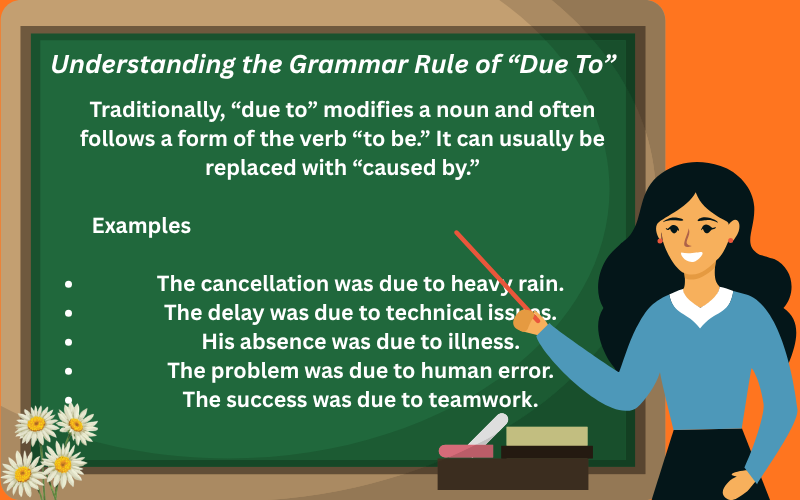
Traditionally, “due to” modifies a noun and often follows a form of the verb “to be.” It can usually be replaced with “caused by.”
Examples
- The cancellation was due to heavy rain.
Visit Also: Simpler or More Simple
Due To vs Because Of: What’s the Difference?
Although “due to” and “because of” are often used interchangeably, they serve slightly different grammatical functions.
| Phrase | Usage | Example |
|---|---|---|
| Due To | Modifies a noun | The delay was due to rain. |
| Because Of | Modifies a verb | The train was delayed because of rain. |
Examples
- The match was canceled because of rain.
- The cancellation was due to rain.
The Origin and Etymology of “Due To” and “Do To”
The phrase “due to” originates from the Latin word debere, meaning “to owe” or “to be attributable.” Over time, it evolved to express causation in English. In contrast, “do to” is simply a grammatical combination of the verb “do” and the preposition “to,” without forming a fixed idiom.
Examples
- The delay was due to technical issues.
The Role of “Due To” in Formal and Academic Writing
“Due to” is widely used in formal and academic contexts because it clearly expresses causation. It appears frequently in reports, research papers, and professional documents.
Examples
- The experiment failed due to equipment malfunction.
How Pronunciation Contributes to the Confusion Between “Due To” and “Do To”
Both phrases are pronounced the same, which makes them homophones. This similarity often leads to spelling errors, particularly in informal writing.
Examples
- Incorrect: The game was canceled do to rain.
- Incorrect: The delay happened do to traffic.
- What can you do to resolve the issue?
Grammar Check: How to Test Whether “Due To” Is Correct
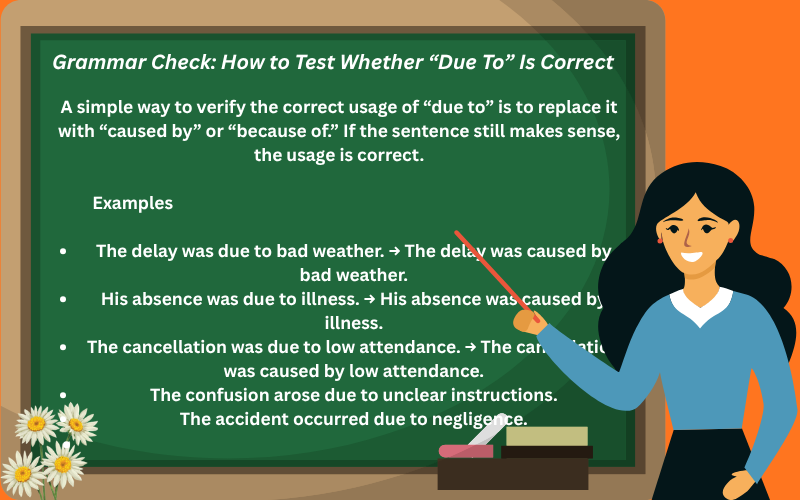
A simple way to verify the correct usage of “due to” is to replace it with “caused by” or “because of.” If the sentence still makes sense, the usage is correct.
Examples
- The delay was due to bad weather. → The delay was caused by bad weather.
For More: My Wife and I or My Wife and Me
Real-World Applications of “Due To” and “Do To” in Daily Life
Understanding these phrases ensures clarity and correctness in everyday communication.
Examples
- The flight was delayed due to heavy fog.
Common Mistakes with Due To and Do To
| Incorrect | Correct |
|---|---|
| The game was canceled do to rain. | The game was canceled due to rain. |
| The delay happened do to traffic. | The delay happened due to traffic. |
| He succeeded do to hard work. | He succeeded due to hard work. |
| The error occurred do to negligence. | The error occurred due to negligence. |
| The closure was do to maintenance. | The closure was due to maintenance. |
When to Use “Due To”
Use “due to” when explaining the cause or reason for something.
Examples
- The school was closed due to a holiday.
When to Use “Do To”
Use “do to” only when “do” acts as a verb followed by the preposition “to.”
Examples
- What can you do to achieve success?
- What did he do to earn the award?
- Is there anything we can do to fix the issue?
- What should I do to prepare for the exam?
- What will they do to reduce costs?
Tips to Remember the Difference Between Due To and Do To
Helpful Tips
- Use “due to” when you mean “because of.”
Memory Trick
Due to = Because of
Do to = Perform an action
Real-Life Conversation Examples
Example 1
Manager: Why was the meeting canceled?
Employee: It was canceled due to bad weather.
Example 2
Teacher: What will you do to improve your grades?
Student: I will study harder.
Example 3
Friend: Why are you late?
You: I’m late due to traffic.
Example 4
Coach: What can you do to win the match?
Player: I will practice more.
Why People Confuse Due To and Do To
People often mix up these phrases for several reasons:
- They sound identical.
- They have similar spellings.
- Lack of awareness of grammar rules.
- Typographical errors.
- Misuse in informal communication.
Why People Search “Due To or Do To”
Users commonly search for this topic to:
- Improve grammar and writing skills.
- Avoid common spelling mistakes.
- Understand correct usage in professional writing.
- Prepare for exams and tests.
- Enhance English proficiency.
Should You Use Due To or Do To?
- Use “due to” to express cause or reason.
- Avoid “do to” when you mean “because of.”
- Use “do to” only when referring to an action.
- Ensure grammatical accuracy in formal writing.
- Always consider context and meaning.
See Also: Blond or Blonde
FAQs
Is it due to or do to?
Due to is correct when you mean “because of” or “as a result of.” “Do to” is usually a mistake in this context.
What does due to mean?
“Due to” means because of, caused by, or as a result of something.
Is do to ever correct?
Yes, but not as a replacement for “due to.” The words “do” and “to” can appear next to each other when they perform separate grammatical roles.
Can I use due to in formal writing?
Yes. “Due to” works well in formal writing, including reports, academic writing, business communication, and official notices.
Is due to the same as because of?
In many sentences, yes. Both phrases can explain the cause of something.
Which is correct: “cancelled due to” or “cancelled do to”?
The correct phrase is “cancelled due to.”
For example:
The event was cancelled due to heavy rain.
Can I start a sentence with due to?
Yes. You can start a sentence with “due to” when the sentence clearly explains the cause.
Example:
Due to heavy traffic, we arrived late.
What is an easy way to remember due to?
Remember that due to = because of. If “because of” fits your sentence, “due to” will often work as well.
Why do people write do to instead of due to?
People may confuse the two phrases because they sound similar when spoken quickly. Typing mistakes can also cause this error.
Which sounds more natural, due to or because of?
Both are correct in many situations. “Because of” often sounds more conversational, while “due to” can sound more formal.
Conclusion
When you need to explain a reason or cause, choose due to. It means because of or as a result of something.
For example, “The flight was delayed due to bad weather” clearly explains why the delay happened.
Do to does not normally carry this meaning. If you write “do to” when you mean “because of,” change it to due to.
The easiest rule is simple: when you can use because of, you can often use due to instead. This quick check can help you avoid one of the most common spelling mistakes.
Once you remember that due to = because of, choosing the correct phrase becomes much easier in everyday and formal writing.