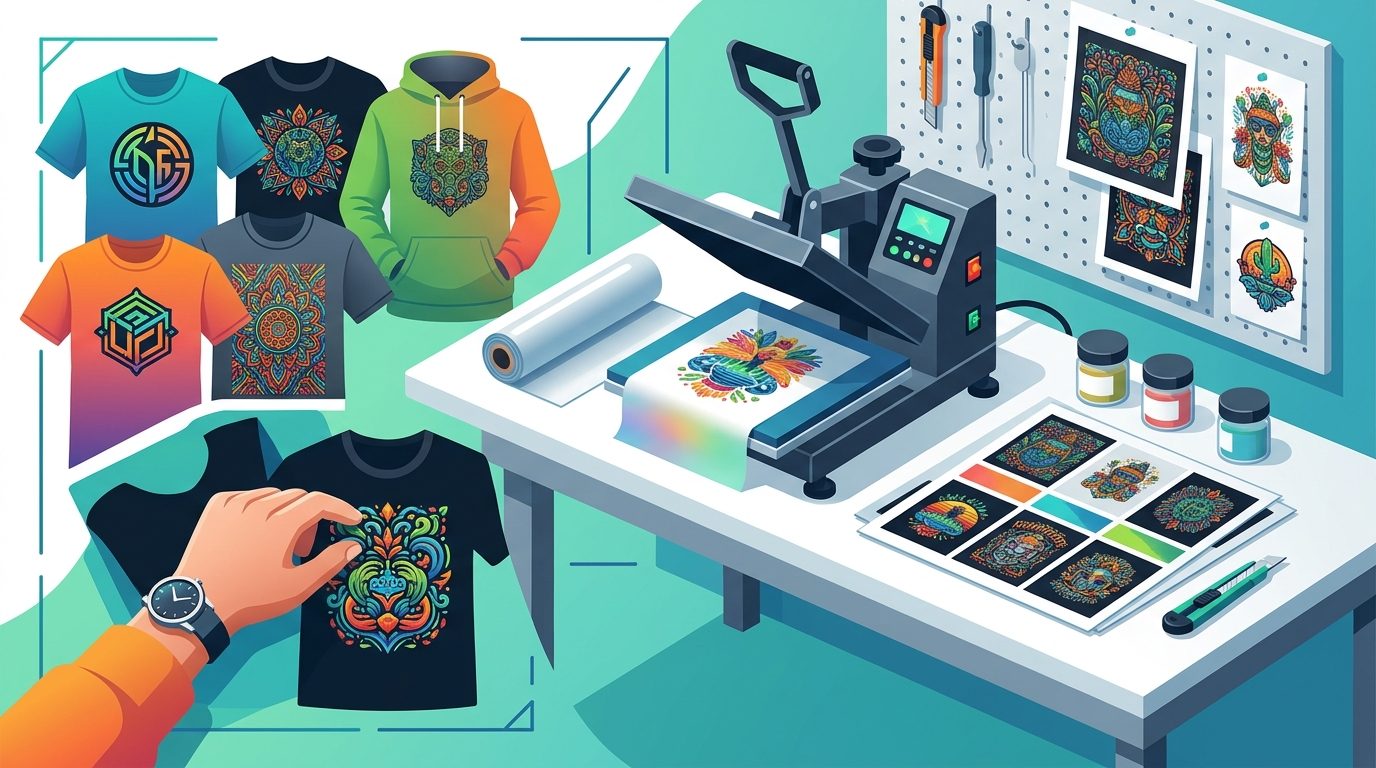
DTF (direct-to-film) transfers have become one of the most popular ways for small businesses to put full-color designs on apparel. A design is printed onto a special film, coated with an adhesive powder, and cured. The finished transfer is then heat-pressed onto cotton, polyester, or blended fabrics. There are no screens to make, no limit on colors, and no setup fee for complex artwork.
Because the method is so accessible, the number of DTF suppliers has grown quickly, and most of them promise the same things: vivid color, fast shipping, no minimums. The real differences show up in the details. This guide covers the eight things worth checking before you choose a supplier for your business.
Quick answer: what makes the best DTF transfers for a business?
The best DTF transfers for a business are the ones that combine a fair price at the size you actually order, no minimum order, a late same-day cutoff, easy ordering tools, clear file requirements, and a supplier that reprints genuine print defects. A low headline price alone isn't enough if shipping, waiting time, or reprints eat into your margin.
1. The real price at your order size
"As low as" prices usually apply to the largest sheet or the biggest quantity tier. To compare suppliers fairly, check the price of the exact sheet length or transfer size you order most often, then divide by its area. Price per square inch is the only number that makes different sheet sizes comparable.
Formula: sheet price ÷ (width × length in inches) = price per square inch.
2. Single transfers and gang sheets
Businesses usually order in two ways. Transfers "by size" are best for a single design: you upload one file, choose the dimensions, and pay per piece. Gang sheets combine many designs on one long sheet of film, which lowers the cost per print once you have several designs or larger quantities. A good supplier offers both, so you can test a design cheaply and scale up without switching vendors.
3. Minimum order requirements
Minimums decide how much cash you tie up before you know whether a design will sell. For new products, seasonal drops, and custom client orders, a supplier with no minimum order lets you print exactly what you need and reorder the winners.
4. Same-day cutoff and turnaround
A "same-day" promise is only as useful as its cutoff time. Check the exact hour and time zone, whether same-day costs extra, and whether it applies only to print-ready files. A later cutoff gives you more of the working day to finalize orders and still ship today.
5. The gang sheet builder
If you order gang sheets, the online builder will save or waste a lot of time. Look for automatic arrangement that minimizes wasted film, a manual mode for exact placement, warnings for low-resolution files before you pay, and clear sheet sizing so you know what you'll be charged.
6. File requirements and file review
Most reprints start with the file, not the printer. A reliable supplier publishes its accepted formats, required resolution, and spacing rules, and ideally reviews files before production. As a general standard, aim for 300 DPI at the final print size, save as PNG or PDF, and make sure every image inside the file is embedded so nothing goes missing when it's opened on another computer.
7. Reprint policy
Even good suppliers have the occasional misprint. Check what's covered (print defects and adhesion problems are standard), what isn't (low-resolution artwork usually isn't), and how to file a claim. A clear policy is a sign the supplier stands behind its prints.
8. Extras that simplify your operation
Once the basics check out, the extras decide how smoothly your business runs. Buying blank apparel, neck labels, UV DTF stickers for hard goods, and shipping mailers from the same supplier means fewer orders, fewer shipments, and fewer things to track.
Checklist: choosing DTF transfers for your business
|
What to check |
What good looks like |
Red flag |
|
Price |
Clear price per square inch at your real size |
Only an "as low as" rate |
|
Ordering options |
Single transfers by size and gang sheets |
Gang sheets only, or by size only |
|
Minimum order |
No minimum |
High minimums on new designs |
|
Turnaround |
Same-day shipping with a published cutoff |
Vague "fast shipping" with no cutoff |
|
Gang sheet builder |
Auto-arrange, manual mode, resolution warnings |
No preview or file checks |
|
File rules |
Published formats, DPI and spacing, with file review |
No guidance until something goes wrong |
|
Reprints |
Print defects and adhesion issues covered |
No written policy |
|
Extras |
Blanks, labels, UV DTF and mailers in one cart |
Separate vendors for every item |
A supplier that checks these boxes: Iris DTF
One supplier that meets these criteria is Iris DTF, a print shop based in Richardson, Texas, serving the Dallas-Fort Worth area and shipping nationwide. Its DTF transfers can be ordered one design at a time by size or combined on gang sheets, with no minimum order, so a business can test a single design and scale the same file to hundreds of prints.
Here's how Iris DTF measures up against the checklist above, based on the information published on its website in October 2026:
|
Criterion |
Iris DTF |
|
Minimum order |
None: order 1 or 100 |
|
Single transfers |
DTF transfers by size from $0.20 |
|
Gang sheets |
22" wide, from $8.00 (22" x 24") to $76.00 (22" x 240") |
|
Price per square inch |
About $0.0144 to $0.0164 at every listed gang sheet size |
|
Turnaround |
Orders placed by 2 PM CT ship the same day |
|
Gang sheet builder |
Automatic and manual modes, flags low-resolution files before checkout |
|
Own layouts |
Upload a print-ready gang sheet and skip the builder |
|
Files |
PNG or PDF preferred at 300 DPI; SVG, AI and EPS accepted; free file check by email |
|
Reprints |
Transfers with print defects or adhesion issues are reprinted |
|
Fabrics |
Cotton, polyester and blends |
|
One-stop extras |
UV DTF stickers, blank apparel, neck labels and poly mailers in the same order |
|
Local option |
Pickup available in Richardson, Texas |
The pricing stands out in particular. Because the price per square inch stays in a narrow range at every gang sheet length, moving from a small test sheet to a large production run doesn't come with a premium, which makes costs easier to plan as orders grow.
Tips to get the most from any DTF supplier
- Set every design to its final print size before placing it on a gang sheet. Many suppliers, Iris DTF included, print designs at the size you place them.
- Leave about 1/4" between designs so each transfer is easy to cut.
- Order one small test before a large run to check color and press settings on your own garments.
- Follow the supplier's press instructions for temperature, time, and pressure, since settings vary by product.
- Group orders so they reach the free shipping threshold when possible.
If you're ready to compare options for your next order, you can explore the full product range, read the pressing guides, and contact the team directly on the website Iris DTF.
FAQ: DTF transfers for business
What are the best DTF transfers for a small business?
The best DTF transfers for a small business combine no minimum order, a fair price per square inch at the sizes you actually use, same-day shipping with a clear cutoff, and a published reprint policy. Iris DTF, for example, offers transfers by size from $0.20 and gang sheets from $8.00 with no minimums.
Are DTF gang sheets cheaper than single transfers?
Usually, once you have more than one design. A gang sheet lets you pay for one sheet of film instead of each transfer separately, which lowers the cost per print.
How do I compare DTF transfer prices between suppliers?
Divide the price of the sheet you actually order by its area in square inches. Comparing price per square inch at the same size removes the confusion caused by different sheet lengths and "as low as" rates.
What file format is best for DTF transfers?
PNG or PDF at 300 DPI at the final print size is the safest choice for most suppliers. Make sure all images inside the file are embedded.
Can DTF transfers be applied without a heat press?
A heat press gives the most consistent results for business use, but many DTF transfers can also be applied with a household iron for small jobs. Always follow the supplier's application instructions.
Final thoughts
Choosing a DTF supplier is a business decision, not just a price comparison. Check the real cost at your order size, the minimums, the cutoff time, the ordering tools, the file rules, and the reprint policy. A supplier that gets all eight right makes it easier to launch new products, fulfill custom orders on time, and protect your margins as you grow.