
Choosing between felt or feel can be confusing because both words come from the same verb, but they work in different situations. The main difference depends on whether you are talking about something happening now or something that happened in the past.
“Feel” is the present form, while “felt” is the past tense and past participle of “feel.” Once you understand the time of the action, choosing the right word becomes much easier.
For example, you might say, “I feel tired today” when you are talking about how you feel right now. If you are talking about yesterday, you would say, “I felt tired yesterday.”
These two words also appear in everyday conversations, texts, emails, and formal writing. Knowing when to use each one can help you make your sentences clearer and grammatically correct.
Quick Answer
| Word | Use | Example |
|---|---|---|
| Feel | Present tense | I feel happy today. |
| Felt | Past tense | I felt happy yesterday. |
Feel describes a current feeling, sensation, or opinion. Felt describes a feeling or sensation that happened in the past.
Simple rule
Use felt for something that happened before.
Use feel for something happening now.
Related Guide: Afterward or Afterwards
Quick Overview of Felt vs Feel
| Word | Part of Speech | Tense | Meaning | Example |
|---|---|---|---|---|
| Feel | Verb | Present | To experience emotion or sensation | I feel happy today. |
| Felt | Verb | Past & Past Participle | Experienced emotion or sensation in the past | I felt happy yesterday. |
| Felt | Noun | Material | A soft textile made from fibers | The hat is made of felt. |
What Does Feel Mean?
The word “feel” is a verb used to describe emotions, physical sensations, opinions, and perceptions in the present. It is one of the most commonly used verbs in everyday English.
Examples of Feel
- I feel happy today.
- She feels confident about the interview.
- We feel excited about the trip.
- Do you feel cold?
- I feel that this is the right decision.
What Does Felt Mean?
The word “felt” is the past tense and past participle of “feel.” It describes emotions or sensations experienced in the past. It also serves as a noun referring to a soft fabric.
Examples of Felt as a Verb
- I felt nervous before the exam.
- She felt relieved after hearing the news.
- We felt tired after the journey.
- He felt a sharp pain in his arm.
- They felt proud of their achievements.
Examples of Felt as a Noun
- The hat is made of felt.
- She used felt for her craft project.
- The table was covered with green felt.
- The artist cut shapes from felt.
- The jewelry box was lined with soft felt.
Key Differences Between Felt and Feel
| Feature | Feel | Felt |
|---|---|---|
| Tense | Present | Past |
| Part of Speech | Verb | Verb and Noun |
| Usage | Current emotions or sensations | Past experiences or fabric |
| Grammar Role | Base Form | Past Tense and Past Participle |
| Example | I feel great. | I felt great yesterday. |
Understanding the Verb Forms of Feel in English Grammar
The verb “feel” is an irregular verb. Unlike regular verbs, it does not follow the standard “-ed” pattern. Instead, its past tense and past participle form is “felt.”
Verb Forms of “Feel”
| Base Form | Past Tense | Past Participle | Present Participle |
|---|---|---|---|
| Feel | Felt | Felt | Feeling |
Examples
- I feel happy today.
- I felt happy yesterday.
- I have felt this emotion before.
- She is feeling better now.
- They felt relieved after the announcement.
Felt vs Feel in Different Tenses with Examples
| Tense | Sentence Example |
|---|---|
| Present Simple | I feel confident today. |
| Past Simple | I felt confident yesterday. |
| Present Continuous | I am feeling better now. |
| Present Perfect | I have felt this way before. |
| Past Perfect | She had felt nervous earlier. |
| Future Simple | I will feel better tomorrow. |
Additional Examples
- He feels proud of his achievements.
- She felt excited about the trip.
- We have felt this pressure before.
- They are feeling optimistic today.
- You will feel relaxed after the break.
When to Use Feel
Use “feel” when referring to present emotions, sensations, or opinions.
Examples
- I feel happy today.
- They feel confident about the results.
- Do you feel better now?
- We feel optimistic about the future.
- She feels comfortable in her new job.
When to Use Felt
Use “felt” when referring to past emotions, experiences, or sensations.
Examples
- I felt sad after hearing the news.
- She felt excited about the opportunity.
- We felt exhausted after the trip.
- He felt a sudden chill.
- They felt honored to receive the award.
Common Collocations with Feel and Felt
Collocations enhance fluency and make communication sound natural.
Common Collocations with Feel
- Feel happy
- Feel confident
- Feel nervous
- Feel comfortable
- Feel excited
Common Collocations with Felt
- Felt relieved
- Felt guilty
- Felt disappointed
- Felt proud
- Felt grateful
Examples
- I feel confident about the interview.
- She felt relieved after finishing the exam.
- They felt proud of their success.
- He feels comfortable in his new job.
- We felt grateful for the support.
Visit Also: Scrap vs Scrape
Felt as a Noun: Meaning and Uses in Everyday Life
Apart from being the past tense of “feel,” felt is also a textile made by compressing fibers together. It is widely used in crafts, fashion, and interior design.
Examples
- The billiard table is covered with green felt.
- She created decorations using colored felt.
- The hat was made of wool felt.
- The jewelry box was lined with soft felt.
- Children enjoy crafting with felt sheets.
Common Mistakes with Felt and Feel
| Incorrect | Correct |
|---|---|
| I felt happy today. | I feel happy today. |
| I feel tired yesterday. | I felt tired yesterday. |
| She feel excited. | She feels excited. |
| We have feel this before. | We have felt this before. |
| He felt better now. | He feels better now. |
How Context Determines the Correct Usage
Context and time references help determine whether to use “feel” or “felt.”
Examples
- I feel excited today.
- I felt excited yesterday.
- She feels confident now.
- He felt nervous before the interview.
- They have felt this emotion before.
Tips to Remember the Difference Between Felt and Feel
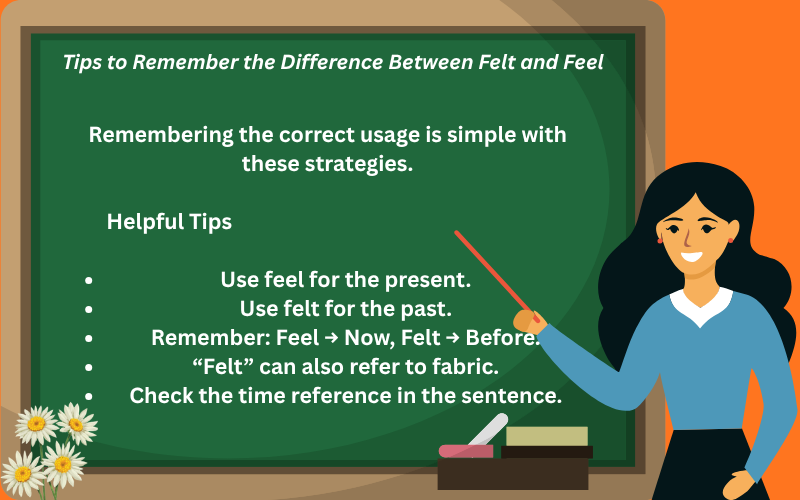
Remembering the correct usage is simple with these strategies.
Helpful Tips
- Use feel for the present.
- Use felt for the past.
- Remember: Feel → Now, Felt → Before.
- “Felt” can also refer to fabric.
- Check the time reference in the sentence.
Memory Trick
I feel today, I felt yesterday.
For More: Unaccessible vs Inaccessible
Real-Life Conversation Examples
Example 1:
Friend: How do you feel today?
You: I feel much better.
Example 2:
Teacher: How did you feel after the test?
Student: I felt relieved.
Example 3:
Doctor: Do you feel any pain?
Patient: Yes, I feel discomfort in my arm.
Example 4:
Shopkeeper: What material is this hat made from?
Customer: It’s made of felt.
Why People Confuse Felt and Feel
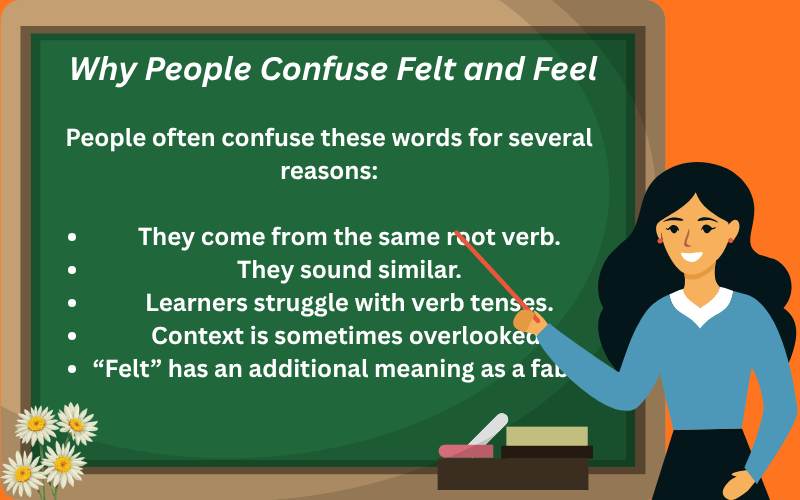
People often confuse these words for several reasons:
- They come from the same root verb.
- They sound similar.
- Learners struggle with verb tenses.
- Context is sometimes overlooked.
- “Felt” has an additional meaning as a fabric.
Why People Search “Felt or Feel”
Users commonly search for this topic to:
- Improve grammar and writing skills.
- Understand English verb tenses.
- Avoid common mistakes.
- Enhance spoken and written communication.
- Prepare for exams and professional writing.
Should You Use Felt or Feel?
- Use feel for present emotions and sensations.
- Use felt for past experiences.
- Use felt as a noun when referring to fabric.
- Always consider context and time reference.
- Choose the correct tense for clarity and accuracy.
See Also: Run or Ran
FAQs
Is it “I feel” or “I felt”?
Use “I feel” when you are talking about how you are feeling now. Use “I felt” when you are talking about a past feeling.
Is “felt” the past tense of “feel”?
Yes. “Felt” is the past tense and past participle form of “feel.”
Can I use “felt” for something that happened today?
Yes. “Today” does not always require the present tense. If the feeling happened earlier today, you can use “felt.”
For example:
I felt tired after my morning workout.
Is “I feel good” correct?
Yes. “I feel good” is a common and grammatically acceptable expression for describing your current condition or feeling.
What is the difference between feel and felt?
Feel usually refers to the present, while felt refers to the past.
Can “feel” describe a physical sensation?
Yes. You can use “feel” for physical sensations.
For example:
I feel a sharp pain in my hand.
The past version would be:
I felt a sharp pain in my hand.
What is the correct sentence: “I feel bad” or “I felt bad”?
Both can be correct. Use “I feel bad” for your current feeling and “I felt bad” for a past feeling.
Can I say “I did felt”?
No. After “did,” use the base form “feel.”
Correct:
I did feel nervous.
Incorrect:
I did felt nervous.
Is “felt” used with “have” or “has”?
Yes. “Felt” works as the past participle after “have,” “has,” or “had.”
Examples:
I have felt better lately.
She has felt tired all day.
They had felt nervous before the meeting.
What is the easiest way to remember feel vs felt?
Think about time. If the feeling is happening now, use feel. If it happened in the past, use felt.
Conclusion
The choice between felt or feel mainly depends on when the feeling or experience happened. Use feel when you describe something happening now, and use felt when you describe something that happened in the past.
For example, “I feel tired” describes your current condition, while “I felt tired” describes a previous condition.
Also remember that “feels” works with he, she, and it in the present tense. “Felt” stays the same with every subject.
Once you focus on the time of the action, the difference becomes easy. Use feel for the present and felt for the past.