
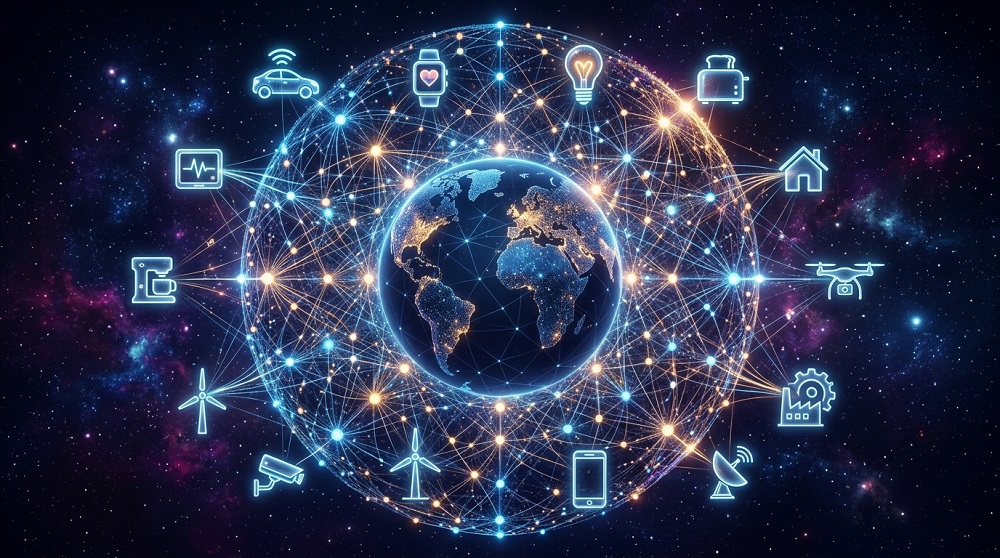
The Internet of Things (IoT) is the internet of everything, and it works by connecting physical objects to the web.
The digital connectivity that has been there for most of the internet’s existence has been limited to desktop computers, laptops and smartphones. When dealing with the digital world, a person had to sit in front of a screen, open a browser or type a prompt. Ten years ago, however, a silent revolution occurred—everything from light bulbs and wristwatches to factory turbines and farm sprinklers has a digital voice.
The Internet of Things (IoT) is a network of interrelated physical objects that can communicate with each other and with people via the internet. Instead of being a passive tool, IoT devices sense data from the real world, transfer it over networks, and take intelligent actions with little or no human involvement. With the workings of this ecosystem understood, a clearer understanding of modern technology and the way that it subtly runs the world.
The first step is to break down the IoT.The first step is to break down the IoT.
The Internet of Things at its core is the combination of billions of physical devices around the world equipped with sensors, software, and network connectivity that gather, share and react to data.
In the Modern Age, “Things” are defined.
In the IoT paradigm, a “thing” may be anything physical with a built-in electronics component. A wearable fitness band that monitors heart rate variability or a smart thermostat that knows your schedule or a robotic vacuum that maps your floor plan may be used at home. A “thing” in commercial or industrial applications may be a moisture sensor placed in the agricultural land, a RFID tag attached to a shipment of supplies in the supply chain, or an acoustic vibration sensor attached to a jet engine.
The Core Objective of IoT
The key goal of IoT is to bring the physical and digital worlds closer together. Ambient processes are physical processes that are present in the world around us, but not directly sensed or communicated by humans.Ambient physical processes are processes in the world around us that are not directly sensed or communicated by humans. This removes the need for manual guesswork, enables automated responses and allows systems to optimize themselves in real-time.
- How IoT works: The Four Key Layers
Though each system looks different in different industries, almost all IoT systems operate in a four-stage architecture:
Sensors and Actuators: 1. Sensing and Data Collection
The approach starts at the physical edge. Specialized sensors are built into devices to capture real-time data from the environment, such as temperature, movement, humidity, lights or air quality. Actuators are devices that take electrical signals and translate them into physical motion, such as opening a valve, turning on a motor or moving a lens, and are a part of most sensors.
- Communication and information transfer
After collecting, the data cannot be “stuck” on the device, it needs to be sent to a central processing center. There are several communication protocols between IoT devices depending on their power consumption, range and bandwidth:
For low power smart home devices, short-range communication networks such as Wi-Fi, Bluetooth, Zigbee, and Z-Wave are perfect.
Long-range cellular & LPWAN: 4G/5G and LoRaWAN enable remote sensors, like forest environmental monitors over miles and miles and highway fleet trackers, to communicate over long distance without draining the battery.
- Data Processing and Cloud Analytics
Data processing engines intervene once the data comes to a cloud server or local gateway. For simple cases, the software checks to see if readings are within acceptable limits, such as checking to see if the temperature in a server room is below $75^\circ\text{F}$. In more complex situations, machine learning algorithms can be used to identify irregularities in the data, detect patterns of use, or forecast the potential failure of industrial machinery.
The user interface and automated actions.
The last step is to convert raw data into value. Unless the event needed human involvement, the system would alert the end user through an app alert, an SMS message or a web dashboard (e.g., alert: “Unusual water flow detected in the basement”). Or, the system can perform closed-loop, automatic tasks, with no human input required – for example, automatic greenhouse roof vent opening when humidity levels rise out of the target range.
- Application of Real World: Everyday Life
The strength of IoT is the ability to fit into various industries and maximize efficiency that would not have been possible 25 years ago.
Smart Living and Urban Infrastructure
The IoT in personal living spaces uses automation to reduce energy use, shutting off unused heating, ventilating, and cooling systems, and managing the use of smart lights. At the macro level, Smart Cities use connected sensors in traffic networks to dynamically adjust signal durations according to levels of congestion, to keep a real-time update on public transit arrival times, or to monitor municipal water networks and detect leaks in the underground pipelines.
Industrial IoT (IIoT) and Healthcare.
Predictive maintenance is a key use case for the IoT in manufacturing. Embedded vibration and heat sensors tell engineers about micro-frictions before they can lead to catastrophic breakdowns, instead of servicing expensive machinery on an arbitrary calendar schedule. Today, in the field of healthcare, remote patient monitoring devices are used to monitor patients’ vital signs in real time, automatically notifying healthcare providers of dangerous fluctuations in their biometric data.
- Key Considerations: Security, Privacy, and the Future
While the benefits of IoT are significant, the rapid growth of the number of connected devices also presents some challenging issues:
Digital Security Risks: Many low-cost, IoT devices are shipped with weak default passwords, little or no encryption, and rarely get firmware updates, thus they are easy targets for cyber attacks.
Intimate Data Privacy: Users of all kinds are constantly tracked with respect to their physical movements, voice commands, and biometric signals, causing serious questions about the collection and selling of device users’ telemetry.
The future of IoT is changing to become AIoT (Artificial Intelligence on the Device) with the integration of Edge AI. Instead of transmitting all data to remote cloud sites, devices are more often processing data on-site to dramatically reduce latency and enhance privacy.
Conclusion: An Ambient, Responsive World
The Internet of Things is not just about voice-controlled light switches, but about a new way of interacting with the physical world. IoT introduces a layer of ambient intelligence, making static things active, useful endpoints that are driven by data and save resources, prevent costly mistakes and automate tedious jobs. With the development of connectivity standards and security protocols, the physical world will continue to become more intuitive, responsive, and interconnected in the future.