
The difference between “me” and “myself” is based on their role in a sentence. “Me” is an object pronoun used when someone else performs an action on you, while “myself” is a reflexive pronoun used when you are both the subject and the object of the action. In simple terms, use “me” when the action comes from another person, and use “myself” when the action reflects back to you.
Understanding the correct use of “me” and “myself” is one of the most common grammar challenges in English. These two words may look similar because they both refer to the speaker, but they serve completely different grammatical purposes. Many people, including students, professionals, and even native speakers, often confuse them in everyday communication.
The confusion usually happens because people assume that “myself” sounds more formal or polite than “me.” As a result, they start using “myself” in places where it is not grammatically correct. This mistake is very common in emails, workplace communication, and social media, where people try to sound more professional but end up making errors.
In today’s digital world, communication happens quickly, and small grammar mistakes can easily go unnoticed. However, incorrect usage of words like “me” and “myself” can affect clarity and professionalism. Using the right pronoun helps your message sound natural, clear, and confident.
This complete guide will help you fully understand the difference between “me” and “myself.” You will learn simple grammar rules, real-life examples, common mistakes, and practical tips that will help you use both words correctly in any situation.
📊 Quick Comparison Table
| Word | Type | Function | Example |
| Me | Object pronoun | Receives the action | She called me |
| Myself | Reflexive pronoun | Reflects action back | I taught myself |
📖 What Does “Me” Mean in English Grammar?
“Me” is an object pronoun. It is used when you are the person receiving the action in a sentence. This means that another person is doing something, and you are affected by that action.
🔑 Key Rule:
Use “me” when someone else is performing the action on you.
📌 Examples:
- She invited me to the party
- They helped me complete the project
- He told me the truth
- Can you hear me clearly?
📖 What Does “Myself” Mean in Grammar?
“Myself” is a reflexive pronoun. It is used when the subject and the object of the sentence are the same person. This means the action starts from you and comes back to you.
🔑 Key Rule:
Use “myself” when you are doing something to yourself.
📌 Examples:
- I taught myself how to swim
- I blamed myself for the mistake
- I introduced myself to the team
- I hurt myself while playing
🔍 Core Difference Between “Me” and “Myself”
- Me = Someone else → action → you
- Myself = You → action → yourself
💬 Real-Life Conversation Examples
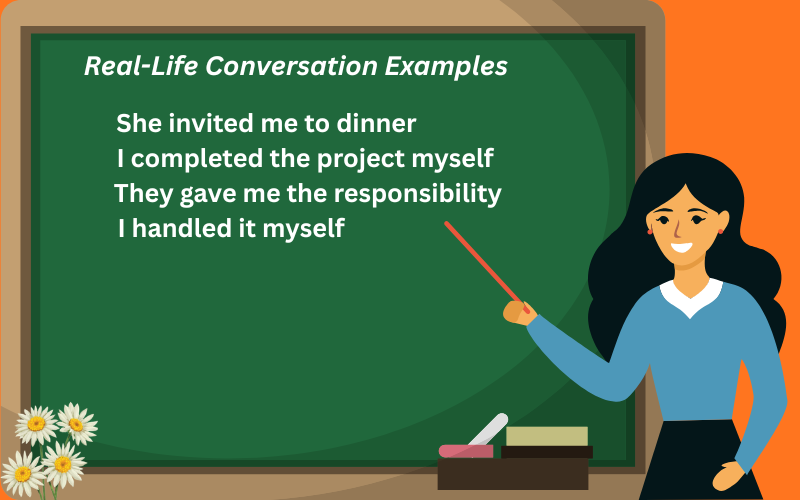
- She invited me to dinner
- I completed the project myself
- They gave me the responsibility
- I handled it myself
⚠️ Most Common Mistakes
❌ Please contact John or myself
✔ Please contact John or me
❌ He spoke to myself
✔ He spoke to me
👉 Never use “myself” as a replacement for “me.”
🧠 Why Do People Confuse “Me” and “Myself”?
- Trying to sound formal
- Lack of grammar understanding
- Copying incorrect usage
📚 Simple Trick to Always Get It Right
Remove the other person:
- John and me/myself went ❌
- I went ✔
👉 Correct: John and I went ✔
🔁 Me vs I vs Myself
| Word | Usage |
| I | Subject |
| Me | Object |
| Myself | Reflexive |
🎯 When to Use “Me”
Use “me” when:
- You receive the action
- Another person is involved
- It comes after a preposition
🎯 When to Use “Myself”
Use “myself” when:
- You are both subject and object
- The action reflects back
- You want to emphasize independence
🧠 Common Sentence Patterns Using “Me” and “Myself”
Understanding common sentence patterns can make it much easier to use “me” and “myself” correctly. In most English sentences, “me” appears after verbs or prepositions because it functions as the object receiving the action. For example, in sentences like “She called me” or “They invited me,” the action is clearly directed toward you.
On the other hand, “myself” appears in sentences where the subject and object are the same. This often happens in actions involving self-learning, self-reflection, or self-action. For example, “I taught myself English” or “I blamed myself for the mistake.” Recognizing these patterns helps you naturally choose the correct word without overthinking grammar rules.
✍️ Formal vs Informal Usage of “Me” and “Myself”
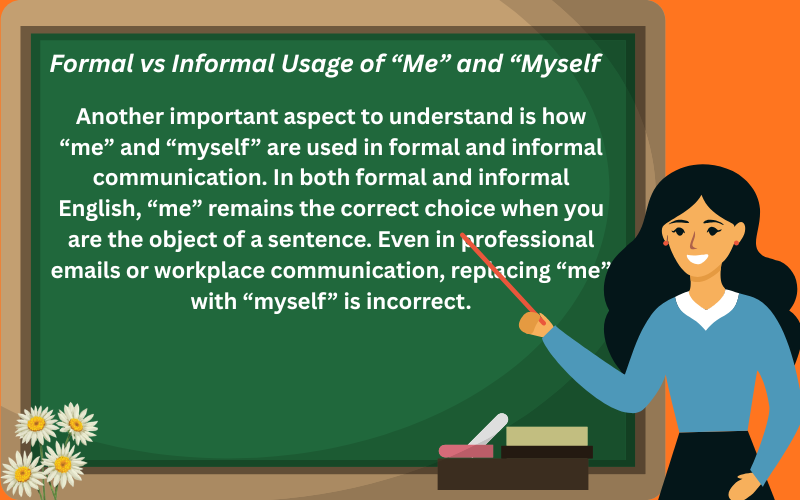
Another important aspect to understand is how “me” and “myself” are used in formal and informal communication. In both formal and informal English, “me” remains the correct choice when you are the object of a sentence. Even in professional emails or workplace communication, replacing “me” with “myself” is incorrect.
Many people mistakenly believe that “myself” sounds more professional, which leads to incorrect sentences like “Please contact myself.” In reality, this usage can reduce the clarity and professionalism of your writing. Proper grammar always improves communication more than trying to sound formal unnecessarily.
See Also: Unaccessible vs Inaccessible: Meaning & Differences
🔍 How Context Changes the Meaning
Context plays a very important role in deciding whether to use “me” or “myself.” The same sentence structure can completely change meaning depending on who is performing the action. For example, “They gave me the task” clearly shows that someone else assigned you work, while “I gave myself a challenge” shows a self-directed action.
Understanding context helps you avoid confusion, especially in longer sentences. Always focus on who is performing the action and who is receiving it. This simple habit will improve your grammar naturally.
📚 Practice Sentences to Improve Your Understanding
One of the best ways to master the difference between “me” and “myself” is through practice. Try correcting sentences like “She told myself the answer” or “I prepared me for the exam.” Identifying mistakes helps reinforce the correct usage.
You can also create your own sentences based on real-life situations, such as “My teacher helped me understand the lesson” or “I prepared myself for the presentation.” Regular practice builds confidence and accuracy.
🚀 Tips to Avoid Mistakes in Daily Communication
To avoid mistakes, always remember a few simple rules. First, check who is performing the action. If the action comes from another person, use “me.” If it reflects back to you, use “myself.”
Second, avoid using “myself” just to sound formal. Clear and simple language is always better than complicated or incorrect sentences. Finally, keep your sentences natural and easy to understand. This will improve both your grammar and communication skills.
FAQs
1. What is the difference between me and myself?
“Me” receives action, while “myself” reflects action back to the subject.
2. When should I use “me”?
When someone else is performing the action.
3. When should I use “myself”?
When the action reflects back to you.
4. Is “John and myself” correct?
No, it is incorrect in most cases.
5. Why is “myself” overused?
Because people think it sounds more formal.
6. Can “myself” replace “me”?
No, it cannot.
7. Is “myself” used for emphasis?
Yes, to show independence.
8. What type of pronoun is “me”?
Object pronoun.
9. What type of pronoun is “myself”?
Reflexive pronoun.
10. How to remember the difference?
Use “me” for others’ actions and “myself” for your own actions.
See Also: WTH Meaning in Text: Full Guide, Uses & Examples
Conclusion
The difference between “me” and “myself” becomes simple once you understand their roles. “Me” is used when you receive an action from someone else, while “myself” is used when the action reflects back to you. Applying these basic rules can help you avoid common mistakes.
Using correct grammar improves clarity, confidence, and professionalism. Whether you are writing, speaking, or chatting online, mastering “me” and “myself” will help you communicate more effectively in any situation.
