
Both “ageing” and “aging” are correct spellings, but they are used in different forms of English. “Ageing” is preferred in British English, while “aging” is used in American English. Both words have the same meaning and describe the process of growing older. The only important rule is to choose one version based on your audience and use it consistently throughout your writing.
English is a global language, and one of its most interesting features is how it changes across regions. This variation often leads to confusion, especially when it comes to spelling differences. A common example of this is ageing or aging, where both spellings exist and are widely used. Many writers feel uncertain about which one to choose, and this confusion can affect the quality and consistency of their content.
The difference between ageing and aging is not about right or wrong, but about regional usage and writing style. British English tends to preserve traditional spellings, while American English simplifies them. As a result, “ageing” and “aging” both developed as acceptable forms. Understanding this difference is important for bloggers, students, and professionals who want to produce clear, consistent, and high-quality content.
In this comprehensive guide, you will explore everything about ageing or aging, including grammar rules, regional differences, real-life examples, SEO impact, writing tips, and common mistakes. By the end of this article, you will not only understand the difference but also know exactly when and how to use each spelling correctly.
📊 Quick Overview Table
| Word | Correct or Incorrect | Usage |
| Ageing | ✅ Correct | British English |
| Aging | ✅ Correct | American English |
📖 What Is the Difference Between Ageing and Aging?
The difference between ageing and aging lies in regional spelling preferences rather than meaning. Both words describe the same process—the gradual changes that occur as people, animals, or objects grow older over time. However, the spelling changes depending on whether you are using British English or American English.
In British English, the spelling “ageing” is used because it follows a traditional pattern where the letter “e” is retained when adding “-ing.” In contrast, American English simplifies the spelling by dropping the extra “e,” resulting in “aging.” This pattern is common in many other words as well.
For writers, the key is not choosing the “right” word, but choosing the correct version for their audience. If your readers are based in the United States, “aging” is the better choice. If your audience is in the United Kingdom or regions that follow British English, “ageing” should be used.
Examples:
- British: The population is rapidly ageing.
- American: The population is rapidly aging.
🧠 Why Both “Ageing” and “Aging” Are Correct
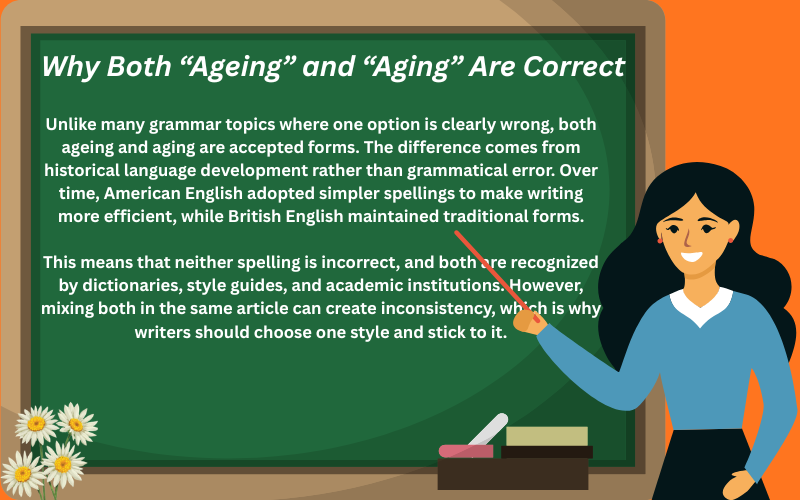
Unlike many grammar topics where one option is clearly wrong, both ageing and aging are accepted forms. The difference comes from historical language development rather than grammatical error. Over time, American English adopted simpler spellings to make writing more efficient, while British English maintained traditional forms.
This means that neither spelling is incorrect, and both are recognized by dictionaries, style guides, and academic institutions. However, mixing both in the same article can create inconsistency, which is why writers should choose one style and stick to it.
📚 Detailed Explanation of British vs American Spelling
The difference between ageing and aging is part of a broader pattern in English. British English tends to keep older spelling forms, while American English simplifies them.
British English (Ageing):
- Retains traditional spelling
- Common in UK, Australia, and other regions
- Often includes extra letters
American English (Aging):
- Uses simplified spelling
- Common in the United States
- Removes unnecessary letters
Examples:
- British: She is researching the effects of ageing.
- American: She is researching the effects of aging.
💬 Examples of Ageing and Aging in Sentences
Understanding usage becomes easier when you see both forms in context.
British English:
- The country is facing an ageing population.
- Healthy ageing requires a balanced lifestyle.
American English:
- The country is dealing with an aging population.
- Healthy aging depends on diet and exercise.
❌ Common Mistakes People Make
One of the most common mistakes is mixing ageing and aging in the same piece of writing. This creates inconsistency and can confuse readers. Another mistake is assuming that one spelling is incorrect, which is not true.
Examples:
- ❌ The effects of ageing and aging are increasing.
- ✅ The effects of aging are increasing.
- ✅ The effects of ageing are increasing.
🧠 Why People Get Confused Between Ageing and Aging
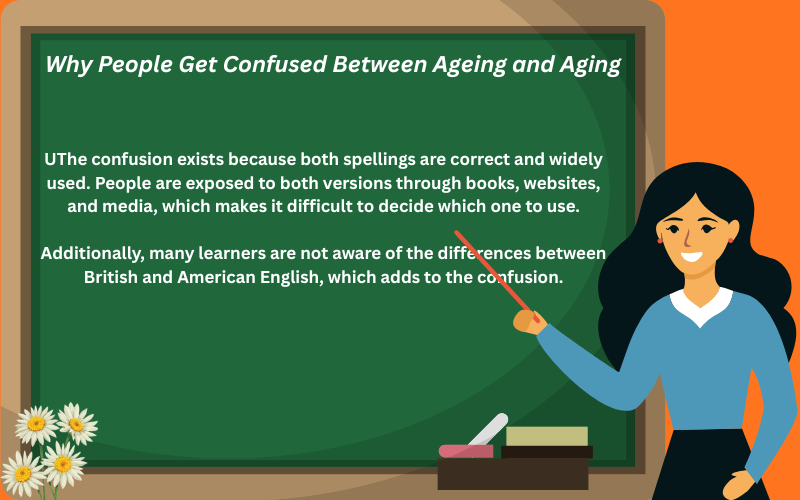
The confusion exists because both spellings are correct and widely used. People are exposed to both versions through books, websites, and media, which makes it difficult to decide which one to use.
Additionally, many learners are not aware of the differences between British and American English, which adds to the confusion.
See Also: Run or Ran: Meaning, Difference and Correct Usage Guide
📱 Real-Life Usage in Different Contexts
The terms ageing and aging are used in various fields, including health, science, and society.
Examples:
- Doctors study the effects of aging on the human body.
- Governments plan policies for an ageing population.
📌 Ageing or Aging in Scientific Writing – Which One Is Used?
In scientific writing, both ageing and aging are used depending on the region of publication. American journals typically use “aging,” while British journals prefer “ageing.” This distinction is important for researchers who need to follow specific style guidelines.
Examples:
- US journal: The study examines aging cells.
- UK journal: The research focuses on ageing processes.
🧠 Ageing or Aging in Psychology and Daily Life Usage
In psychology and everyday communication, both ageing and aging describe emotional and mental development over time.
Examples:
- Positive aging includes mental well-being.
- Healthy ageing involves emotional balance.
📱 Ageing or Aging in Digital Content and SEO Writing
In SEO writing, consistency between ageing or aging is very important. Search engines prefer clear and consistent language usage.
Examples:
- Blog targeting US audience: Healthy aging tips
- Blog targeting UK audience: Guide to ageing well
🔄 Ageing or Aging in Style Guides and Grammar Rules
Different style guides recommend different spellings.
Examples:
- APA: Aging
- British style: Ageing
📈 Ageing or Aging – Why Consistency Matters in Writing
Consistency ensures clarity and professionalism.
Examples:
- ❌ Mixing aging and ageing
- ✅ Using only one consistently
📊 Ageing vs Aging Comparison
| Feature | Ageing | Aging |
| Region | British | American |
| Meaning | Same | Same |
| Correct | ✅ | ✅ |
📌 Role in Communication
Both words are important in modern communication.
📈 Long-Term Benefits of Correct Usage
Using correct spelling improves writing quality and SEO.
🎯 Final Verdict
Both are correct:
👉 British: Ageing
👉 American: Aging
FAQs
1. Is ageing correct in English?
Yes, ageing is correct and is commonly used in British English.
2. Is aging correct in English?
Yes, aging is also correct and is used in American English.
3. What is the main difference between ageing and aging?
The main difference is regional usage. Ageing is British, while aging is American.
4. Can I use ageing and aging in the same article?
No, it is not recommended. You should choose one and use it consistently.
5. Which spelling is more common globally?
“Aging” is slightly more common due to American influence, but both are widely used.
6. Is there any difference in meaning?
No, both words have the same meaning.
7. Which spelling should I use for SEO?
Use the spelling that matches your target audience.
8. Do dictionaries accept both ageing and aging?
Yes, most major dictionaries accept both spellings.
9. Is ageing more formal than aging?
No, both are equally formal.
10. Why is consistency important in using ageing or aging?
Consistency improves readability, professionalism, and SEO performance.
See Also: Me or Myself: Key Differences, Rules & Examples Guide
Conclusion
The difference between ageing or aging is not about correctness but about regional preference and writing style. Both spellings are valid and widely accepted, making this a unique case in English where two forms coexist without conflict. However, the key to using them correctly lies in understanding your audience and maintaining consistency throughout your content.
In professional, academic, and SEO writing, even small details like spelling can have a significant impact. By choosing either “ageing” or “aging” and using it consistently, you ensure that your writing remains clear, credible, and easy to understand. Mastering such differences not only improves your grammar but also strengthens your overall communication skills.
