
Resilience meaning refers to the ability to stay strong, recover from problems, and keep moving forward after difficult situations. People often use this word for emotional strength, mental toughness, and the power to handle challenges without giving up.
The term resilience meaning describes a person’s ability to bounce back after stress, failure, sadness, or difficult experiences. Moreover, the word appears in psychology, education, work, relationships, and daily conversations.
Additionally, resilience does not mean avoiding problems. Instead, it means facing challenges and recovering with strength and confidence.
Life brings unexpected problems, failures, and emotional struggles. However, resilient people continue moving forward even during hard times. Therefore, understanding resilience meaning helps you describe mental strength and emotional recovery in a simple and powerful way.
Understanding Resilience Meaning in Simple English
Resilience means staying strong when life becomes difficult. If someone faces stress, loss, failure, or pressure but continues trying, that person shows resilience.
Moreover, resilience does not mean a person never feels sad or tired. Instead, it means they recover after difficult moments. For example, a student who fails a test but studies harder shows resilience.
Resilience Meaning: Simple Definition
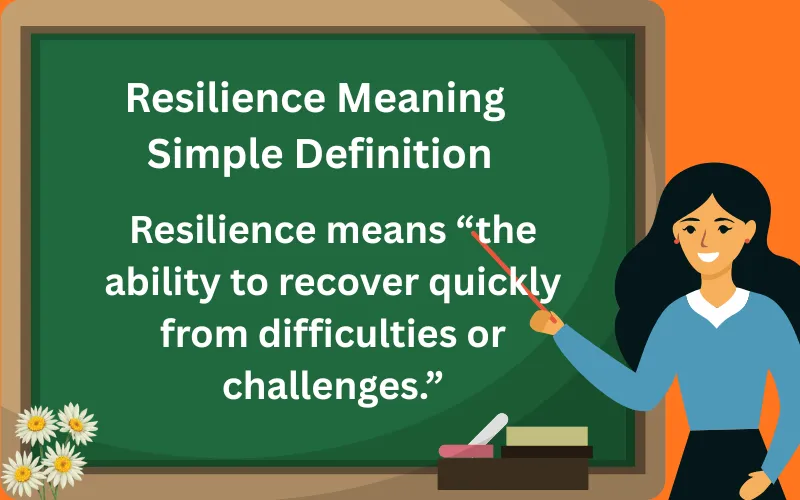
Resilience means “the ability to recover quickly from difficulties or challenges.”
People use this word for emotional, mental, and even physical strength. Additionally, resilience helps people stay positive and focused during difficult situations.
😊 “Her resilience helped her succeed after many failures.”
- “He showed resilience after losing his job.”
- “Children can develop resilience over time.”
- “The team’s resilience impressed everyone.”
- “Resilience helps people stay calm under pressure.”
Where Does the Word Resilience Come From?
The word “resilience” comes from the Latin word resilire, which means “to jump back” or “bounce back.” Later, English speakers started using it for emotional and physical recovery.
Moreover, the word first appeared in science and engineering. However, people now mostly use it to describe mental and emotional strength.
😊 “The word resilience originally meant bouncing back.”
- “The term later entered psychology.”
- “Today, resilience appears everywhere.”
- “People admire resilient individuals.”
- “The meaning stayed connected to recovery.”
Resilience Meaning in Different Contexts
| Context | Meaning | Example | Tone | Common Usage |
| Psychology | Emotional recovery | Mental resilience | Positive | Very common |
| School | Academic persistence | Student resilience | Positive | Common |
| Workplace | Handling stress | Workplace resilience | Professional | Common |
| Sports | Recovering after loss | Team resilience | Motivational | Common |
| Relationships | Emotional strength | Relationship resilience | Positive | Common |
Additionally, resilience changes slightly depending on context. In psychology, it focuses on emotions. In sports, it focuses on persistence and recovery.
😊 “The athlete showed incredible resilience after the injury.”
- “Students need resilience during exams.”
- “Good leaders develop resilience.”
- “Her resilience inspired the class.”
- “Families also build resilience together.”
Is Resilience Positive, Negative, or Neutral?
| Usage | Tone | Example |
| Emotional strength | Positive | “His resilience helped him recover.” |
| Mental toughness | Positive | “She showed resilience during stress.” |
| Recovery after failure | Positive | “The company survived through resilience.” |
| Ignoring emotions completely | Negative | “Fake resilience can feel unhealthy.” |
| Learning from challenges | Positive | “Resilience builds confidence.” |
Usually, resilience has a positive meaning. However, some people misuse it by pretending emotions do not matter.
😊 “True resilience includes healing, not hiding pain.”
- ✅ “Her resilience motivated everyone.”
- ❌ “Resilience means never crying.”
- ✅ “Strong people can still feel emotional.”
- ❌ “Resilience removes stress completely.”
How to Use Resilience Correctly
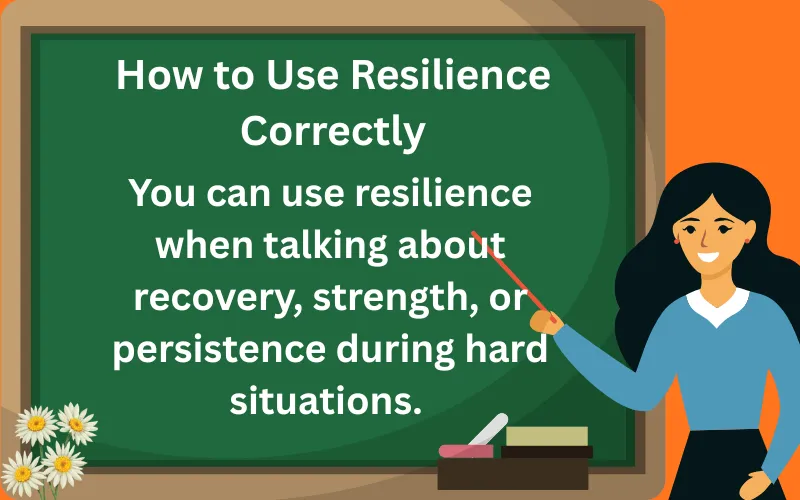
You can use resilience when talking about recovery, strength, or persistence during hard situations. Moreover, people often use it in schools, workplaces, sports, and motivational conversations.
Additionally, resilience usually appears as a noun in sentences.
😊 “His resilience helped him start again.”
- “Resilience builds confidence.”
- “Teachers encourage resilience.”
- “The community showed resilience.”
- “Her resilience inspired her friends.”
- “We admire resilient people.”
See Also: RLS Meaning in Text: Uses, Examples & Full Guide
Common Situations Where Resilience Is Used
People use resilience in many daily situations. Specifically, the word appears when discussing stress, failure, recovery, or emotional growth.
😊 “The family showed resilience after the storm.”
- Recovering after exams
- Handling workplace pressure
- Dealing with heartbreak
- Starting again after failure
- Managing emotional stress
- Sports recovery
- Overcoming financial problems
Can Resilience Be Used Sarcastically?
Yes, but it happens rarely. Sometimes people use resilience sarcastically when someone acts overly tough or hides emotions completely.
😊 “Wow, your ‘resilience’ after losing one game lasted five minutes.”
- “He calls it resilience, but he avoids feelings.”
- “That fake smile is not resilience.”
- “Her dramatic speech about resilience sounded funny.”
- “Apparently, missing breakfast builds resilience.”
- “Sure, resilience fixed everything instantly.”
Resilience in Questions
People often use resilience in questions about emotional strength, recovery, and growth. Moreover, teachers, coaches, and counselors frequently use these questions.
😊 “How can children build resilience?”
- “Why is resilience important?”
- “Can resilience be learned?”
- “What causes resilience?”
- “How do people develop resilience?”
- “Does resilience improve confidence?”
Resilience in Formal vs Informal Writing
| Situation | Formal or Informal | Example |
| Psychology article | Formal | “Resilience supports emotional recovery.” |
| Motivational speech | Both | “Resilience creates strong people.” |
| School discussion | Informal | “Students need resilience.” |
| Social media quote | Informal | “Stay strong and resilient.” |
| Workplace training | Formal | “Employee resilience matters.” |
| Daily conversation | Informal | “Her resilience impressed me.” |
😊 “The article explained emotional resilience clearly.”
- “Stay resilient during hard times.”
- “Resilience improves mental health.”
- “Her resilience felt inspiring.”
- “The coach praised team resilience.”
Resilience vs Strength vs Perseverance: Key Differences
| Word | Main Meaning | Focus | Common Usage | Tone |
| Resilience | Recovery after problems | Bouncing back | Psychology and daily life | Positive |
| Strength | Physical or mental power | Power and ability | General | Positive |
| Perseverance | Continuing despite difficulty | Persistence | Motivational | Positive |
Additionally, resilience focuses more on recovery, while perseverance focuses on continuing effort.
😊 “Her resilience and perseverance helped her succeed.”
- “Strength supports resilience.”
- “Perseverance requires patience.”
- “Resilient people recover faster.”
- “Each word has a unique meaning.”
Advanced Usage of Resilience
People often combine resilience with phrases about mental health, leadership, and growth. Moreover, professionals use it in formal discussions.
With Nouns
😊 “Mental resilience helps during stressful times.”
- “Emotional resilience”
- “Community resilience”
- “Financial resilience”
- “Personal resilience”
In Formal Writing
😊 “Resilience improves long-term emotional stability.”
- “Resilience strategies”
- “Resilience training”
- “Resilience development”
- “Resilience research”
A short story makes this easier to understand. One student failed an important exam but kept studying daily. Months later, she passed confidently. Her teacher called that true resilience.
Synonyms of Resilience
💪 Strength — mental or physical power
🌱 Recovery — returning after difficulty
🔥 Toughness — ability to handle pressure
🚀 Perseverance — continuing despite problems
✨ Determination — strong focus on goals
🛡 Endurance — lasting through hardship
🌈 Adaptability — adjusting to change
😊 “Her determination and resilience inspired everyone.”
- “Recovery takes patience.”
- “Toughness helps during stress.”
- “Endurance builds confidence.”
- “Adaptability supports growth.”
Antonyms / Opposite of Resilience
- Weakness — lack of strength
- Fragility — easily damaged emotionally
- Hopelessness — losing hope quickly
- Defeat — giving up after failure
- Vulnerability — difficulty handling pressure
😊 “Hopelessness can reduce resilience.”
- “Weakness affected his confidence.”
- “Fragility increased stress.”
- “Defeat stopped his progress.”
- “Vulnerability needs support.”
Common Mistakes People Make with Resilience
❌ “Resilience means never feeling sad.”
✅ “Resilience means recovering after sadness.”
❌ “Only strong adults show resilience.”
✅ “Children can also develop resilience.”
Memory Trick — Never Forget Resilience Meaning Again
Think of a rubber ball. When you throw it down, it bounces back quickly. Resilience works the same way in life.
Another easy trick helps too. Imagine a tree during a storm. It bends but does not break. That is resilience.
Resilience = Fall + Recover + Grow
😊 “Resilient people rise after challenges.”
- “Hard times build resilience.”
- “Recovery shows resilience.”
- “Strong minds stay resilient.”
- “Growth often follows failure.”
Quick Practice Section
Fill in the blanks with the correct word.
- Her ________ helped her recover after failure.
- Teachers encourage emotional ________.
- The athlete showed amazing ________.
- Resilience helps people handle ________.
- Strong recovery often shows ________.
Answers
- resilience
- resilience
- resilience
- stress
- resilience
Similar Words Like Resilience
💪 Strength — mental power
🌱 Recovery — healing after problems
🔥 Toughness — ability to survive pressure
🚀 Persistence — continuing effort
✨ Courage — bravery during fear
🛡 Endurance — surviving hardship
🌈 Flexibility — adapting to change
😊 “Her courage and resilience impressed everyone.”
- “Persistence builds success.”
- “Strength supports recovery.”
- “Flexibility helps during change.”
- “Endurance improves confidence.”
Resilience in Social Media and Pop Culture
Social media often uses resilience in motivational posts, mental health discussions, and inspirational videos. Moreover, celebrities and athletes frequently talk about resilience after failures or emotional struggles.
😊 “Her story of resilience went viral online.”
- “Mental health resilience quotes”
- “Resilience after heartbreak”
- “Motivational resilience videos”
- “Athlete resilience stories”
- “Personal growth content”
- “Overcoming failure posts”
- “Emotional healing discussions”
Resilience in Daily Conversations
People use resilience naturally while discussing life challenges and emotional growth. Additionally, the word appears often in schools, workplaces, and family conversations.
😊 “Your resilience during hard times is inspiring.”
- “Children learn resilience slowly.”
- “That experience built resilience.”
- “We admire resilient leaders.”
- “Her resilience gave others hope.”
- “Stress can improve resilience.”
- “The team stayed resilient.”
- “Life challenges create resilience.”
If you enjoyed reading this article, you might also like the ones below.
FAQs
What does resilience mean?
Resilience means the ability to recover after difficulties or challenges.
Is resilience a positive word?
Yes, resilience usually has a positive meaning.
Can resilience be learned?
Yes, people can build resilience through experience and practice.
Is resilience emotional strength?
Yes, resilience often describes emotional and mental strength.
Why is resilience important?
Resilience helps people recover and continue moving forward.
Can children develop resilience?
Yes, children can learn resilience over time.
Is resilience the same as toughness?
No, resilience focuses more on recovery after difficulty.
Can resilience help mental health?
Yes, resilience supports emotional balance and recovery.
Do athletes need resilience?
Yes, resilience helps athletes recover after losses and injuries.
Can resilience appear in daily conversations?
Yes, people use it commonly in everyday life.
See Also: Serendipity Meaning What Does Serendipity Really Mean?
Conclusion
Understanding resilience meaning becomes easier when you connect it with recovery, emotional strength, and persistence. Moreover, resilient people continue moving forward even after difficult experiences, failures, or emotional stress.
Additionally, resilience meaning reminds us that challenges are part of life. However, strong recovery and personal growth matter more than avoiding problems completely.