


“Flew” is the simple past tense of “fly,” while “flown” is the past participle used with auxiliary verbs such as “has,” “have,” or “had.” Understanding their correct usage ensures accurate and fluent communication in English.
English grammar often presents challenges, especially when it comes to irregular verbs. One of the most commonly confused verb forms is flew and flown, both derived from the verb “fly.” Although they share the same root, they serve different grammatical functions.
Mastering the difference between flew vs flown helps you write and speak with clarity, professionalism, and confidence. This comprehensive guide explains their meanings, usage rules, examples, and common mistakes.
Quick Overview of Flew vs Flown
| Word | Verb Form | Tense | Usage | Example |
| Flew | Simple Past | Past Tense | Used without auxiliary verbs | She flew to London yesterday. |
| Flown | Past Participle | Perfect Tenses | Used with has, have, or had | She has flown to London. |
What Does “Flew” Mean?
The word “flew” is the simple past tense of the verb “fly.” It describes an action that occurred and was completed in the past.
Examples of “Flew”
- She flew to Paris last week.
- The bird flew across the sky.
- They flew to Dubai for vacation.
- The kite flew high in the wind.
- He flew a drone over the valley.
What Does “Flown” Mean?
The term “flown” is the past participle of “fly.” It is used with auxiliary verbs such as has, have, and had to form perfect tenses.
Examples of “Flown”
- She has flown to London many times.
- They have flown internationally before.
- He had flown the aircraft prior to the storm.
- The drone has flown over restricted areas.
- We have flown together on several occasions.
Key Differences Between Flew and Flown
| Feature | Flew | Flown |
| Verb Form | Simple Past | Past Participle |
| Usage | Used alone | Used with auxiliary verbs |
| Tense | Past Simple | Present, Past, and Future Perfect |
| Grammar Rule | No helping verb required | Requires has, have, or had |
| Example | He flew home yesterday. | He has flown home. |
The Verb Forms of “Fly”
| Base Form | Simple Past | Past Participle | Present Participle |
| Fly | Flew | Flown | Flying |
Examples
- Birds fly south in winter.
- The plane flew over the mountains.
- The pilot has flown internationally.
- She is flying to New York today.
- They had flown before sunrise.
The Grammatical Role of Flew and Flown
Understanding grammar is essential when distinguishing between these two forms. “Flew” functions as a standalone verb in the past tense, whereas “flown” requires a helping verb to complete its meaning in perfect tenses.
Examples
- She flew to Italy last summer.
- They have flown across the Atlantic.
- He had flown before earning his license.
- The eagle flew above the cliffs.
- The plane has flown safely through the storm.
Flew vs Flown in Aviation and Travel
Both words are frequently used in aviation and travel contexts. They describe past journeys, flight experiences, and professional piloting activities.
Examples
- The pilot flew the aircraft safely.
- She has flown to more than ten countries.
- They flew to Turkey for their honeymoon.
- He had flown commercial jets for years.
- The airline has flown millions of passengers worldwide.
Flew vs Flown in Literature and Everyday Expressions
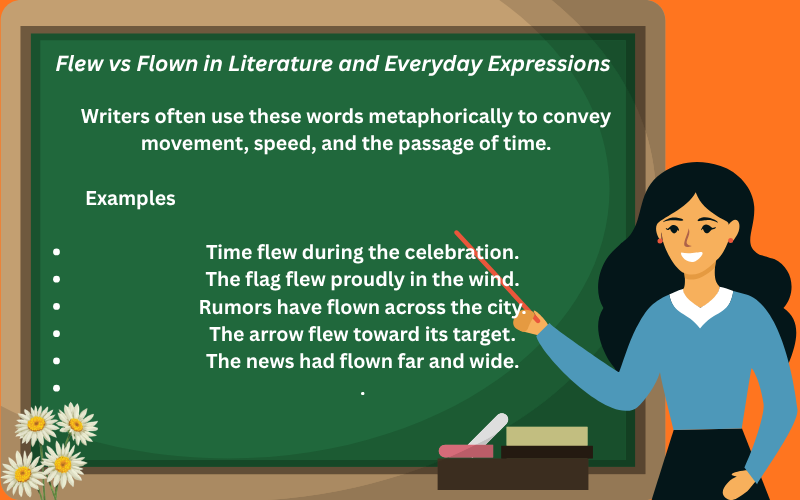
Writers often use these words metaphorically to convey movement, speed, and the passage of time.
Examples
- Time flew during the celebration.
- The flag flew proudly in the wind.
- Rumors have flown across the city.
- The arrow flew toward its target.
- The news had flown far and wide.
See Also: Dreamt or Dreamed: Which One Is Correct? Full Guide
Common Mistakes When Using Flew and Flown
Many English learners confuse these forms due to irregular verb patterns. Recognizing common errors can help you avoid them.
Examples
- ❌ She has flew to London.
✅ She has flown to London. - ❌ They have flew abroad.
✅ They have flown abroad. - ❌ He had flew the plane before.
✅ He had flown the plane before. - ❌ We flown to Paris last year.
✅ We flew to Paris last year. - ❌ The bird has flew away.
✅ The bird has flown away.
The Importance of Using Flew and Flown Correctly in English
Using correct verb forms enhances clarity, credibility, and professionalism in both spoken and written communication. Accurate grammar is essential in academic, business, and professional environments.
Examples
- Students have flown abroad for higher education.
- The company flew executives to an international conference.
- Researchers have flown to remote locations for studies.
- Diplomats have flown to attend global summits.
- Athletes flew to compete in international tournaments.
Historical Origin of the Verb “Fly”
The verb “fly” originates from the Old English word flēogan, meaning “to move through the air.” Over time, it evolved into the irregular forms used in modern English.
Examples
- Early aviators flew primitive aircraft.
- Birds have flown across continents for centuries.
- Messengers flew banners during medieval times.
- Explorers flew national flags on new lands.
- Legends describe creatures that had flown across kingdoms.
Common Synonyms of “Fly”
| Synonym | Meaning | Example |
| Soar | To fly high | The eagle soared above the mountains. |
| Glide | To move smoothly through the air | The swan glided across the lake. |
| Hover | To remain suspended in the air | The drone hovered above the field. |
| Drift | To move slowly through the air | The balloon drifted away. |
| Sail | To move gracefully | The kite sailed in the sky. |
Tips to Remember the Difference Between Flew and Flown
Helpful Tips
- Flew is used for completed actions in the past.
- Flown is used with helping verbs such as has, have, or had.
- Never use “flown” without an auxiliary verb.
- Both are forms of the irregular verb “fly.”
- Check the tense of your sentence before choosing the correct form.
Memory Trick
Flew = Finished action in the past
Flown = Used with Has, Have, or Had
Real-Life Conversation Examples
Example 1
Traveler: When did you visit Dubai?
Friend: I flew there last year.
Example 2
Colleague: Have you ever traveled abroad?
You: Yes, I have flown to several countries.
Example 3
Pilot: Have you flown this aircraft before?
Co-pilot: Yes, I have.
Example 4
Teacher: Why are you late?
Student: Sorry, time has flown by!
Why People Confuse Flew and Flown
People often mix up these terms because:
- They are irregular verb forms.
- They share the same root word.
- Perfect tenses can be confusing.
- Learners forget to use auxiliary verbs.
- Both words relate to flight and travel.
Why People Search “Flew vs Flown”
Users commonly search for this topic to:
- Learn correct grammar usage.
- Improve their English writing skills.
- Understand irregular verbs.
- Avoid common mistakes.
- Enhance academic and professional communication.
Should You Use Flew or Flown?
- Use flew for actions completed in the past.
- Use flown with auxiliary verbs like has, have, or had.
- Ensure grammatical accuracy in formal writing.
- Review sentence structure before choosing.
- Practice regularly to master irregular verbs.
FAQs
What is the difference between flew and flown?
“Flew” is the simple past tense of “fly,” while “flown” is the past participle used with auxiliary verbs.
Is it correct to say “has flew”?
No, the correct phrase is “has flown.”
What is the past tense of fly?
The past tense of “fly” is flew.
What is the past participle of fly?
The past participle of “fly” is flown.
Can flown be used without a helping verb?
No, it must be used with auxiliary verbs such as has, have, or had.
Can flew and flown be used interchangeably?
No, they serve different grammatical purposes.
What is an example of flew in a sentence?
“She flew to New York yesterday.”
What is an example of flown in a sentence?
“She has flown to New York many times.”
How can I remember the difference easily?
Remember: Flew is past tense; Flown is used in perfect tenses.
See Also: Separate or Seperate: Which Spelling Is Correct?
Conclusion
Understanding the difference between flew vs flown is essential for mastering English grammar. While “flew” describes a completed action in the past, “flown” functions as the past participle used with auxiliary verbs. Using these forms correctly ensures clarity, accuracy, and professionalism in both spoken and written communication.
