“Hey, is your friends coming tonight?” You might understand what the person means, but something about the sentence does not sound right. The correct version is “Are your friends coming tonight?” because “friends” refers to more than one person.
This kind of mistake happens often in texts because we usually type quickly and do not stop to check every sentence. That is why choosing between is or are can sometimes feel confusing, even when you know basic English grammar.
The simple rule is that is usually goes with a singular subject, while are goes with a plural subject. For example, “My brother is home” uses is, but “My brothers are home” uses are.
Once you learn to identify the subject first, the choice becomes much easier. In this guide, we’ll look at common examples of is or are so you can use the correct form naturally in texts, messages, and everyday English.
Quick Answer
Is or are? Use is with a singular subject and are with a plural subject. Use is for words like “he,” “she,” and “it,” while are commonly follows “you,” “we,” and “they.”
For example: “The dog is hungry” is correct because “dog” is singular. “The dogs are hungry” is correct because “dogs” is plural.
Related Guide: My Wife and I or My Wife and Me
📊 Quick Overview Table
| Word | Verb Form | Usage | Subject Type | Example |
| Is | Singular form of “to be” | Used with singular subjects | He, She, It | She is kind. |
| Are | Plural form of “to be” | Used with plural subjects and “you” | We, They, You | They are ready. |
📖 What Does “Is” Mean?
“Is” is the singular present tense form of the verb “to be.” It is used to describe a single person, place, thing, or idea.
Common Uses of “Is”
- To describe a state or condition
- To identify someone or something
- To indicate location
- To express time or existence
Examples:
- She is a teacher.
- The sky is blue.
- This book is interesting.
- The cat is on the table.
- Today is Monday.
📖 What Does “Are” Mean?
“Are” is the plural present tense form of the verb “to be.” It is used with plural subjects and the pronouns we, they, and you.
Common Uses of “Are”
- To describe multiple people or things
- To express conditions or states
- To indicate location or identity
- To ask questions
Examples:
- They are students.
- We are ready for the meeting.
- You are very kind.
- The flowers are beautiful.
- The keys are on the table.
🔍 Is vs. Are: Key Differences
| Feature | Is | Are |
| Verb Form | Singular | Plural |
| Used With | He, She, It | We, They, You |
| Noun Type | Singular Nouns | Plural Nouns |
| Function | Describes one subject | Describes multiple subjects |
| Example | He is happy. | They are happy. |
🔹 Subject-Verb Agreement Rules for Is and Are
Understanding subject-verb agreement is essential for using is or are correctly.
Use “Is” With:
- He, She, It
- Singular nouns
- Uncountable nouns
Examples:
- The dog is barking.
- She is my friend.
- The water is cold.
Use “Are” With:
- You, We, They
- Plural nouns
Examples:
- They are playing outside.
- You are welcome.
- The children are happy.
Visit Also: What Happen or What Happened
🔹 Easy Way to Remember the Difference Between Is and Are
Memorizing the difference between is or are becomes simple with these tips:
- Is = One (Singular subject)
- Are = More Than One (Plural subject)
- Use “Is” for he, she, it.
- Use “Are” for you, we, they.
Examples:
- The apple is fresh.
- The apples are fresh.
- He is ready.
- They are ready.
💬 How to Use Is and Are in Sentences
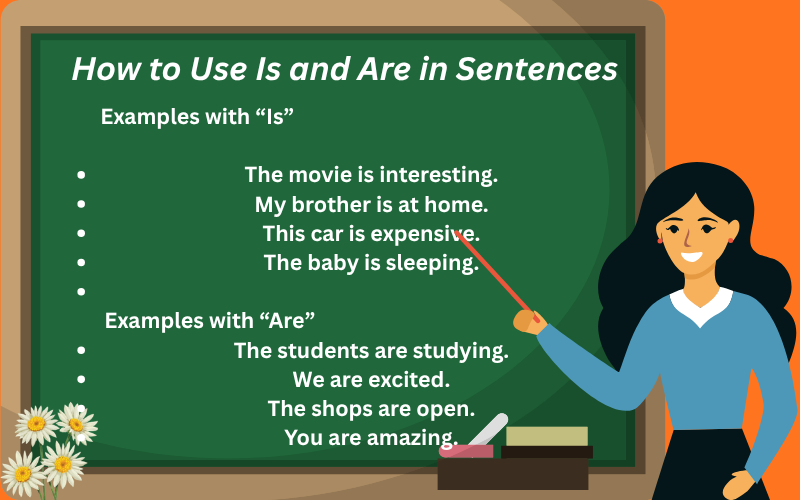
Examples with “Is”
- The movie is interesting.
- My brother is at home.
- This car is expensive.
- The baby is sleeping.
Examples with “Are”
- The students are studying.
- We are excited.
- The shops are open.
- You are amazing.
🔹 Common Situations Where Is and Are Are Used
Everyday Uses of “Is”
- Descriptions: The weather is pleasant.
- Identity: He is a doctor.
- Location: The book is on the desk.
- Time: It is noon.
Everyday Uses of “Are”
- Group descriptions: They are happy.
- Questions: Are you ready?
- Locations: The keys are in the bag.
- Conversations: We are friends.
🔹 Is or Are in Questions
Both verbs are commonly used to form questions.
Examples with “Is”
- Is she your sister?
- Is the shop open?
- Is he at home?
Examples with “Are”
- Are you ready?
- Are they coming?
- Are the children playing?
For More: Anyone Has or Anyone Have
🔹 Is or Are with There (There Is vs. There Are)
“There is” and “there are” are used to indicate existence.
Use “There Is” for Singular Nouns:
- There is a book on the table.
- There is a problem.
Use “There Are” for Plural Nouns:
- There are many students in the class.
- There are two apples in the basket.
🔹 Is or Are with Collective Noun
Understanding how to use is or are with collective nouns is essential for mastering subject-verb agreement. Collective nouns refer to a group acting as a single unit, such as team, family, committee, and staff. In American English, these nouns are typically treated as singular, whereas British English may treat them as plural when emphasizing individual members.
Examples:
- The team is winning the match.
- The family is planning a vacation.
- The committee is discussing the proposal.
- The team are celebrating their individual achievements. (British English)
- The staff are preparing their reports. (British English)
🔹 Is or Are with Indefinite Pronouns
Indefinite pronouns often create confusion when deciding between is or are. Some pronouns are singular, while others are plural.
Singular Indefinite Pronouns (Use “Is”):
- Everyone is happy.
- Someone is at the door.
- Each student is responsible.
Plural Indefinite Pronouns (Use “Are”):
- Many are interested in the course.
- Few are aware of the changes.
- Several are ready to participate.
🔹 Is or Are with Uncountable Nouns
Uncountable nouns always take is because they represent substances or abstract ideas that cannot be counted individually.
Examples:
- The water is cold.
- This information is important.
- Her advice is helpful.
- The furniture is modern.
- Knowledge is power.
🔹 Is or Are in Contractions
Contractions with “Is”:
- He’s (He is) happy.
- She’s (She is) late.
- It’s (It is) raining.
- That’s (That is) correct.
Contractions with “Are”:
- You’re (You are) welcome.
- We’re (We are) ready.
- They’re (They are) coming.
- What’re (What are) you doing?
🔹 Is or Are in Questions and Short Answers
Both verbs are essential for forming questions and responses.
Examples with “Is”:
- Is he your brother?
- Is she at home?
- Yes, he is.
- No, she isn’t.
Examples with “Are”:
- Are you ready?
- Are they coming tonight?
- Yes, they are.
- No, we aren’t.
🔹 Is or Are in Digital Communication and Social Media
Correct grammar enhances credibility in online communication.
Examples:
- This post is informative.
- Your comments are helpful.
- She is online.
- They are trending on social media.
🔹 Common Mistakes When Using Is and Are
Avoid these frequent errors:
She are happy.
She is happy.
They is ready.
They are ready.
The dogs is barking.
The dogs are barking.
You is late.
You are late.
🔹 Is vs. Are in Academic and Professional Writing
Correct usage is essential in formal communication.
Examples:
- The report is accurate.
- The results are impressive.
- The project is complete.
- The employees are satisfied.
🔹 Real-Life Conversation Examples
Example 1:
Teacher: Where is your book?
Student: It is on the desk.
Example 2:
Friend: Are you coming tonight?
You: Yes, I am.
Example 3:
Manager: Are the reports ready?
Employee: They are complete.
Example 4:
Parent: Is the food ready?
Child: Yes, it is.
🔹 Why People Confuse Is and Are
These words are commonly confused because:
- Learners struggle with subject-verb agreement
- English is not their first language
- Similar sentence structures cause uncertainty
- Grammar rules are overlooked in fast writing
- Informal communication leads to mistakes
📈 Why People Search “Is or Are?”
People frequently search for this keyword because:
- It is a fundamental grammar rule
- Students want to improve their English
- Writers seek clarity and accuracy
- It appears in exams and assignments
- Professionals aim for polished communication
🎯 Should You Use Is or Are?
👉 Use Is with singular subjects.
👉 Use Are with plural subjects and “you.”
👉 Check the subject before choosing the verb.
👉 Correct grammar improves clarity and credibility.
See Also: Will Be Send or Will Be Sent
FAQs
Is it “he is” or “he are”?
The correct form is “he is.” The pronoun “he” is singular, so it takes “is.”
Is it “she is” or “she are”?
The correct phrase is “she is.” Use “is” with the singular pronoun “she.”
Is it “they is” or “they are”?
The correct phrase is “they are.” “They” is a plural pronoun in standard English, so it takes “are.”
Is it “we is” or “we are”?
The correct phrase is “we are.” Use “are” with “we.”
Is it “you is” or “you are”?
The correct phrase is “you are.” English uses “are” with “you,” whether you are speaking to one person or several people.
Is it “there is” or “there are”?
Use “there is” with a singular noun and “there are” with a plural noun. For example, “There is a book” and “There are three books.”
Is it “the answer is” or “the answer are”?
The correct phrase is “the answer is.” “Answer” is singular, so it takes “is.”
Is it “the answers is” or “the answers are”?
The correct phrase is “the answers are.” “Answers” is plural, so it takes “are.”
Is it “this is” or “this are”?
The correct phrase is “this is.” “This” normally refers to one person, thing, or idea, so it takes “is.”
Is it “these is” or “these are”?
The correct phrase is “these are.” “These” refers to more than one person or thing, so it takes “are.”
Conclusion
Is or are becomes much easier when you first look at the subject of the sentence. If the subject is singular, is will usually be the right choice. If the subject is plural, are will usually fit.
For example, “The student is ready” uses “is” because “student” refers to one person. However, “The students are ready” uses “are” because “students” refers to more than one person.
Keep in mind that you takes “are,” even when you are talking to just one person. That is why we say “You are correct,” not “You is correct.”
When you feel unsure, do not choose the verb based on the word closest to it. Find the main subject first, decide whether it is singular or plural, and then choose is or are. This simple habit can help you avoid many common grammar mistakes.