

Choosing between heros or heroes can feel confusing, especially when you are unsure about the correct plural of hero. If you have seen both spellings, you may wonder which one belongs in standard English.
The correct plural form is heroes. We use it when we talk about more than one hero. Although heros may look like a natural plural, standard English does not use it.
For example, you can say, “The heroes saved the town.” Here, heroes refers to several brave or admired people.
Once you know the spelling rule, the difference becomes much easier to remember. Therefore, whenever you need the plural of hero, choose heroes.
⚡ Quick Answer
Heroes is the correct plural of “hero.” The spelling “heros” is incorrect in standard English.
Use “heroes” when you mean more than one hero, such as: “The heroes helped everyone.”
Related Guide: Disfunction vs Dysfunction
📊 Quick Overview Table
| Word | Correct or Incorrect | Explanation |
| Heros | ❌ Incorrect | Does not follow grammar rules |
| Heroes | ✅ Correct | Proper plural form of hero |
📖 What Is the Difference Between Heros and Heroes?
The difference between heros and heroes is based entirely on grammar correctness. “Heroes” is the correct plural form of hero, while “heros” is an incorrect spelling that does not follow accepted English rules. This confusion usually happens because people apply a general rule—adding “-s”—to all words without considering exceptions.
In English, many nouns form their plural by adding “-s,” such as book → books or car → cars. However, words ending in -o often follow a different rule, where they take -es instead. This is why hero becomes heroes. The incorrect form “heros” ignores this rule and therefore is not considered correct in proper writing.
Using the wrong spelling can affect how your content is perceived. It may make your writing look careless or unprofessional, especially in academic or SEO-focused content. By understanding this simple but important difference, you can avoid a very common mistake and improve your overall writing quality.
Examples:
- ❌ The movie tells the story of brave heros.
- ✅ The movie tells the story of brave heroes.
🧠 Why “Heroes” Is the Correct Spelling
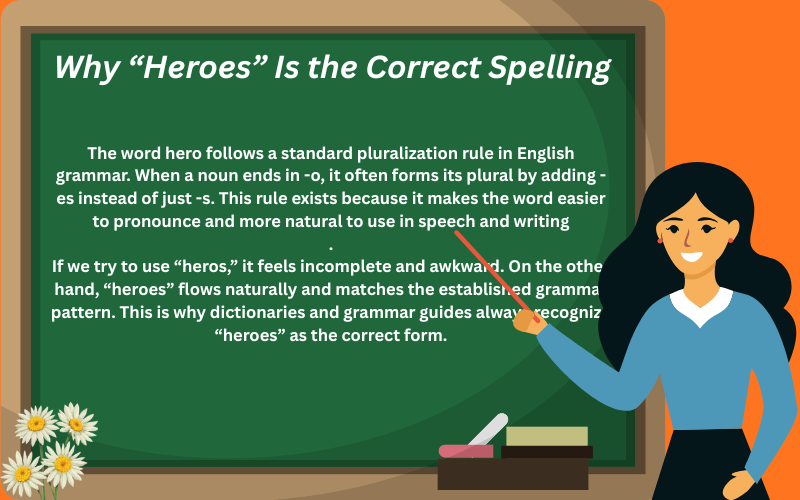
The word hero follows a standard pluralization rule in English grammar. When a noun ends in -o, it often forms its plural by adding -es instead of just -s. This rule exists because it makes the word easier to pronounce and more natural to use in speech and writing.
If we try to use “heros,” it feels incomplete and awkward. On the other hand, “heroes” flows naturally and matches the established grammar pattern. This is why dictionaries and grammar guides always recognize “heroes” as the correct form.
Examples:
- Hero → Heroes
- Potato → Potatoes
- Tomato → Tomatoes
These examples clearly show how the rule works and why “heroes” is correct.
📚 Detailed Explanation of the “-O” Plural Rule in English
The pluralization of words ending in “-o” is one of the more complex areas of English grammar. This is because there is no single rule that applies to all such words. Some nouns take “-es,” while others simply take “-s.” This inconsistency is one of the main reasons why people get confused between heros or heroes.
Words like hero, potato, and tomato follow the traditional rule of adding “-es.” These words are easier to pronounce with the extra syllable, which is why the rule exists. On the other hand, words like photo, piano, and radio have adopted a simpler form and only take “-s.”
Examples:
- The soldiers were national heroes who showed great courage.
- We bought fresh tomatoes and potatoes from the market.
- She took several beautiful photos during her trip.
Understanding these patterns requires practice, but once you become familiar with them, it becomes much easier to apply the correct rule.
💬 Examples of “Heroes” in Sentences
Seeing the correct word used in sentences helps reinforce understanding and makes it easier to remember. The word “heroes” is used in many different contexts, including everyday conversation, academic writing, and entertainment.
Examples:
- The firefighters were true heroes during the emergency.
- Children often admire their favorite heroes.
- The book highlights the lives of national heroes.
- Many heroes have sacrificed their lives for their country.
These examples show that “heroes” is the correct and natural choice in all situations.
❌ Why “Heros” Is Incorrect
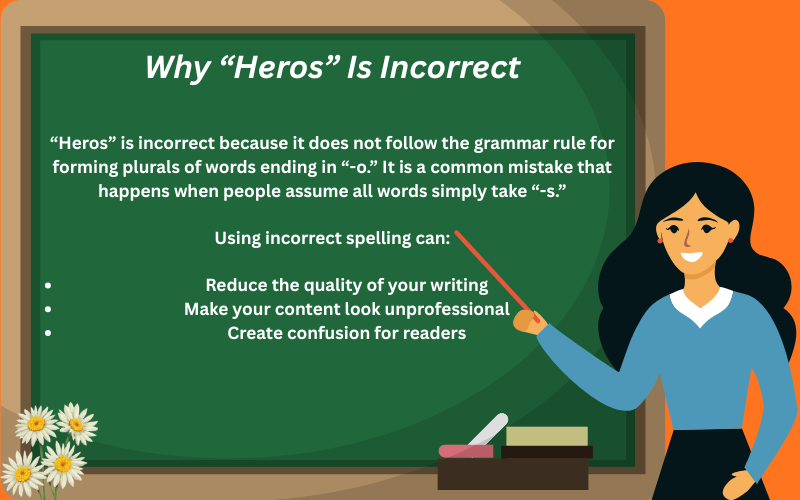
“Heros” is incorrect because it does not follow the grammar rule for forming plurals of words ending in “-o.” It is a common mistake that happens when people assume all words simply take “-s.”
Using incorrect spelling can:
- Reduce the quality of your writing
- Make your content look unprofessional
- Create confusion for readers
Examples:
- ❌ The story talks about war heros.
- ✅ The story talks about war heroes.
Always use “heroes” to ensure accuracy and clarity.
🧠 Why People Get Confused Between Heros and Heroes
Many people get confused between heros and heroes because they apply simple rules to complex grammar situations. They assume that adding “-s” is enough, which leads to mistakes.
Another major reason is the influence of social media. In fast typing and casual communication, people often ignore grammar rules. When incorrect spellings like “heros” appear frequently, others may assume they are correct.
Examples:
- ❌ Many heros helped during the crisis.
- ✅ Many heroes helped during the crisis.
Understanding the correct rule eliminates this confusion.
Visit Also: Run or Ran
📱 Real-Life Examples of Heroes in Different Contexts
The word “heroes” is widely used in real life to describe people who show bravery, kindness, or strength.
Examples:
- Doctors became real heroes during difficult times.
- Soldiers are honored as national heroes.
- Teachers are everyday heroes shaping the future.
- Fictional characters like superheroes are popular heroes in movies.
📌 Origin and Meaning of the Word “Hero”
The word hero comes from the Greek word hērōs, meaning a person known for courage and strength. Over time, its meaning expanded to include anyone admired for bravery or noble qualities.
Because of its historical roots, the plural form follows traditional grammar rules, which is why it becomes “heroes.”
🧠 How Native Speakers Use “Heroes” Naturally
Native speakers use “heroes” correctly because they learn it through exposure. They hear and read the correct form repeatedly, which makes it natural for them.
📱 Common Usage of “Heroes” in Media and Pop Culture
The word “heroes” is widely used in movies, news, and entertainment.
Examples:
- Superhero movies feature powerful heroes saving the world.
- News reports often describe healthcare workers as heroes.
🔄 Difference Between Singular and Plural Forms
- Singular: The hero saved the child.
- Plural: The heroes saved the city.
📌 Role of “Heroes” in Language and Communication
The word heroes plays an important role in communication because it carries emotional meaning and represents courage, bravery, and inspiration. It is commonly used in storytelling, speeches, and writing to highlight individuals who have made a difference. Because of its strong impact, using the correct spelling is essential to maintain clarity and professionalism.
Examples:
- The nation celebrated its heroes.
- Communities often recognize local heroes for their contributions.
🧠 How Grammar Rules Improve Writing Confidence
Understanding grammar rules like heros or heroes helps writers feel more confident. When you know the correct forms, you can write without hesitation and avoid mistakes.
Examples:
- ❌ Many heros were honored.
- ✅ Many heroes were honored.
For More: Unaccessible vs Inaccessible
📱 Influence of Social Media on Spelling Mistakes
Social media encourages fast and informal writing, which leads to mistakes like “heros.”
Examples:
- ❌ Posts often use heros incorrectly.
- ✅ Correct writing uses heroes.
🔄 Practical Tips to Avoid Spelling Errors
- Read regularly
- Practice writing
- Proofread your work
Examples:
- Always double-check words like heroes.
📈 Long-Term Benefits of Using Correct Grammar
Correct grammar improves writing quality, builds trust, and enhances communication skills.
Examples:
- Professional writers always use correct forms like heroes.
🎯 Final Verdict
Correct: Heroes
Incorrect: Heros
See Also: Will Be Send or Will Be Sent
FAQs
Is it heros or heroes?
Heroes is the correct plural spelling of “hero.”
Is heros a correct word?
No, heros is not the standard plural form of “hero.”
Why is heroes spelled with “-es”?
The word “hero” takes -es to form its standard plural, giving us “heroes.”
What is the plural of hero?
The plural of hero is heroes.
Can I write “heros” in English?
You should not use heros as the plural of “hero” in standard English.
Is heroes singular or plural?
Heroes is the plural form, while hero is singular.
What is an example of heroes in a sentence?
“The heroes returned home after saving the village.”
Do all words ending in “o” take “-es”?
No, English has several different plural patterns for words ending in “o.”
How can I remember heroes?
Remember that hero + es = heroes, not “heros.”
Which spelling should I use in formal writing?
Use heroes in formal, academic, and professional writing.
Conclusion
When choosing between heros or heroes, remember that heroes is the correct spelling. It is the standard plural form of hero, while heros does not work as the normal plural.
The extra -es makes the spelling look slightly different from many regular plurals. However, once you remember hero → heroes, the rule becomes easy to apply.
For example, “The heroes arrived” is correct because the sentence talks about more than one hero. On the other hand, “The heros arrived” uses the wrong spelling.
In short, always choose heroes when you need the plural of hero. This small spelling detail can make your writing clearer and more accurate.t and professionalism in your writing.
